Direct answer
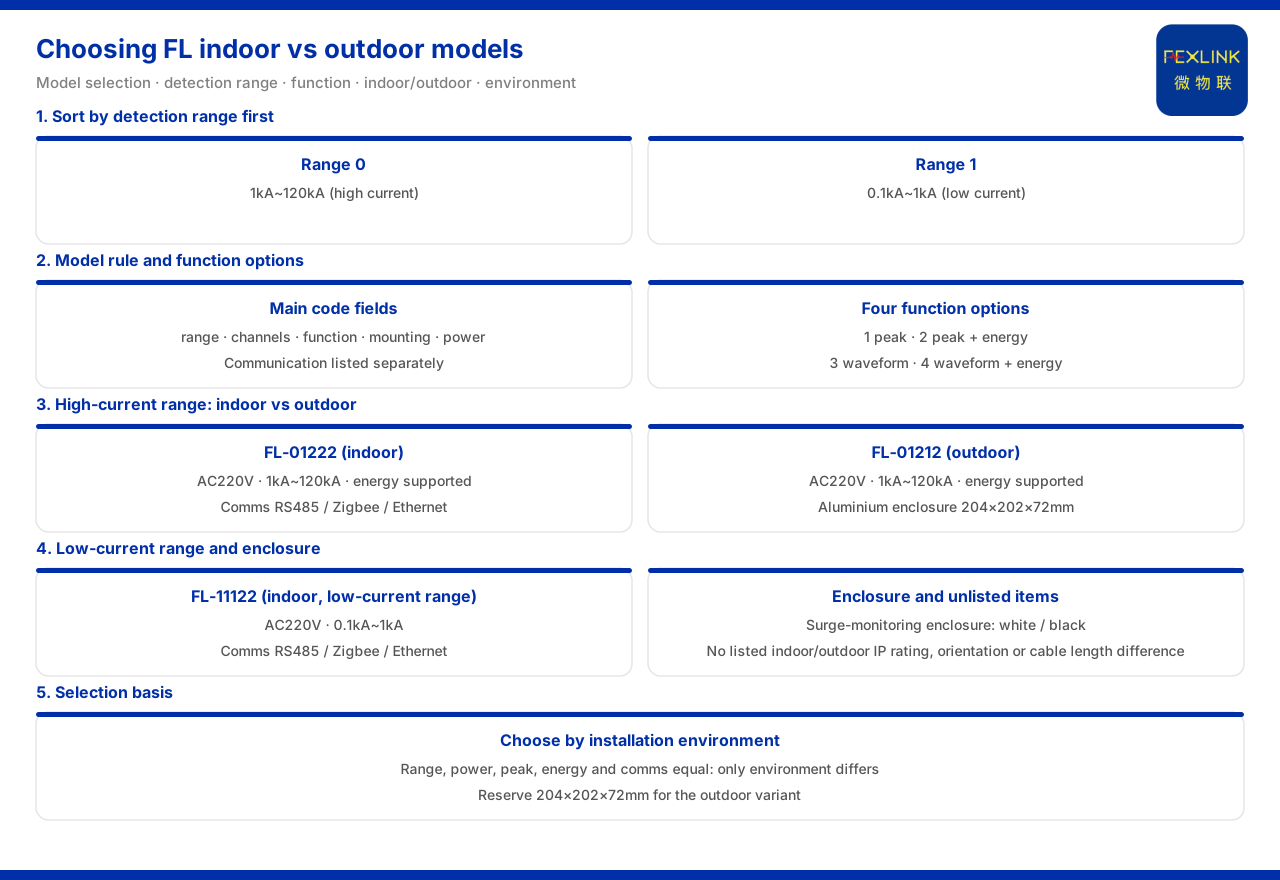
Selection of a lightning current / transient current monitor starts with the detection-range grade, then the installation environment—not the other way around. The product knowledge base gives this series' model rule: the body segment is composed of detection range, channels, function, installation mode and power supply, with communication listed separately; detection range 0 is 1kA to 120kA and 1 is 0.1kA to 1kA; function 1 is peak, 2 is peak plus energy, 3 is waveform, and 4 is waveform plus energy. On the high-current grade, the indoor and outdoor models listed in the model table are identical in capability: the lightning current / transient current monitor (FL-01222, indoor) and the lightning current / transient current monitor (FL-01212, outdoor) are both AC220V-supplied, with a peak range of 1kA to 120kA, energy support (charge and specific energy), and communication selectable among RS485, Zigbee and Ethernet; the two differ only in installation environment. The low-current grade has a separate indoor model, the lightning current / transient current monitor (FL-11122), with a peak range of 0.1kA to 1kA. As for housing, the series uses a lightning-protection monitoring enclosure (white or black), and the outdoor model uses an aluminum shell of 204×202×72mm. This article expands the distinction item by item below.
1. Grading by detection range first
The first cut in selection is the detection range. The model rule lists detection range as the first field of the body segment, with two values, 0 and 1: 0 corresponds to 1kA to 120kA and 1 to 0.1kA to 1kA. The two grades cover orders of magnitude far apart—the former targets larger lightning or transient current peaks, the latter smaller ones. Not all models under the same series are therefore interchangeable: where the current peak to be monitored falls directly decides the first digit of the body segment. Fixing the magnitude first keeps the selection order from being reversed.
2. Model rule: five fields define one model
After the detection range, the model rule specifies the remaining fields. The body segment is composed of detection range, channels, function, installation mode and power supply, with communication listed separately. The function field has four grades: 1 is peak, 2 is peak plus energy, 3 is waveform and 4 is waveform plus energy. That is, "peak" and "energy" are two recordable objects that can be combined: peak alone is the basic grade, and recording energy as well is one grade higher; "waveform" corresponds to another recording requirement and can likewise combine with energy. Installation mode takes indoor or outdoor. During selection, aligning the measured current magnitude, the quantity to be recorded, the field installation environment and the available power supply with these fields determines the body segment.
3. Indoor and outdoor models of the high-current grade
On the high-current grade, the model table gives a pair of indoor and outdoor models. It lists the lightning current / transient current monitor (FL-01222-R/Z/E) as indoor-installed, AC220V-supplied, with a peak range of 1kA to 120kA, energy support (charge and specific energy), and communication selectable among RS485, Zigbee and Ethernet; the same table lists the lightning current / transient current monitor (FL-01212-R/Z/E) as outdoor-installed, with the remaining sampling-capability fields the same as the indoor model. Both are on the high-current grade, both support energy recording, and their communication options are identical. The choice between them therefore rests on the field installation environment, not on sampling capability.
4. Indoor and outdoor models: same capability, different environment
Comparing the two field by field narrows the distinction to one item. The lightning current / transient current monitor (FL-01222, indoor) and the lightning current / transient current monitor (FL-01212, outdoor) are completely identical in power supply (both AC220V), peak range (both 1kA to 120kA), energy support and communication options; the only recorded difference is whether the installation environment is indoor or outdoor. When detection range, power supply and communication requirements are the same and the divergence lies only in installation position, the indoor/outdoor choice does not affect the sampling scope, only the installation form. If the site permits indoor installation, choose the indoor model; if outdoor installation is required, choose the outdoor model.
5. The indoor model of the low-current grade
Not every requirement falls on the high-current grade. The model table also lists the lightning current / transient current monitor (FL-11122-R/Z/E) as indoor-installed, AC220V-supplied, with a peak range of 0.1kA to 1kA, likewise with communication selectable among RS485, Zigbee and Ethernet. It belongs to a different detection-range grade from the 01222 and 01212 above: the former's first body-segment digit is 1, corresponding to 0.1kA to 1kA; the latter's is 0, corresponding to 1kA to 120kA. When the measured current peak is small and falls in 0.1kA to 1kA, select by the low-current grade; when the peak is larger, return to the high-current grade. Selection requires distinguishing both the detection range and the installation environment; aligning only one of them is not enough.
6. Housing and enclosure: the outdoor model has explicit dimensions
The housing and enclosure are also given with the models. The series uses a lightning-protection monitoring enclosure in white or black; the outdoor lightning current / transient current monitor (FL-01212) uses an aluminum shell measuring 204×202×72mm. This record gives two items of confirmed information: the series has a unified lightning-protection enclosure form in two colors, and the outdoor model explicitly uses an aluminum shell with specific dimensions, in keeping with its outdoor-installation position. For the enclosure, the knowledge base gives only the outdoor model's aluminum dimensions and does not expand the indoor model's dimensions; during selection the outdoor dimensions should not be applied directly to the indoor model.
7. Differences not recorded
The indoor and outdoor models differ, in the product knowledge base, by the installation environment alone. The knowledge base gives no explanation of differences between the indoor and outdoor models in protection rating, installation orientation or cable length; the installation-mode field takes only "indoor" and "outdoor." This is a negative boundary: one cannot use common sense to add conclusions such as "the outdoor model has higher protection" or "the indoor model has a longer cable." Anything concerning specific differences in protection rating, installation orientation and cable length should be checked against the manufacturer's material and project conditions, not back-inferred from the model table. Marking the unlisted items truthfully keeps the selection conclusion within a traceable scope.
8. Condensing selection into a check order
The above can be condensed into a check order. First, determine the magnitude of the measured current peak and choose between detection range 0 (1kA to 120kA) and 1 (0.1kA to 1kA). Second, determine the quantity to be recorded: peak alone, peak plus energy, waveform, or waveform plus energy, and fix the function field accordingly. Third, determine the channels and power-supply requirement and align them with the body segment. Fourth, determine the installation environment: choose the corresponding indoor model (such as 01222 on the high-current grade or 11122 on the low-current grade) indoors, or 01212 on the high-current grade outdoors, and reserve installation space by the outdoor model's aluminum dimensions. Fifth, determine the communication mode among RS485, Zigbee and Ethernet by site conditions. Sixth, mark unlisted items such as protection rating, installation orientation and cable length as pending confirmation against the manufacturer's material and do not infer them.
Scope and limitations
First, this article restates only what the product knowledge base lists, with the factual boundary limited to the lightning current / transient current monitor's model rule, the sampling capability and installation environment of each model in the model table, the housing description, and the record of unlisted differences, introducing no unlisted parameter, certification or case.
Second, detection range 0 as 1kA to 120kA and 1 as 0.1kA to 1kA, and function 1 as peak, 2 as peak plus energy, 3 as waveform and 4 as waveform plus energy, are cited as the product knowledge base gives them.
Third, the lightning current / transient current monitor (FL-01222, indoor) and (FL-01212, outdoor) are cited as AC220V-supplied with a peak of 1kA to 120kA, energy support and selectable communication; this article explains on that basis that they differ only by installation environment and does not infer other capability differences.
Fourth, the peak range 0.1kA to 1kA, AC220V supply and communication options of the lightning current / transient current monitor (FL-11122, indoor), and the outdoor model's aluminum shell of 204×202×72mm, are cited as the product knowledge base gives them. The knowledge base gives no differences between the indoor and outdoor models in protection rating, installation orientation or cable length, and the installation-mode field takes only indoor and outdoor; this article records this boundary and adds no unlisted content.
Fifth, this article explains only the series' selection distinction and check order and provides no range selection, installation or lightning-protection design solution for a specific project; the relevant conclusions must be confirmed with site survey and the project solution, and actual conditions are subject to the latest product material and project solution.