Direct answer
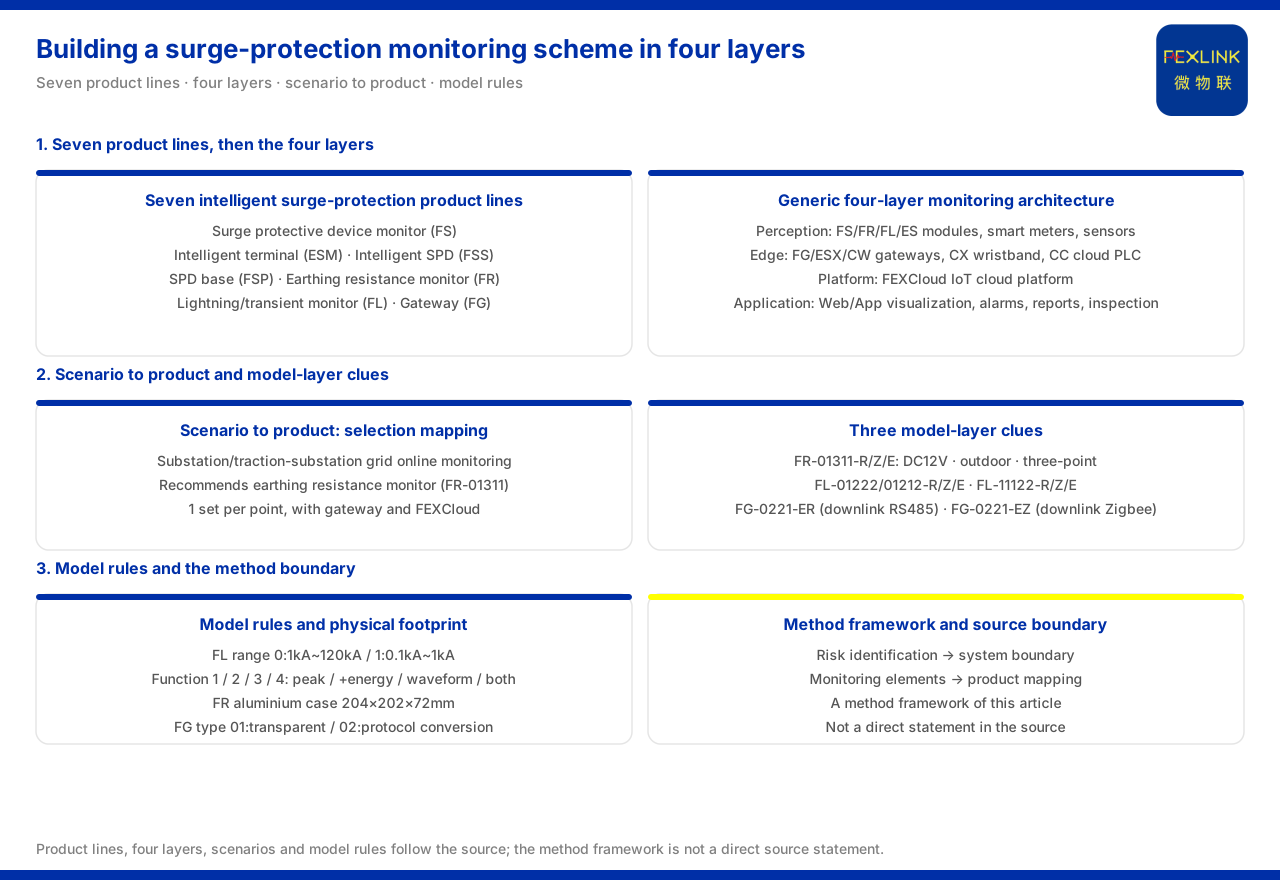
Compiling an intelligent lightning-protection monitoring scheme can proceed through four levels: product line, system architecture, scenario selection and model parameters. The product-line panorama of the product knowledge base divides the intelligent lightning-protection line into seven classes: the surge protective device monitor (FS), the intelligent lightning-protection monitoring terminal (ESM), the intelligent surge protective device (FSS), the SPD lightning-protection base (FSP), the grounding resistance monitor (FR), the lightning current / transient current monitor (FL) and the lightning-protection smart gateway (FG). On system architecture, the knowledge base summarises the monitoring system into four layers: perception, edge, platform and application. Typical application scenarios and the selection reference are given as "scenario to recommended product combination," for example substation and traction-substation grounding-grid online monitoring, which recommends 1 set of the grounding resistance monitor (FR-01311) per point together with the lightning-protection smart gateway (FG) and the FEXCloud platform. At the model level, the grounding resistance monitor (FR-01311-R/Z/E) is DC12V, outdoor installation, three-pole method, with communication in three kinds, RS485, Zigbee and Ethernet; the lightning current / transient current monitor and the lightning-protection smart gateway each have their own model rules. Aligning these four levels is the main thread of scheme compilation. It should be noted that the product knowledge base does not pose the order "risk identification, system boundary, monitoring elements, product mapping" directly in those words; this order is the methodological framework this article summarises.
1. Recognise the product line first: seven classes of intelligent lightning protection
The starting point of scheme compilation is to recognise the range of available products. The product-line panorama of the product knowledge base divides the intelligent lightning-protection line into seven classes: surge protective device monitor, intelligent lightning-protection monitoring terminal, intelligent surge protective device, SPD lightning-protection base, grounding resistance monitor, lightning current / transient current monitor and lightning-protection smart gateway. These seven classes cover different links from surge protection and status monitoring to grounding monitoring, lightning-current monitoring and gateway aggregation. In compiling a scheme, it is more reliable first to locate which link the monitoring object belongs to among the seven classes and then look at the models and parameters of that class than to pick a model straight away.
2. Recognise the system architecture: four layers
After locating the products, the system architecture is needed to string them together. The product knowledge base summarises the monitoring system into a general four layers: the perception layer consists of various monitoring modules, smart meters and sensors; the edge layer consists of devices such as gateways; the platform layer is the IoT cloud platform; and the application layer provides Web and App visualisation, alarm management, analytical reports and mobile inspection. The four layers connect level by level: perception collects, edge converts and uplinks, platform aggregates and judges, and application presents and operates. In scheme compilation, placing each class of product into its corresponding layer makes clear its interface with the other links, avoiding mixing acquisition devices and platform functions in one description.
3. Scenario to product: the selection reference
The typical application scenarios and selection reference of the product knowledge base are given in the form of scenarios corresponding to recommended product combinations. One clear example: substation and traction-substation grounding-grid online monitoring recommends 1 set of the grounding resistance monitor (FR-01311) per point, together with the lightning-protection smart gateway (FG) and the FEXCloud platform. This combination embodies the four-layer idea: the grounding resistance monitor sits in the perception layer completing grounding-grid parameter acquisition, the lightning-protection smart gateway sits in the edge layer completing aggregation and uplink, and FEXCloud sits in the platform layer completing data collection and presentation. In compiling a scheme, one can follow this pattern, matching site scenarios to the recommended combinations and checking whether each product falls within the chosen product line, thereby avoiding a missing perception, aggregation or platform link.
4. Model level: the grounding resistance monitor
When a scenario settles onto a specific model, look first at the grounding resistance monitor. The product knowledge base records its models as FR-01311-R, FR-01311-Z and FR-01311-E, with DC12V supply, outdoor installation and three-pole measurement; the communication of the three models is RS485, Zigbee and Ethernet respectively, the housing is aluminium, and the dimensions are 204×202×72mm. The same entry also records its applications, including railway traction-substation grounding-grid online monitoring and the Jinzhou Port oil tank farm project, the latter at 10 sets per tank. It can be seen that the model suffix corresponds directly to the communication method; in selection, first determine the suffix by the site networking, then verify whether the supply, installation method and housing dimensions meet the site conditions.
5. Model level: the lightning current / transient current monitor
The lightning current / transient current monitor takes its value by model rule. The rule the product knowledge base gives encodes detection range, channel count, function, installation method, supply and communication into the model. The detection range has two steps, corresponding to 1kA to 120kA and 0.1kA to 1kA; the function digit indicates peak, peak plus energy, waveform, or waveform plus energy. Accordingly, the 1kA to 120kA step of the lightning current / transient current monitor corresponds to the models FL-01222-R/Z/E and FL-01212-R/Z/E; its 0.1kA to 1kA step corresponds to the model FL-11122-R/Z/E. Once the model rule is understood, selection becomes digit-by-digit confirmation: first set the detection-range step, then the function digit and channel count, and finally settle by the communication suffix.
6. Model level: the lightning-protection smart gateway
The lightning-protection smart gateway undertakes edge aggregation. The model rule the product knowledge base gives encodes gateway type, installation method, supply, downlink and uplink into the model, in which the gateway type is divided into transparent transmission and protocol conversion. Among the models listed, the lightning-protection smart gateway (FG-0221-ER) is DC12V, protocol conversion, with RS485 downlink and Ethernet uplink; the lightning-protection smart gateway (FG-0221-EZ) is likewise DC12V, protocol conversion, with Zigbee downlink and Ethernet uplink. The two differ in the downlink method: one connects RS485 and one connects Zigbee. In compiling a scheme, the gateway downlink must match the chosen monitor's communication suffix, and the uplink must land on the network conditions available at the site, so that the perception and edge layers connect.
7. Check order for scheme compilation
Combining the four layers with the model level yields a compilation order. First, identify the monitoring object and scenario, clarifying whether what is to be monitored is grounding, lightning current, SPD status or another element. Second, locate the product that carries this class of monitoring among the seven classes of the intelligent lightning-protection line. Third, match the scenario to the typical application scenarios and selection reference and take the recommended combination. Fourth, place each product in the combination into the perception, edge, platform and application layers and check whether any link is missing. Fifth, determine the specific model digit by digit by the model rule, first setting the function and range step, then the communication suffix. Sixth, verify whether the gateway downlink matches the monitor suffix and whether the uplink is available. Followed in this order, scheme compilation moves from scenario to model, with a corresponding basis to check at every step.
Scope and limitations
First, this article restates only what the product knowledge base lists, and its factual boundary is limited to the records of the seven classes of the intelligent lightning-protection product line, the four-layer monitoring-system architecture, the typical application scenarios and selection reference, and the related model parameters and model rules.
Second, the seven product-line names and the four-layer architecture are cited as the product knowledge base gives them; this article infers no unlisted product or layer.
Third, the typical application scenarios and selection reference are given in the form of "scenario to recommended product combination," and the substation and traction-substation grounding-grid online monitoring example cited here, together with the combination of 1 set of the grounding resistance monitor per point with the gateway and platform, are cited as the knowledge base gives them, without extending conclusions for other scenarios.
Fourth, the models, DC12V, outdoor installation, three-pole method, three kinds of communication, aluminium housing and dimensions 204×202×72mm of the grounding resistance monitor, together with its application records, are cited as the knowledge base gives them.
Fifth, the detection-range steps, function digits and listed models of the lightning current / transient current monitor, and the gateway type, supply and downlink/uplink pairing of the lightning-protection smart gateway, are cited from the model rules and model table of the knowledge base.
Sixth, the compilation order "risk identification, system boundary, monitoring elements, product mapping" is the methodological framework this article summarises; the knowledge base does not pose it directly in those words, and this article uses it only as a methodological note.
Seventh, this article explains only the method of scheme compilation and product mapping and provides no grading configuration, parameter value or setting for a specific project; relevant conclusions must be established in combination with site conditions and the project solution.