Direct answer
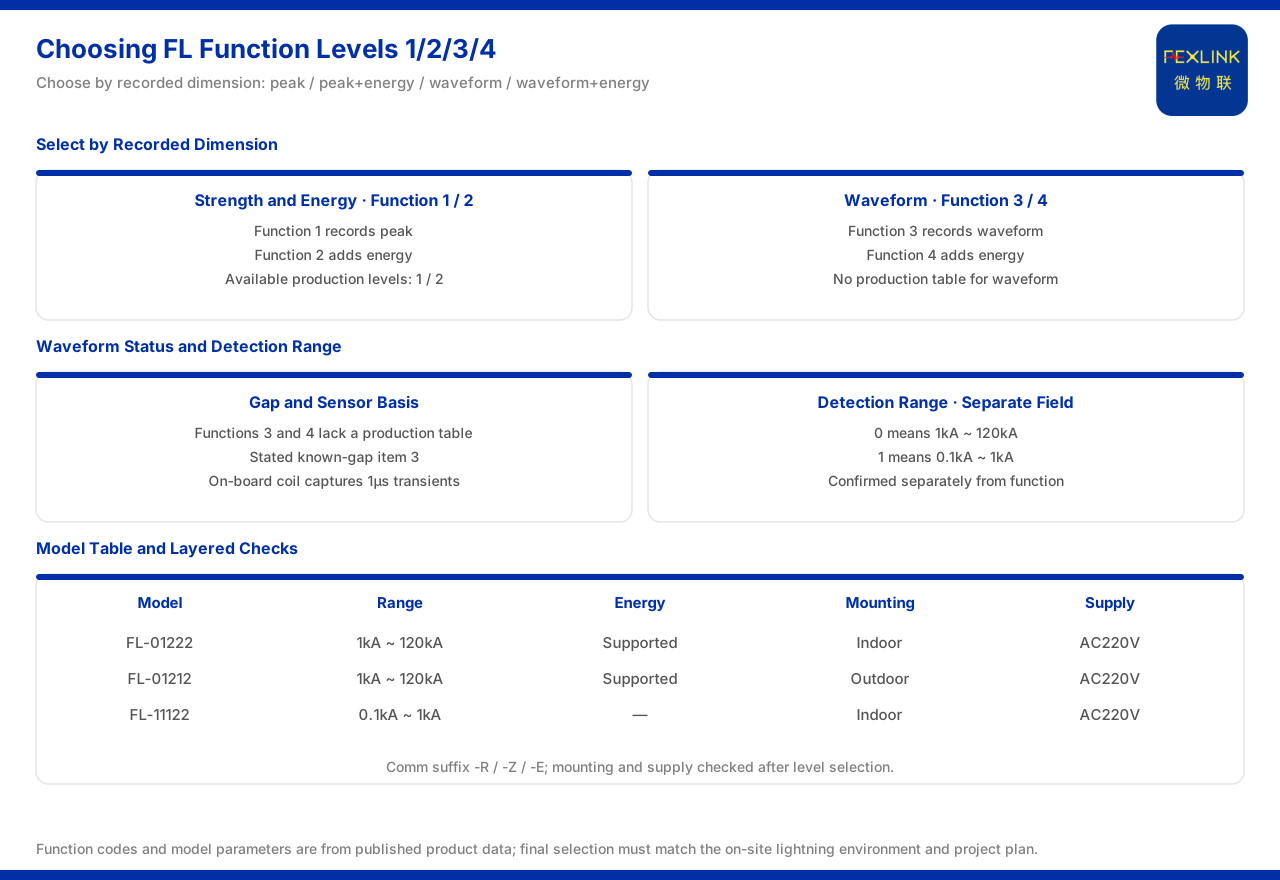
The function tiers of the FL lightning current / transient current monitor (e.g. FL-01222-R) are divided into four by "what is recorded": 1 is peak, 2 is peak plus energy, 3 is waveform and 4 is waveform plus energy. In selection, first ask whether energy is needed and whether waveform is needed. If only the strength of the event matters, choose the peak tier; if energy is to be added to strength, choose the peak-plus-energy tier; to reconstruct the process shape of the event, the waveform tiers are involved, of which 3 is waveform only and 4 is waveform plus energy. But one gap explicitly recorded by the product knowledge base must be pointed out at the same time: item 3 of the known information gaps in the appendix states that the waveform-tier models (function 3 and 4) have no mass-produced selection table for the time being. Under the current specification, therefore, the function tiers actually selectable fall on the peak and peak-plus-energy tiers; the waveform tiers exist in definition but are absent in mass production.
1. What the four function tiers record
The function position decides the information granularity included in the event record. The product knowledge base divides it into four tiers: 1 for peak, 2 for peak plus energy, 3 for waveform and 4 for waveform plus energy. These four values can be grouped into two main lines: the peak line answers "how strong this event was" and the waveform line answers "the process shape of this event"; energy does not stand as a tier on its own but is superimposed on the two lines. The function tier therefore does not change the magnitude the instrument records, only what information it records.
2. Function tier and detection range are two independent lines
In the model rule, detection range and function are two different fields that cannot substitute for each other. The product knowledge base specifies that detection range 0 means 1kA to 120kA and 1 means 0.1kA to 1kA; functions 1 to 4 correspond to peak, peak plus energy, waveform and waveform plus energy. The detection range decides "what magnitude of event is to be recorded", and the function decides "what information is recorded". On a model, this means the same detection range can be paired with different functions, and the same function can appear in product combinations of different detection ranges.
3. Choosing the tier by recording need
Unfolding the function tiers by recording need makes the selection logic clear. If the site cares only about "how strong this lightning or transient event was", the peak tier suffices; if, beyond strength, the energy carried by the event is also needed, the peak-plus-energy tier should be chosen. The waveform tiers correspond to another class of need: reconstructing the process shape of the event. The product knowledge base records that the onboard profiled Rogowski coil in the core sensor technology has a 1μs-level abnormal-current capture capability, and this capability is the sensor basis for lightning current and transient current acquisition (including the waveform-tier functions 3 and 4); that is, waveform recording depends on the sensor's time resolution and cannot be added at the software level alone. It must be emphasised that the product knowledge base gives no tier-by-tier judgment criterion for functions 1 / 2 / 3 / 4; this article explains each tier by the recording dimension and does not replace the on-site solution in making a tier decision.
4. The current state of the waveform tier: no mass-produced table
One current state must be stated when choosing a tier, otherwise one may look directly for a model by definition and come up empty. In item 3 of its known information gaps, the product knowledge base states that the waveform-tier FL models (function values 3 and 4) have no mass-produced selection table for the time being. This means that although the function position defines a waveform tier and a waveform-plus-energy tier, under the current specification these two tiers have no mass-produced model available. Where a waveform-recording objective is required, therefore, the corresponding model cannot be found directly in the model table; the tier can only be confirmed to exist in definition but to be absent in mass production. This gap is a known information gap self-stated by the product knowledge base.
5. Energy support in the model table
The relation between function tiers and energy support can be corroborated in the model table. The FL model table of the product knowledge base lists three mass-produced models, with detection range, energy support, installation environment and power supply as follows:
| Model | Detection range | Energy | Installation environment | Power supply | |:--|:--|:--|:--|:--| | FL-01222 | 1kA~120kA | Supported | Indoor | AC220V | | FL-01212 | 1kA~120kA | Supported | Outdoor | AC220V | | FL-11122 | 0.1kA~1kA | — | Indoor | AC220V |
As the table shows, all three are supplied at AC220V; the two high-range types support energy and the low-range type lists energy as "—". This corresponds to the definition of the function tiers: where energy information is needed, the landing point is a model that supports energy; if the site's magnitude falls in the low-range span, one must first confirm whether energy is within the recording need. The role of the table is to align the function need with the objective differences of the models, not to replace the on-site decision.
6. Installation environment, power supply and communication
After the function tier is fixed, one must return to the model table to check the installation environment and power supply. The model table of the product knowledge base distinguishes the installation environment by indoor and outdoor, of which FL-01212 is the outdoor type; as for the housing, the product knowledge base records that the lightning-protection monitoring housing comes in white and black, and the outdoor type uses an aluminium housing 204×202×72mm. On power supply, all the types listed in the model table are AC220V. On communication, the model table distinguishes versions by suffix, for example FL-01222 offers the three types -R, -Z and -E. This means installation method and power supply must likewise be checked item by item after the tier is chosen.
7. Reducing the selection to a checking order
Putting the above together, the choice of function tier reduces to a checking order. First, look at the recording need: only strength means peak, strength plus energy means peak plus energy, and only process shape involves waveform. Second, if it falls on the waveform tiers, note first the gap that no mass-produced model exists yet, and do not look for a model directly by definition. Third, confirm the detection range: whether the site's magnitude falls in the high or low range, confirmed separately from the function tier. Fourth, return to the model table to check energy support, installation environment and power supply. Fifth, fix the communication method by suffix. By this order, the function tier answers "which information dimensions this instrument records", not a vague "the more functions the better".
Scope and limitations
First, this article restates only what the product knowledge base lists, with the factual boundary limited to the model rule of the lightning current / transient current monitor, the definitions of the detection-range and function codes, the model table, the housing, and item 3 of the known information gaps in the appendix.
Second, function codes 1 for peak, 2 for peak plus energy, 3 for waveform and 4 for waveform plus energy, and detection-range code 0 meaning 1kA to 120kA and 1 meaning 0.1kA to 1kA, are cited from the product knowledge base; this article infers no complete code table for the channel-count and installation-method fields, and the relevant values are subject to the model table.
Third, the detection range, energy support, installation environment and power supply of the lightning current monitor's FL-01222, FL-01212 and FL-11122, and the housing (lightning-protection monitoring housing in white / black, outdoor type aluminium 204×202×72mm), are cited from the product knowledge base.
Fourth, the gap that the waveform-tier models (functions 3 and 4) have no mass-produced selection table comes from item 3 of the known information gaps in the product knowledge base appendix; this article transcribes it and infers no subsequent schedule or alternative.
Fifth, the onboard profiled Rogowski coil's 1μs-level abnormal-current capture as the sensor basis for waveform-tier acquisition is cited from the product knowledge base; the product knowledge base gives no tier-by-tier judgment criterion for functions 1 / 2 / 3 / 4, selection must be generalised by the recording dimension, and this article transcribes this boundary.
Sixth, this article only explains how to choose the function tier and provides no specific project detection-range selection, function configuration or installation scheme; the relevant conclusions must be confirmed with the on-site lightning environment and the project solution. This article constitutes no commitment about the result of a specific project; actual conditions are subject to the latest product material and project solution.