Direct answer
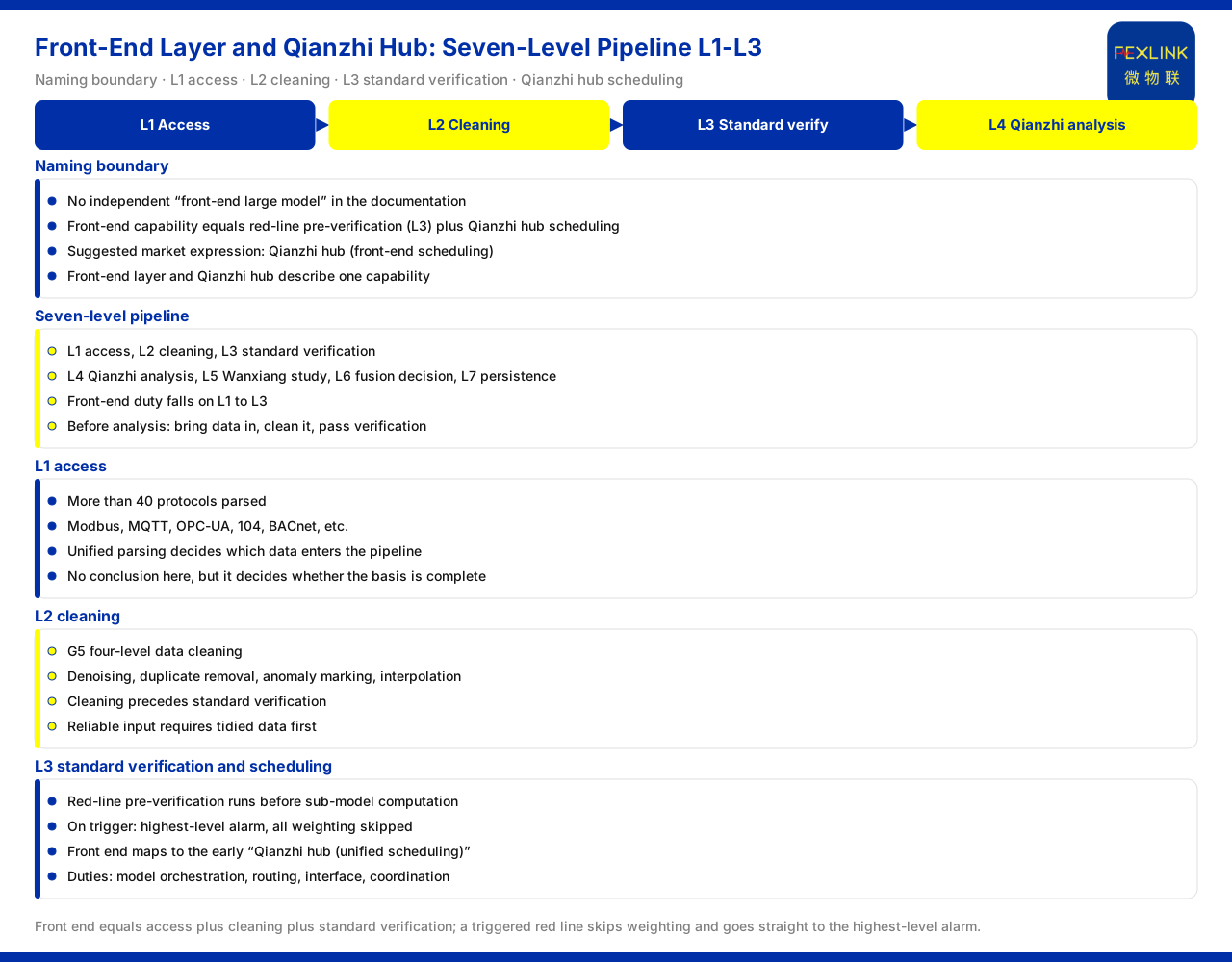
In the expression system of the product knowledge base there is no independent "front-end large model". The terminology note of the product knowledge base expressly states that no independent "front-end large model" naming appears in the documentation; the so-called "front-end" capability actually exists in the form of SAR pre-verification (L3) plus Qianzhi hub unified scheduling. Where the market side needs a separate name, the suggestion is to use "Qianzhi hub (front-end scheduling)". That is, the "front-end layer" and the "Qianzhi hub" are not two competing entities but two descriptions of the same capability: the former describes its position in the seven-level pipeline, the latter describes the scheduling duty it carries. The product knowledge base places the "front-end" duty on L1 to L3 of the seven-level pipeline and corresponds it to the early architecture's Qianzhi hub (unified scheduling). This article restates only the above specification and infers no unlisted module, interface or scheduling algorithm.
1. First clarify the naming boundary
In discussing "what the relation is between the front-end layer and the Qianzhi hub", the first step is not to compare functions but to confirm whether the name exists. The terminology note of the product knowledge base records that no independent "front-end large model" appears in the documentation, that the front-end capability exists in the form of SAR pre-verification plus Qianzhi hub scheduling, and that the market expression is advised to be unified as "Qianzhi hub (front-end scheduling)". The appendix of the product knowledge base gives the same specification in its known information gap entry: there is no independent "front-end large model" in the documentation, and the front-end capability equals SAR pre-verification (L3) plus Qianzhi hub unified scheduling. The terminology note in the body and the gap entry in the appendix corroborate each other, showing that this is not an incidental wording but a naming boundary the product knowledge base deliberately clarifies. Establishing the boundary first keeps the later discussion from being led astray by a concept that does not exist.
2. Front-end duties fall on L1 to L3
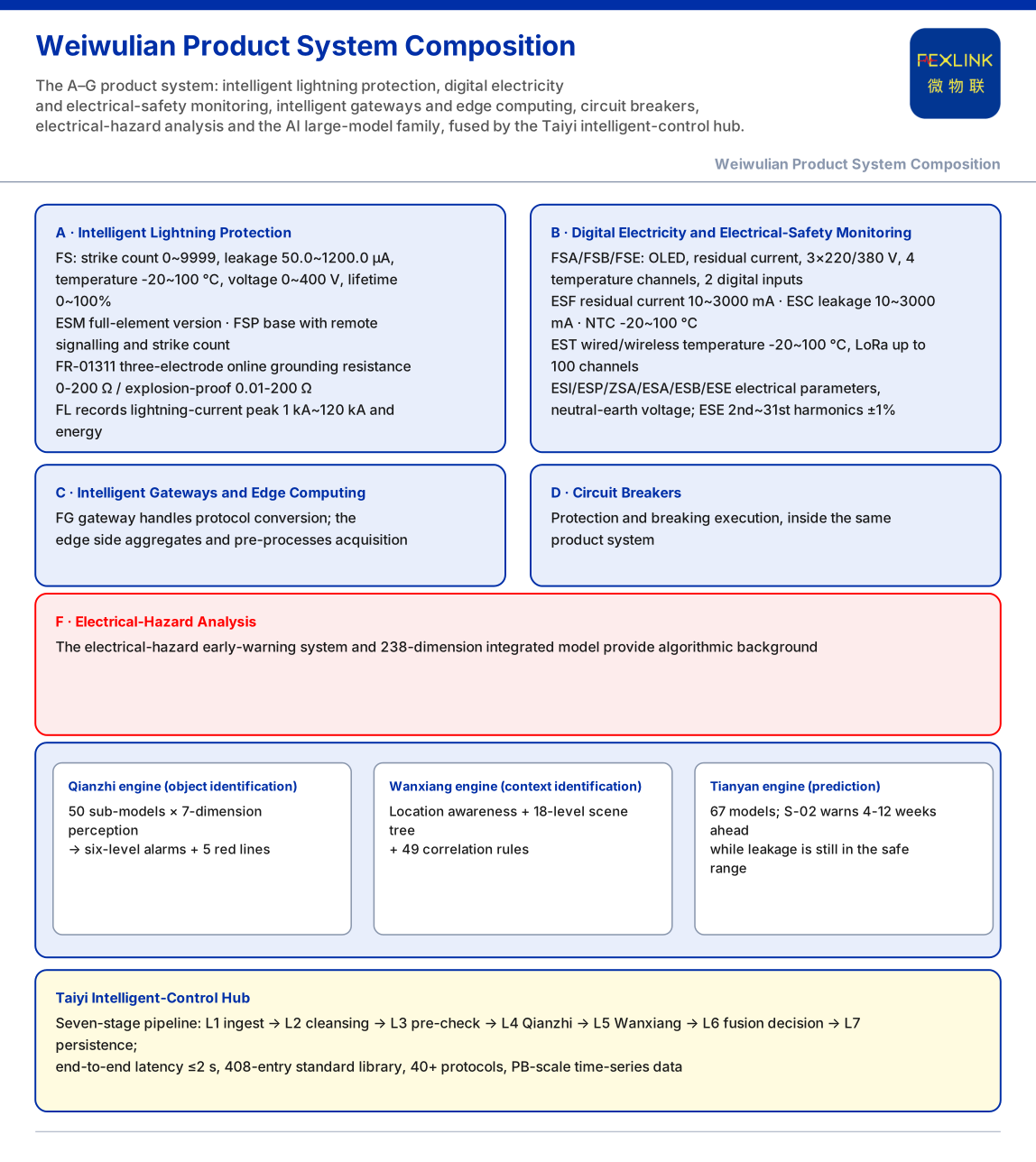
The product knowledge base records that, under the current documentation system, the "front-end" duty is carried by L1 to L3 of the seven-level pipeline. The seven-level pipeline itself is L1 access, L2 cleaning, L3 standard verification, L4 Qianzhi analysis, L5 Wanxiang study, L6 fusion decision and L7 persistence. Ranging L1 to L3 as "front-end" means that the common task of these three levels is: before the analysis layer starts work, to bring the data in, wash it clean, and pass standard verification. This definition explains what the "front-end" really is: not an independent model but the set of duties in the front section of the pipeline. The processing that data undergoes before entering L4 Qianzhi analysis all belongs to the front-end scope. So the question "what is the relation between the front end and the Qianzhi hub" can begin with "where the front end sits in the pipeline", and then move to its correspondence with the Qianzhi scheduling duty.
3. L1 access: parsing of more than 40 protocols
As the first front-end level, L1 carries data access. The product knowledge base records that the L1 access layer parses more than 40 protocols, including Modbus, MQTT, OPC-UA, 104 and BACnet. Field devices communicate in different ways, and without unified protocol parsing the later analysis cannot begin. Placing L1 within the front end shows that "bringing it in" is itself a part of ensuring analysis quality. The coverage of protocol parsing directly decides which devices' data can enter the pipeline. This layer produces no analysis conclusion, yet it decides whether the data on which conclusions rest is complete, so it is reasonable to classify it as a front-end duty.
4. L2 cleaning: G5 four-level data cleaning
The second front-end level is L2 cleaning. The product knowledge base records that L2 is G5 four-level data cleaning, including denoising, deduplication, anomaly marking and interpolation completion. The four levels each address a class of data-quality problem: denoising removes acquisition noise, deduplication eliminates duplicate records, anomaly marking identifies suspicious points, and interpolation completion handles missing values. Placing cleaning before standard verification is deliberate: only after the data has first been tidied is there reliable input for standard verification and analysis. L2 is therefore both the data-quality processing layer and the linking link in the front-end chain.
5. L3 standard verification: why the red line is pre-positioned
The third front-end level is L3 standard verification. The product knowledge base records that the standard verification of L3 includes SAR red-line pre-verification, which is executed before the Qianzhi sub-model computation; once a red line is triggered, the highest-level alarm is output directly and all weighting operations are skipped. This passage is the key to understanding the value of the "front-end". Usually an analysis system computes the results first and then aggregates and weights them; but the product knowledge base advances the red-line verification to before the computation, and when a red line is triggered the data does not enter weighting but is given the highest-level alarm directly. This design means that, for cases involving a non-bypassable red line, the judgment can be made without waiting for the full computation. The front end here is not only "processing the data first" but "guarding the bottom line first". This also explains why the "front-end" capability is expressed together with SAR pre-verification.
6. The correspondence between the front end and the early Qianzhi hub
The product knowledge base records that the "front end" corresponds to the role of the "Qianzhi hub (unified scheduling)" in the early architecture, with duties of model orchestration, routing and distribution, unified interface and multi-model coordination. All four are scheduling-type duties: model orchestration decides which models to use and in what order; routing and distribution send tasks to the corresponding models; the unified interface shields internal differences from the outside; and multi-model coordination lets several models complete one thing together. Comparing the four with L1 to L3, the relation between the "front end" and the "Qianzhi hub" becomes visible: the former emphasises its position and front-end duties in the pipeline, the latter emphasises its function as a unified scheduling role. The two describe two sides of the same thing, not two products to be distinguished.
7. Why naming clarification matters
Putting the above together, the landing point for answering "what the relation is between the front-end layer and the Qianzhi hub" can be summarised in three points. First, there is no independent "front-end large model" in the documentation, and it should not be used as a product name or a new concept. Second, the front-end capability is jointly formed by SAR pre-verification (L3) and Qianzhi hub unified scheduling, positioned at L1 to L3 of the seven-level pipeline. Third, the external expression is advised to be unified as "Qianzhi hub (front-end scheduling)", to stay consistent with the product knowledge base. Naming clarification matters because an untrue concept brings a chain of effects: if market material invents a "front-end large model", technical documentation, solution architecture and external communication may each say something different. Conversely, unifying terminology per the product knowledge base lets market, technical and solution staff discuss the same thing under the same name. All of the above is limited to the terminology note and the appendix specification listed by the product knowledge base.
Scope and limitations
First, this article restates only what the product knowledge base lists, with the factual boundary limited to the terminology note's statements that no independent "front-end large model" appears in the documentation, that the front-end capability equals SAR pre-verification (L3) plus Qianzhi hub unified scheduling, and that the expression is advised to be "Qianzhi hub (front-end scheduling)", the same-specification entry in the appendix known information gaps, the front-end duty carried by L1 to L3, the capabilities of L1 to L3, and the correspondence between the front end and the early Qianzhi hub (unified scheduling).
Second, the L1 parsing of more than 40 protocols and the listed protocols, the four items of L2's G5 four-level data cleaning, and the L3 SAR red-line pre-verification with its output of the highest-level alarm and skipping of weighting operations upon triggering, are cited per the product knowledge base; this article extends no unlisted protocol list, cleaning algorithm or alarm-level definition.
Third, the front end corresponds to the early architecture's Qianzhi hub (unified scheduling), with duties of model orchestration, routing and distribution, unified interface and multi-model coordination; this article infers no deployment form or internal implementation of that role.
Fourth, "Qianzhi hub (front-end scheduling)" is the market expression advised by the product knowledge base, and this article draws no conclusion beyond it as a mandatory name.
Fifth, this article provides no specific system integration scheme or effect conclusion; actual capability is subject to the latest product material and project solution.