Direct answer
Why, after photovoltaic connection, can voltage sag not be judged only by "whether it dropped", but only by "to what level and for how long"? The product knowledge base gives a clear specification: among the M06 to M12 special sub-models of the power-quality check-up of the Qianzhi engine (large model), voltage sag is carried by M10, with the criterion being the ITIC/SEMI F47 curve. That is, whether a sag crosses the boundary is judged not by a single threshold but by a device-withstand curve. For the source-side point of connection, a new-energy station is dominated by converters, and sag withstand must be read by curve. The product knowledge base also records that M06 to M12 cover such directions as harmonics, voltage fluctuation, interharmonics, imbalance and power factor at the same time; the harmonic fingerprint library contains 14 classes of device fingerprint, of which FP-12 is the photovoltaic inverter, and can lock the pollution source within about 2 hours. This article restates only the entries listed by the product knowledge base and infers no on-site sag consequence or governance effect.
1. Why the source-side point of connection needs separate sag analysis
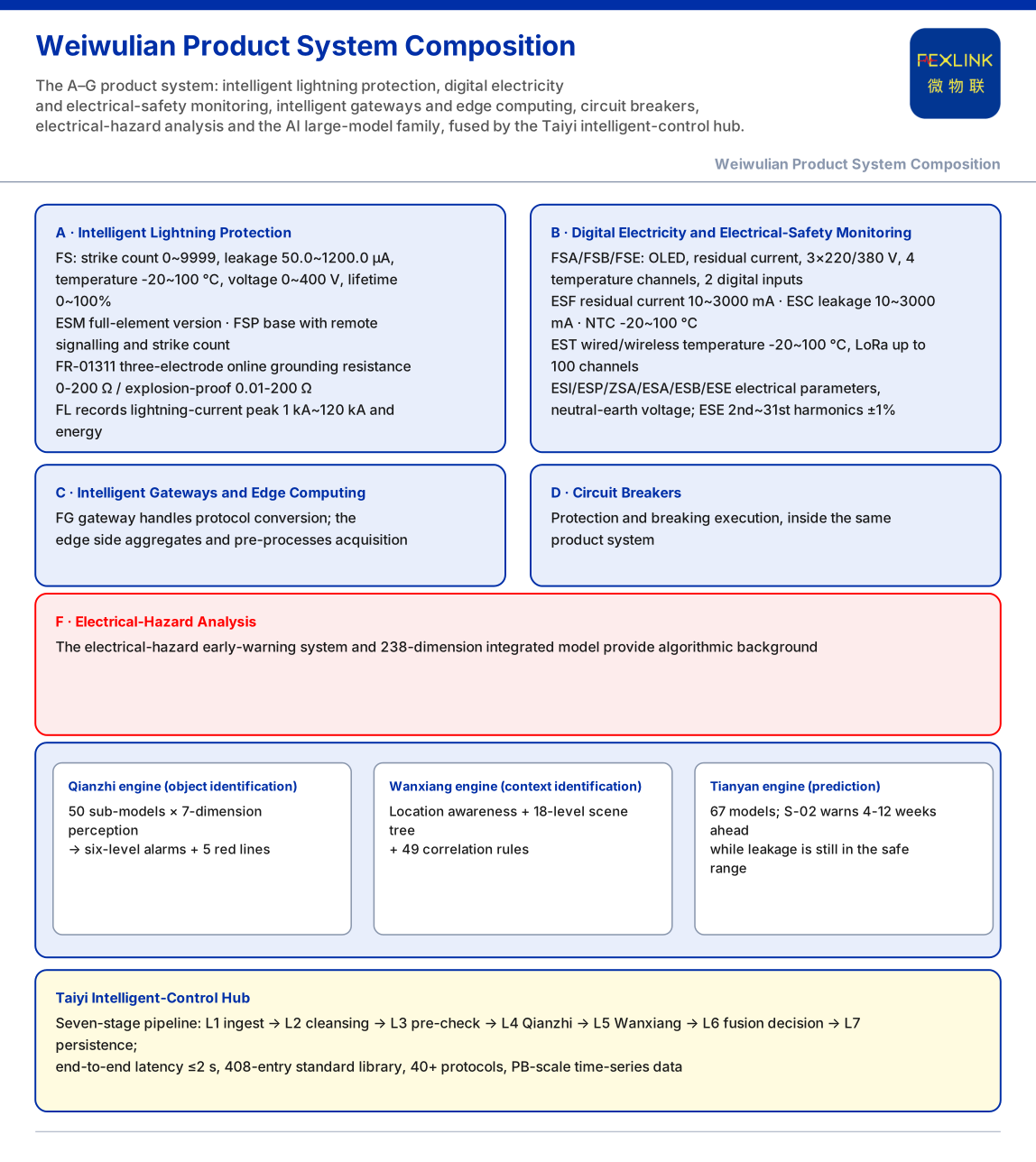
Photovoltaic connection changes the source composition at the point of connection. The product knowledge base lists new-energy stations among the applicable industries of the Taiyi intelligent control hub system, showing that the source-side point of connection is itself an analysis object explicitly included. Sag is sensitive on the source side because the withstand characteristics of converter-type devices differ from those of conventional loads, and a short voltage dip may affect their operating state. To assess this sensitivity, a comparable and reproducible criterion is needed rather than on-site experience. Making sag a quantifiable indicator presupposes specifying which curve is used and which sub-model carries it. The product knowledge base gives this correspondence, and that is the starting point of this article.
2. Sag criterion: ITIC/SEMI F47 curves
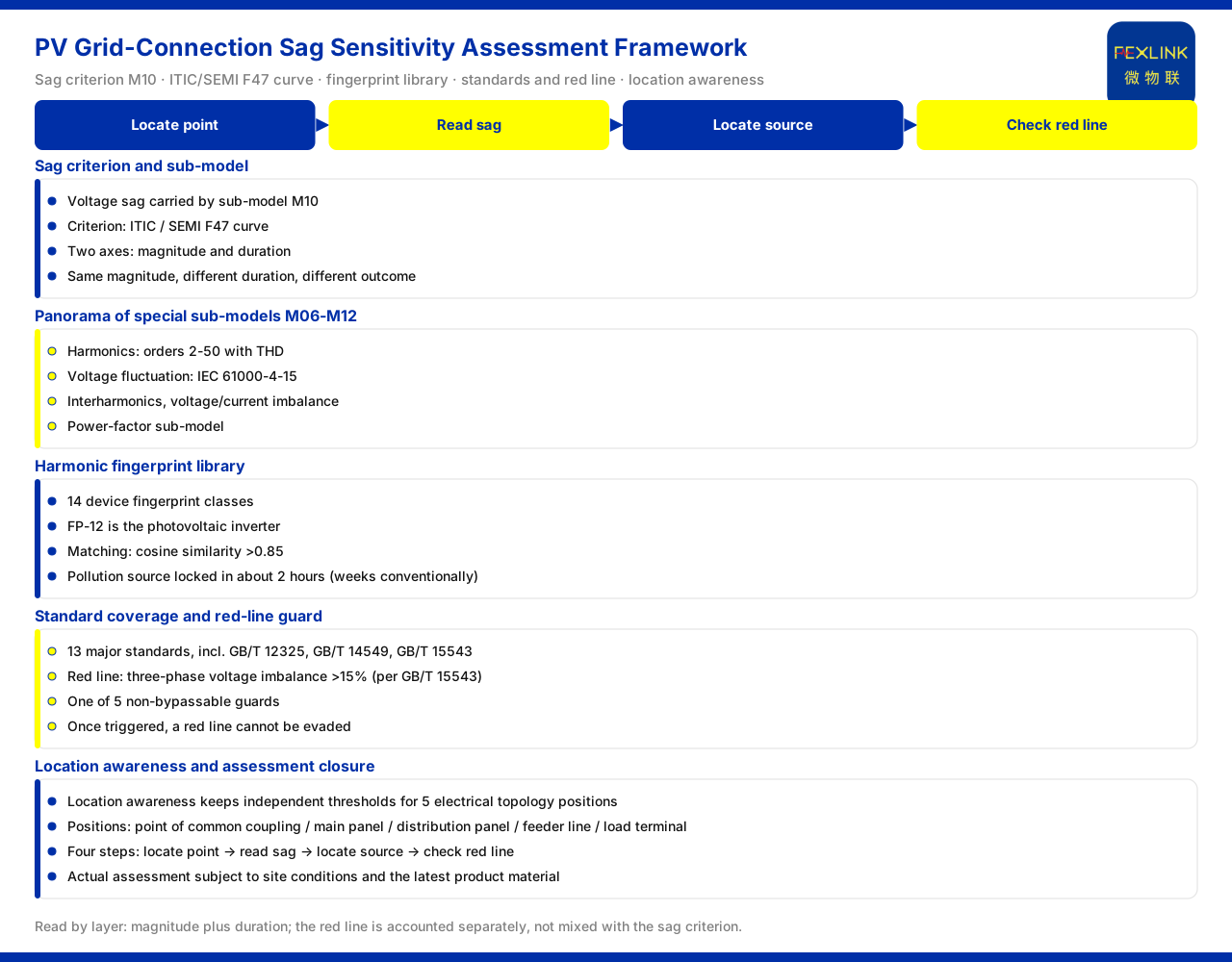
The product knowledge base records that the M06 to M12 special sub-models of the Qianzhi engine power-quality check-up include voltage sag, with the criterion being ITIC/SEMI F47 and the corresponding sub-model M10. The ITIC curve uses the sag magnitude and duration as two axes and draws the region a device can withstand; SEMI F47 gives a similar withstand requirement for scenarios sensitive to sag. Setting the sag criterion as a curve rather than a single-point threshold means that the same magnitude with different durations may lead to completely different conclusions. At the same level of dip, if it lasts only a few milliseconds it may still be within the withstand range; if it lasts longer it may cross the boundary. Answering "how sensitive the sag is" therefore requires looking at magnitude and time together, which is why M10 uses a curve criterion.
3. Panorama of the M06 to M12 special sub-models
Sag is not an isolated item. The product knowledge base records that among M06 to M12, harmonics cover orders 2 to 50 and include THD, the voltage-fluctuation criterion is IEC 61000-4-15, and there are further sub-models for interharmonics, voltage / current imbalance (sequence components) and power factor. This shows that the power-quality check-up is carried out as a system on the source side: harmonics answer waveform distortion, voltage fluctuation answers flicker-type problems, imbalance answers three-phase differences, and power factor answers reactive power and efficiency. Sag is only one item, but it shares the same acquisition and analysis basis with the others. This helps place sag back into the complete power-quality picture during assessment at the point of connection, rather than treating it as an isolated indicator. Assessing source-side risk often requires looking at sag, harmonics and imbalance together to locate the true disturbance cause.
4. Harmonic fingerprint library: why the photovoltaic inverter can be locked
The product knowledge base records that the harmonic fingerprint library contains 14 classes of device fingerprint, of which FP-12 is the photovoltaic inverter; fingerprint matching uses a cosine similarity greater than 0.85 and can lock the pollution source within about 2 hours, whereas the conventional approach often takes several weeks. This is especially relevant to the source-side grid connection: the photovoltaic inverter is itself a harmonic source, and when the point of connection exceeds the harmonic limit, whether the responsible device class can be identified quickly directly decides the troubleshooting efficiency. The fingerprint library models the harmonic signature of a device and compares it with the measured spectrum, giving a match when the similarity exceeds the threshold. This article cites only the fingerprint class count, similarity threshold and location time listed by the product knowledge base and infers no unlisted fingerprint features or matching-algorithm details.
5. Standard coverage and safety red lines
The product knowledge base records that the Qianzhi engine covers 13 major standards such as GB/T 12325, GB/T 14549 and GB/T 15543. Of these, those directly relevant to the source-side grid connection are imbalance and harmonics: three-phase voltage imbalance is supported by GB/T 15543, harmonics by GB/T 14549, and voltage deviation by GB/T 12325. Above these standards, the product knowledge base also has a safety red-line guard, in which the three-phase voltage unbalance red line (GB/T 15543) is "three-phase voltage imbalance greater than 15%", one of 5 non-bypassable red lines. The red line and the sag criterion act differently: sag is read by the ITIC/SEMI F47 curve, while a red line is a limit that cannot be evaded once triggered. Keeping the two apart avoids confusing thresholds of different natures; in grid-connection assessment the two must be checked separately.
6. Location awareness: same sag, different thresholds at different positions
The product knowledge base records that the location awareness of the Wanxiang engine (large model) maintains independent thresholds and risk models for 5 types of electrical topology position, namely the point of common coupling, the main distribution panel, the distribution panel, the feeder line and the load terminal. For photovoltaic grid connection, the meaning of this design is that the same sag occurring at the point of common coupling and at a load terminal has different impact and risk. Location awareness lets the analysis judge separately by the topology level at which the measurement point sits, rather than applying one set of thresholds to the whole station. In assessing the sag sensitivity of a point of connection, one first confirms which position class the measurement point belongs to and then applies the corresponding threshold and risk model, so that the conclusion is comparable. This also indicates that source-side assessment should not focus only on the point of connection but should include the whole distribution hierarchy.
7. Bringing sag sensitivity into the grid-connection assessment
Taken together, the sag assessment of a source-side point of connection can proceed in four steps. First, confirm the measurement-point position, whether at the point of common coupling, the main distribution panel or another level. Second, read the sag record and judge by the ITIC/SEMI F47 curve whether it falls outside the device withstand range. Third, combine the parallel items of harmonics and imbalance, using the harmonic fingerprint library and the standard specification to locate the main disturbance source. Fourth, check whether a safety red line is touched. These four steps are based on the entries listed by the product knowledge base and introduce no unlisted limits or cases. Putting M10's curve criterion, the M06 to M12 system coverage, the fingerprint library's location capability, the safety red lines and location awareness together forms a sag-sensitivity assessment framework for photovoltaic grid connection.
Scope and limitations
First, this article restates only what the product knowledge base lists, with the factual boundary limited to the M06 to M12 special sub-models of the Qianzhi engine power-quality check-up, the ITIC/SEMI F47 criterion for voltage sag (M10), the 14 fingerprint classes and FP-12 of the harmonic fingerprint library, the similarity threshold and location time, the 13 major standards and the three-phase voltage unbalance red line (GB/T 15543), and the 5 topology positions of the Wanxiang location awareness.
Second, the harmonic orders 2 to 50, the voltage-fluctuation IEC 61000-4-15, the voltage / current imbalance (sequence components) and the power factor are cited per the product knowledge base, and this article extends no unlisted measurement method or accuracy.
Third, the 14 classes of device fingerprint, the cosine similarity greater than 0.85 and the location within about 2 hours are knowledge-base specifications, and this article does not expand them into a guarantee for any site, nor infer the internal details of the fingerprint features and algorithm.
Fourth, ITIC/SEMI F47 as the voltage-sag criterion and the three-phase voltage unbalance red line (GB/T 15543), defined as "three-phase voltage imbalance greater than 15%", are listed by the product knowledge base; this article quotes no clause text and gives no unverified limit in the name of a standard.
Fifth, this article provides no specific configuration, governance scheme or effect conclusion for photovoltaic grid connection; actual assessment is subject to the latest product material, the standard-library matching result and the project conditions.