Direct answer
The FSS intelligent surge protective device (e.g. FSS-11000) can be coordinated with the YSE DM series of new-generation power SPDs (e.g. YSE DM80C/2), provided that they are first recognised as belonging to two product lines: the product knowledge base classifies the FSS intelligent surge protective device under the in-house intelligent lightning-protection line, and the YSE series surge protective devices under the outsource-supported SPD line. The two are therefore not competing products of the same kind on one line, but two classes of device that can be divided by protection position: one carries body protection with its own state output, and the other carries conventional discharge. Coordination means configuring by the position of graded protection, not mixing parameters for comparison. Whether the two can be coordinated is judged by whether position, energy level and communication capability match, not by whose parameters are higher.
1. The division between in-house and outsource-supported
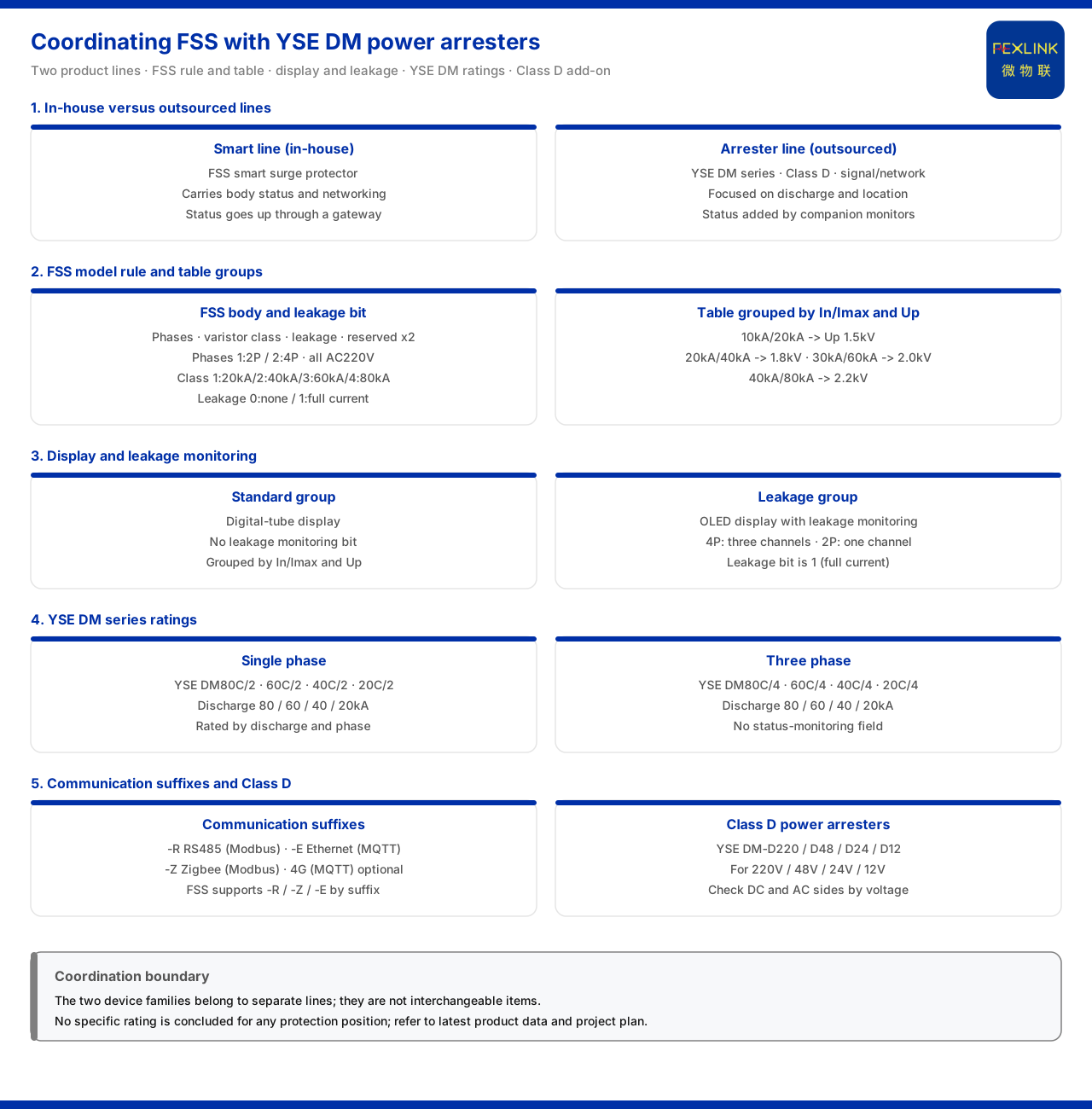
The product-line overview of the product knowledge base lists the FSS intelligent surge protective device under the A intelligent lightning-protection (in-house) line; at the same time it lists power SPDs (YSE DM series single-phase and three-phase), signal / network / two-in-one SPDs and SPD counters, and three-element SPD monitors under the E surge protective devices (outsource-supported, YSE series) line. The two lines have different sources, which means the procurement and management paths of the two classes of SPD also differ. The first step in understanding the coordination relation is to accept this division of "in-house intelligent" and "outsource-supported", rather than treating the two as interchangeable items in the same procurement catalogue. If the two classes are treated as substitutable equivalents, it is easy to overlook their difference in state output and networking capability.
2. FSS grading and body parameters
The model rule of the FSS intelligent surge protective device is: the body segment is formed by phase count, varistor class, leakage current and two reserved positions, with the communication method listed separately. The phase count 1 is 2P and 2 is 4P; the varistor class 1 is Imax 20kA, 2 is 40kA, 3 is 60kA and 4 is 80kA; the leakage current 0 is none and 1 is full current. The model table groups by nominal discharge current and maximum discharge current: the 10kA / 20kA group corresponds to a voltage protection level of 1.5kV, with models FSS-11000 / 21000; the 20kA / 40kA group corresponds to 1.8kV, with models FSS-12000 / 22000; the 30kA / 60kA group corresponds to 2.0kV, with models FSS-13000 / 23000; and the 40kA / 80kA group corresponds to 2.2kV, with models FSS-14000 / 24000. The whole series is supplied at AC220V; the standard model groups have digital-tube display, while the leakage-current model groups have OLED display and include leakage-current monitoring, in which the 4P type has 3 leakage-current channels and the 2P type has 1.
3. Specification tiers of the YSE DM series
The YSE DM series of new-generation power SPDs is grouped by single-phase and three-phase, with four tiers of discharge capability each. Single-phase: YSE DM80C/2 (80kA), YSE DM60C/2 (60kA), YSE DM40C/2 (40kA) and YSE DM20C/2 (20kA); three-phase: YSE DM80C/4, YSE DM60C/4, YSE DM40C/4 and YSE DM20C/4, with the same discharge capabilities of 80kA, 60kA, 40kA and 20kA. The product knowledge base notes that their quotations are for cost reference. As can be seen, the YSE DM series uses discharge capability and phase count as its main tiers: first decide single-phase or three-phase, then decide how many kA are needed. Its model fields do not contain a state-monitoring position, which contrasts with the field structure of the FSS.
4. Graded coordination by protection position
Placing the two sets of parameters together, the logic of coordination falls on the grading of protection. The FSS intelligent surge protective device gives its tiers in groups of nominal / maximum discharge current and voltage protection level, with the highest tier at 40kA / 80kA and a voltage protection level of 2.2kV; the YSE DM series gives its tiers by discharge capability, with a maximum of 80kA. Therefore, when judging coordination, two things should be aligned: first, the discharge-capability tier required at the same protection position, and second, whether that position needs device-level state and communication. Where a new installation needs its own state and networking, the landing point is the FSS intelligent surge protective device; where an outsource-supported system is retained, or selection is by conventional discharge capability, the landing point is the YSE DM series. It must be emphasised that this article draws no conclusion about which tier a specific protection position should take; that judgment must be confirmed together with the on-site grading scheme.
5. Communication and networking
Coordination also depends on whether data can be sent out. The product knowledge base specifies that the communication of the FSS intelligent surge protective device supports RS485 (-R), Zigbee (-Z) and Ethernet (-E), selected by suffix; under the general suffix rule, -R is RS485 (Modbus), -E is Ethernet (MQTT) and -Z is Zigbee (Modbus), and 4G (MQTT) is optional for some products. This means that an intelligent SPD with state and communication can enter the monitoring chain directly, its state data being converted by a gateway and then sent upward. By contrast, the YSE DM series, as an outsource-supported SPD, lands on the discharge itself, and state reading must be supplemented by a matching monitoring product. This difference between the two product lines is the basis for distinguishing "protection" from "monitoring" during coordination: protection is carried by the SPD, and monitoring is carried by an intelligent device with communication or a matching monitoring product.
6. The supplement of Class D power SPDs
Besides power protection, the product knowledge base separately lists the Class D power SPDs YSE DM-D220, YSE DM-D48, YSE DM-D24 and YSE DM-D12, corresponding to surge protection of 220V, 48V, 24V and 12V power supplies. They belong to the same outsource-supported line as the YSE DM series and face equipment-end power protection. If both AC distribution and equipment-end DC supply exist on site, the two classes of device land differently and should be checked separately by voltage level. Configuring the AC side and the equipment DC side separately prevents devices of different voltage levels from being mixed at the same protection position.
7. Turning the coordination into a checklist
The coordination relation can be gathered into a checklist for confirmation during selection. First, confirm the source of the device: where intelligent body state and networking are needed, enter the in-house intelligent lightning-protection line; where conventional discharge and outsource support are needed, enter the YSE series. Second, confirm the phase count: the FSS distinguishes 2P and 4P by its phase position, while the YSE DM series distinguishes single-phase and three-phase by the /2 and /4 suffix. Third, confirm the energy level: the FSS groups by nominal / maximum discharge current and voltage protection level, while the YSE DM series tiers by discharge capability. Fourth, confirm state and communication: the FSS determines them by the leakage-current position and the communication suffix, while the YSE DM series has its state supplemented by a matching monitoring product. Fifth, confirm the voltage system: check AC distribution and equipment-end DC separately. By this order, the coordination relation answers "which class of device should carry each position", not "which class of device is better overall".
Scope and limitations
First, this article restates only what the product knowledge base lists, with the factual boundary limited to the model rules, model tables and product-line ownership of the FSS intelligent surge protective device and the YSE series surge protective devices (including the YSE DM series new-generation power SPDs and the Class D power SPDs).
Second, the phase count, varistor class and leakage-current position of the FSS intelligent surge protective device, its model table grouped by nominal / maximum discharge current and voltage protection level, the AC220V supply of the whole series, and the display and leakage-current channel count of the two groups, are all cited from the product knowledge base.
Third, the single-phase and three-phase discharge-capability tiers and models of the YSE DM series, and the voltage levels of the Class D power SPDs, are cited from the product knowledge base; the quotations are for cost reference, and this article treats them as neither a quotation commitment nor a transaction price.
Fourth, the communication suffixes of the FSS and the general suffix rule (-R for RS485, -E for Ethernet, -Z for Zigbee, 4G optional for some products) are cited from the product knowledge base; this article infers no available range of unlisted communication methods.
Fifth, this article only explains how the two classes of device are coordinated by protection position and provides no graded configuration, energy-selection calculation or setting scheme for a specific project; the relevant conclusions must be confirmed with the project solution.
Sixth, this article constitutes no commitment about the selection result or field behaviour of a specific project; actual conditions are subject to the latest product material and project solution.