Direct answer
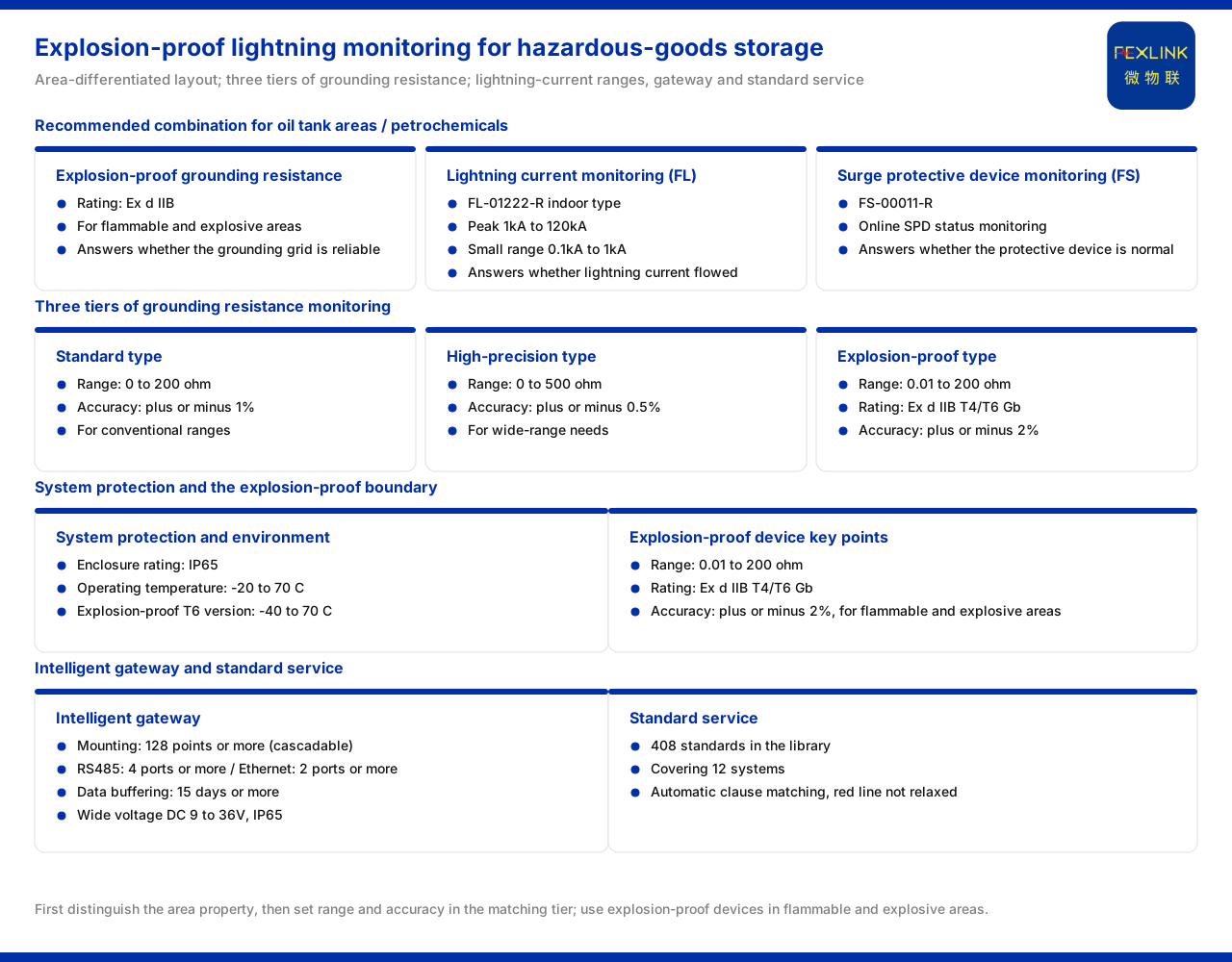
In the lightning-protection and explosion-proof monitoring of a hazardous-goods warehouse, the difficulty is not "whether to install devices" but what grade of device each area needs. In its typical application scenarios and selection comparison, the product knowledge base gives the recommended combination for "oil tank areas / petrochemical lightning-protection and explosion-proof": explosion-proof grounding resistance monitoring (Ex d IIB), the FL lightning current / transient current monitor (e.g. FL-01222-R) and the FS surge protective device monitor (e.g. FS-00011-R). This combination separates three kinds of monitoring: grounding resistance answers "whether the grounding grid is reliable", lightning current answers "whether lightning has flowed through", and surge protective device monitoring answers "whether the protection device is normal". On this basis, differentiating the selection by the explosion-hazard property of the storage area — explosion-proof devices in flammable and explosive areas, and standard or high-precision devices in ordinary areas — yields a traceable, categorised layout list. This article restates only the specifications listed by the product knowledge base and infers no specific result of hazard-area classification.
1. Why a hazardous-goods storage scenario needs area-differentiated layout
A hazardous-goods warehouse usually contains several functional areas at once, and the explosion-hazard properties of these areas differ. The selection comparison given by the product knowledge base lists "oil tank areas / petrochemical lightning-protection and explosion-proof" as a scenario requiring explosion-proof devices, which shows that in such scenarios the device's own explosion-proof rating is the first condition of selection. Area-differentiated layout means: not applying a single model to the whole warehouse, but first distinguishing the areas and then matching each with monitoring devices of the corresponding explosion-proof rating and range. The direct benefit is that non-explosion-proof devices are avoided in flammable and explosive areas, and explosion-proof devices are not over-configured in ordinary areas. This "combination per scenario" is exactly the approach reflected in the product knowledge base, matching device grade to area property.
2. Three tiers of grounding resistance monitoring
Grounding resistance is the basic quantity for judging the reliability of the grounding grid. The product knowledge base records that the grounding resistance monitoring unit is divided into three tiers: a standard type of 0 to 200 ohms with an accuracy of plus or minus 1%; a high-precision type of 0 to 500 ohms with an accuracy of plus or minus 0.5%; and an explosion-proof type of 0.01 to 200 ohms with an explosion-proof rating of Ex d IIB T4/T6 Gb and an accuracy of plus or minus 2%. The three tiers differ in range, accuracy and explosion-proof capability. The standard type covers the conventional range, the high-precision type widens the range and improves accuracy, and the explosion-proof type, with a smaller starting range and a stricter explosion-proof rating, faces flammable and explosive areas. In selection, first judge the area property, then fix the range and accuracy within the corresponding tier; that is the meaning of these three tiers.
3. The boundary of the explosion-proof device
The explosion-proof grounding resistance monitor (Ex d IIB T4/T6 Gb) has a range of 0.01 to 200 ohms and an accuracy of plus or minus 2%. The product knowledge base also records that the protection rating of the grounding resistance monitoring system is IP65 and its operating temperature is minus 20 to 70 degrees Celsius; the explosion-proof T6 type has an operating temperature of minus 40 to 70 degrees Celsius. Explosion-proof rating and temperature class are two properties of the same device: Ex d IIB states its explosion-proof form and gas group, T4/T6 states its temperature class, and the explosion-proof T6 type extends the lower operating-temperature limit to minus 40 degrees Celsius. Note that which temperature class a specific area should use is an engineering-design judgment; the entries on which this article is based give only the rating range the device can reach.
4. Range and installation form of lightning current monitoring
Lightning current monitoring answers "whether a lightning current has flowed and how large it was". The product knowledge base records that the lightning current / transient current monitor (e.g. FL-01222-R) is an indoor type, supplied at AC220V, with a peak range of 1 kiloampere to 120 kiloamperes, and supports energy measurement; the FL-01212-R is an outdoor type, AC220V, with a range of 1 kiloampere to 120 kiloamperes; and the FL-11122-R is an indoor type, AC220V, with a range of 0.1 kiloampere to 1 kiloampere. The three differ mainly in installation form and range: the outdoor type corresponds to outdoor installation, and the small-range model of 0.1 to 1 kiloampere faces a smaller current span. Placing lightning current monitoring alongside grounding resistance monitoring, one watches "whether lightning came" and the other watches "whether the grounding grid holds fast"; the two complement each other.
5. The position of surge protective device monitoring in the combination
In the recommended combination given by the product knowledge base, the surge protective device monitor is listed alongside explosion-proof grounding resistance monitoring and lightning current monitoring. What it monitors is the surge protective device itself, that is, whether the protection device is in a normal state. Put together, the three kinds of device cover three key points on the lightning-protection chain: the lightning current is recorded, the grounding grid is monitored, and the protection device is monitored. For a hazardous-goods storage scenario, the meaning of this combination is that lightning protection is extended from a single grounding check to a parallel observation of lightning events, grounding-grid state and protection devices. In the entries on which this article is based, the product knowledge base does not elaborate this monitor's specific parameters, so this article makes no further inference.
6. Products and cases available for engineering reference
The product knowledge base records that the grounding resistance monitor (e.g. FR-01311-R) is DC12V, outdoor, three-electrode method, RS485, with two further communication forms, FR-01311-Z (Zigbee) and FR-01311-E (Ethernet); its housing is aluminium, 204 by 202 by 72 millimetres. The product knowledge base also records that this class of device has been applied to the online monitoring of the grounding grid of railway traction substations, and to the Jinzhou Port oil tank area project, the latter configured at 10 sets per tank. A distinction must be drawn here between "product form" and "application record": the model and communication method belong to the product entries, while the railway traction substation and the Jinzhou Port oil tank area belong to existing application records. These records are cited to show the established use of this class of device in oil tank area scenarios; no configuration quantity for other projects is inferred from them.
7. The gateway and standard service that connect the devices
The data produced by the monitoring devices must be gathered through a gateway. The product knowledge base records that the smart gateway can carry no fewer than 128 points and supports cascading, has no fewer than 4 channels of RS485 and no fewer than 2 channels of Ethernet, can be equipped with 4G, 5G or LoRa, has a data cache of no fewer than 15 days, is supplied at DC9 to 36 volts wide voltage, and has a protection rating of IP65. In addition, the product knowledge base records that the standard service contains a 408-standard library covering 12 systems such as GB, GB-T, DL, IEC and UL, supports automatic clause matching, and its red lines cannot be relaxed. The gateway decides how monitoring points are accessed and cached, while the standard service decides the basis of clause matching. For a hazardous-goods storage scenario, the two together form the base from the field devices to the compliance comparison.
Scope and limitations
First, this article restates only what the product knowledge base lists, with the factual boundary limited to the recommended combination for "oil tank areas / petrochemical lightning-protection and explosion-proof", the three tiers of grounding resistance monitoring, the range, accuracy and temperature class of the explosion-proof device, the models and ranges of lightning current monitoring, the surge protective device monitor, the models and application records of the grounding resistance monitor, the parameters of the smart gateway and the entries of the standard service.
Second, the division of hazardous areas and the final choice of explosion-proof rating are engineering-design judgments; this article gives only the device rating ranges listed by the product knowledge base and does not replace the conclusion of an on-site hazardous-area classification.
Third, the "10 sets per tank" of the Jinzhou Port oil tank area and similar items are application records listed by the product knowledge base; this article infers no configuration quantity or effect for other projects from them.
Fourth, IP65, the operating temperature range, the gateway point count and cache days are all knowledge-base specifications, and this article does not expand them into a guarantee for any scenario.
Fifth, this article constitutes no commitment about the compliance conclusion or the monitoring effect of a specific project; actual selection and layout are subject to the latest product material, the relevant standards and the project solution.