Direct answer
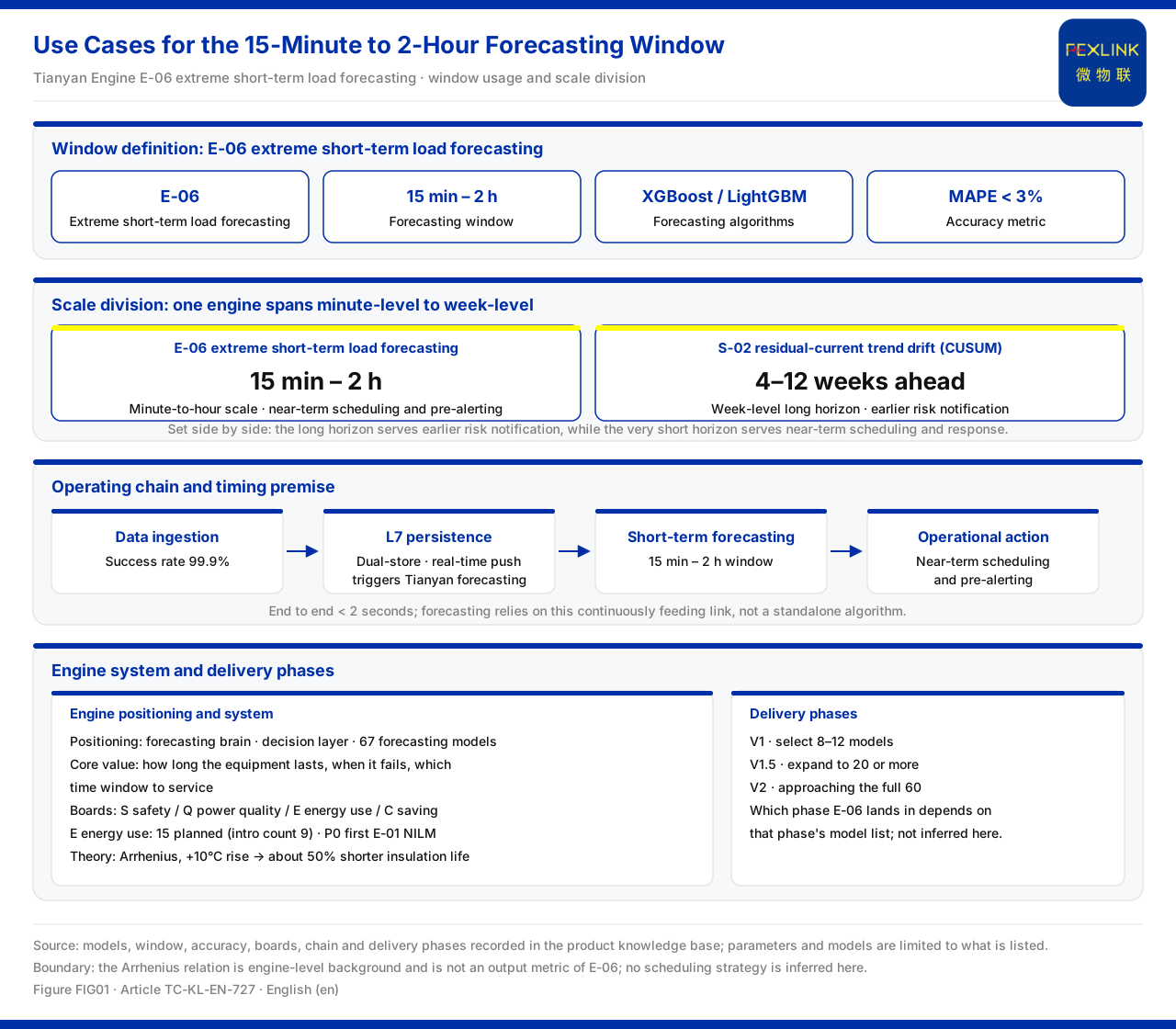
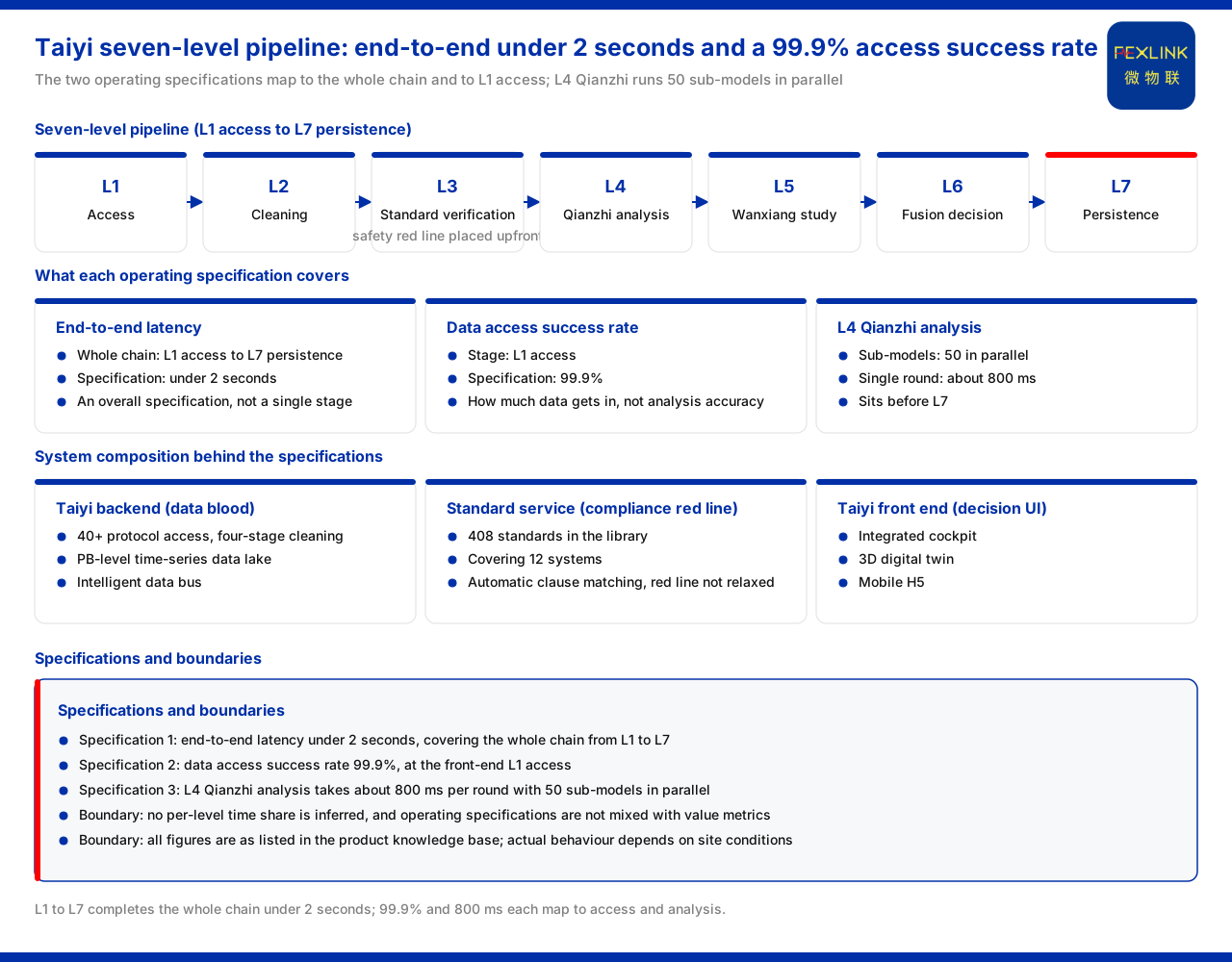
The product knowledge base gives two operating specifications for the Taiyi intelligent control hub system (V2.0): end-to-end latency under 2 seconds, and a data access success rate of 99.9%. The first describes the upper time limit for the seven-level pipeline to run the whole path from data access to persistence; the second describes the proportion of success at the data access stage. The two metrics do not target the same object: end-to-end latency corresponds to the overall process from L1 to L7, while 99.9% corresponds to the specific stage of L1 access. The product knowledge base also records that L4 Qianzhi analysis, in the middle of the chain, is completed by 50 sub-models in parallel, at about 800 milliseconds per round. To read these two metrics correctly, they must be put back into their concrete positions in the seven-level pipeline, rather than treated as a general guarantee for any site or any operating condition. This article restates only the specifications listed in the product knowledge base; it infers no method of evaluating the metrics and compares them with no third-party system.
1. Which segment of the pipeline each metric belongs to
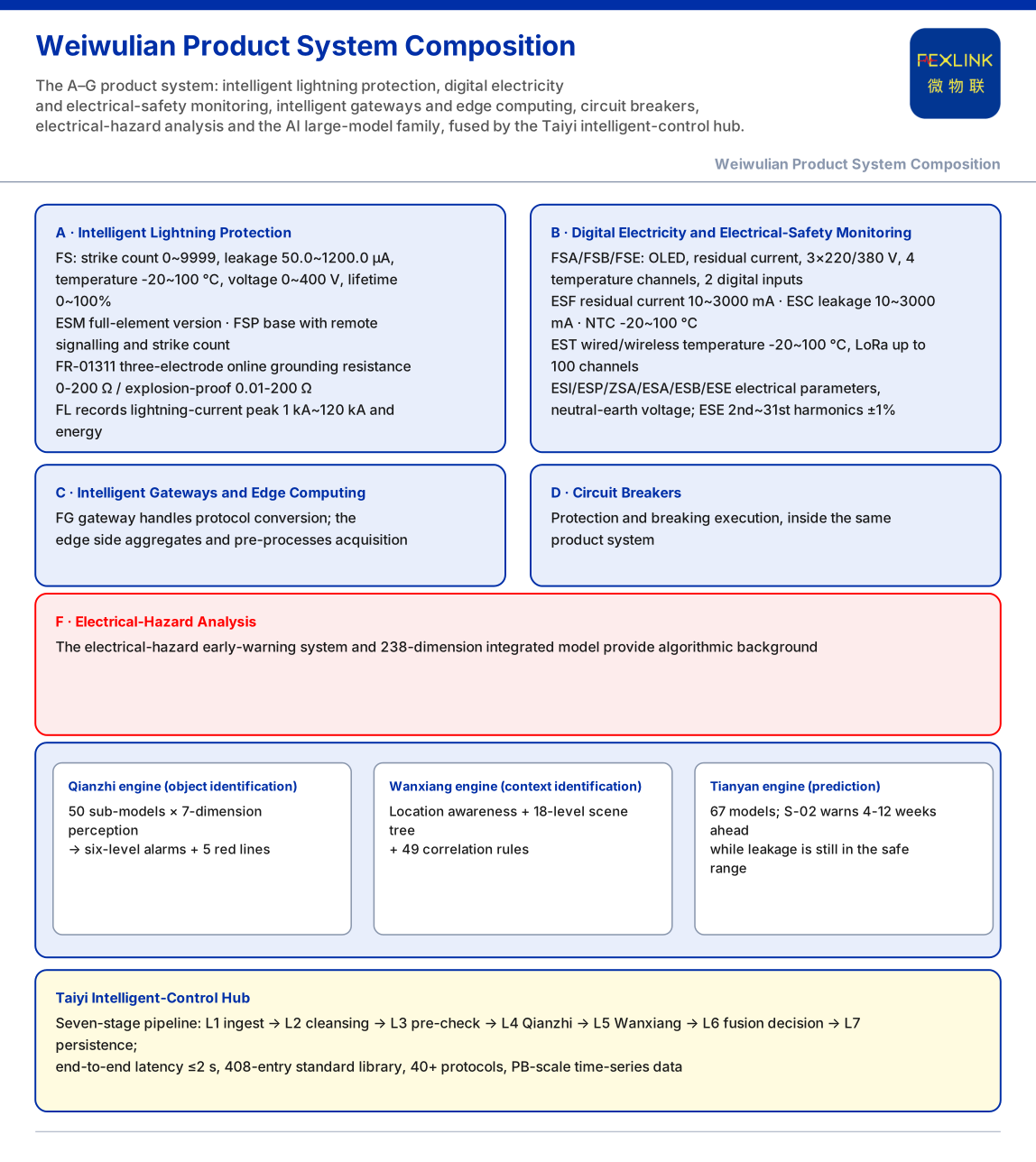
The product knowledge base lists the seven-level pipeline of the Taiyi intelligent control hub system as: L1 access, L2 cleaning, L3 standard verification (red-line pre-position), L4 Qianzhi analysis, L5 Wanxiang study, L6 fusion decision, L7 persistence. End-to-end under 2 seconds covers the complete chain from L1 to L7; the data access success rate of 99.9% falls on L1 access, at the very front of the chain. Seeing the two metrics separately avoids a common confusion: overall latency and single-point success rate are not the same thing. The former asks "how long does one full pass take", the latter asks "how much of the incoming data is successfully caught". One describes speed, the other describes reliability, and together they form the account of how the system performs.
2. The specification of "end-to-end under 2 seconds"
The product knowledge base states the end-to-end latency as "under 2 seconds". The subject of this figure is the whole seven-level pipeline, not any single level within it. That is, from L1 access through L2 cleaning, L3 standard verification, L4 Qianzhi analysis, L5 Wanxiang study and L6 fusion decision to L7 persistence, the time for the complete chain is recorded as under 2 seconds. In the entries on which this article is based, the product knowledge base does not single out any level as the dominant consumer of time, so no share of time should be inferred for individual levels. What can be confirmed is that end-to-end under 2 seconds is an overall specification, not a commitment about a single stage.
3. The specification of "99.9% data access success rate"
Unlike the overall latency, the data access success rate of 99.9% corresponds to the L1 access stage. The product knowledge base records it alongside the end-to-end latency, showing that reliability and real-time behaviour are brought into the system's operating metrics at the same time. Note that access success rate describes "whether data can get in"; it is not equivalent to analysis accuracy, nor to early-warning accuracy. Reading this metric as the success proportion of the access stage fits the original wording of the product knowledge base better than generalising it into whole-system reliability. As for the statistical period and sample basis of the success rate, the entries on which this article is based do not elaborate.
4. Why L4 Qianzhi analysis is separately cited at about 800 milliseconds
Against the background of a whole chain under 2 seconds, the product knowledge base still separately records the single-round time of L4 Qianzhi analysis as about 800 milliseconds, and explains that it is completed by 50 sub-models in parallel. L4 is the analysis stage of the seven-level pipeline, and its single-round time is explicitly listed, which shows that this stage has an identifiable weight in the latency composition. Full parallelism is the organising mode of this stage: 50 sub-models unfold at the same time rather than queueing in sequence. The product knowledge base records elsewhere in its technical specifications that the Qianzhi engine (large model, V4.1) analyses in a single round of about 800 milliseconds (L4 layer), fully in parallel, covering 13 major standards such as GB/T 12325, GB/T 14549 and GB/T 15543. Placed together, these records make the position of L4 fairly clear: it is one parallel analysis covering several standards at once, and its single-round time is defined separately.
5. The system composition supporting these two metrics
The two operating metrics do not exist in a vacuum; their base is made of three parts recorded by the product knowledge base. The first is the Taiyi back end, called "data blood", whose capabilities include access for more than 40 protocols, four-level cleaning, a PB-scale time-series data lake and an intelligent data bus. The second is the standard service, called the compliance red line, containing a 408-standard library covering 12 systems such as GB, GB-T, DL, IEC and UL, supporting automatic clause matching, and its red lines cannot be relaxed. The third is the Taiyi front end, the decision interface, containing a comprehensive cockpit, a 3D digital twin and a mobile H5. The success rate of data access and the latency of the whole chain are both built on this back end and this standard service; seeing this base together with the metrics prevents misreading them as isolated technical parameters.
6. The difference from the quantitative value metrics
Two kinds of figures must be distinguished. End-to-end under 2 seconds and 99.9% are operating specifications, describing "how the system runs"; the product knowledge base has another group of quantitative value metrics describing "what the system brings". The latter include an electrical hazard identification rate above 95%, an alarm compression ratio of 80%, an early-warning lead time of 4 to 12 weeks, fault-location time shortened from several days to 2 hours, an alarm accuracy improvement of 3 times, a mean repair time shortened by 60%, comprehensive energy-saving headroom of 8% to 20%, and more than 100 visualisation components. Operating specifications answer for the system's own latency and access performance, while value metrics answer for outcomes on the business side. The two should not substitute for each other, and the value metrics should not be treated as a guarantee for any deployment.
7. What to note when understanding and using these two metrics
First, they should be understood within the context of the seven-level pipeline, not abstracted into a general performance claim. Second, overall and local should be distinguished: end-to-end under 2 seconds is an overall specification, 99.9% is an access-stage specification, and about 800 milliseconds is an L4-stage specification. Third, operating specifications and quantitative value metrics should be kept apart and not mixed. Fourth, all the above figures are specifications listed by the product knowledge base; actual behaviour is affected by site conditions, data scale and deployment mode, and the latest product material and the specific project solution should prevail. Putting the metrics back into their source, neither overstating nor understating them, is the more prudent way to understand "end-to-end under 2 seconds and an access success rate of 99.9%".
Scope and limitations
First, this article restates only what the product knowledge base lists, with the factual boundary limited to the existing entries on the names of the levels of the Taiyi intelligent control hub system seven-level pipeline, end-to-end under 2 seconds, the data access success rate of 99.9%, the 50 parallel sub-models and about 800 milliseconds of L4 Qianzhi analysis, and the Taiyi back end, the standard service and the Taiyi front end.
Second, "under 2 seconds" and "99.9%" are operating specifications listed by the product knowledge base; this article infers neither their statistical method, their test conditions nor the operating conditions to which they apply.
Third, the 13 major standards, the 408-standard library and the 12 systems are all knowledge-base specifications, and this article does not expand them into a guarantee for any scenario.
Fourth, the quantitative value metrics and the operating specifications belong to different categories, and this article treats none of them as a commitment about the effect of a specific project.
Fifth, this article constitutes no guarantee of the real-time behaviour or reliability of a specific deployment; actual capability is subject to the latest product material and project solution.