Direct answer
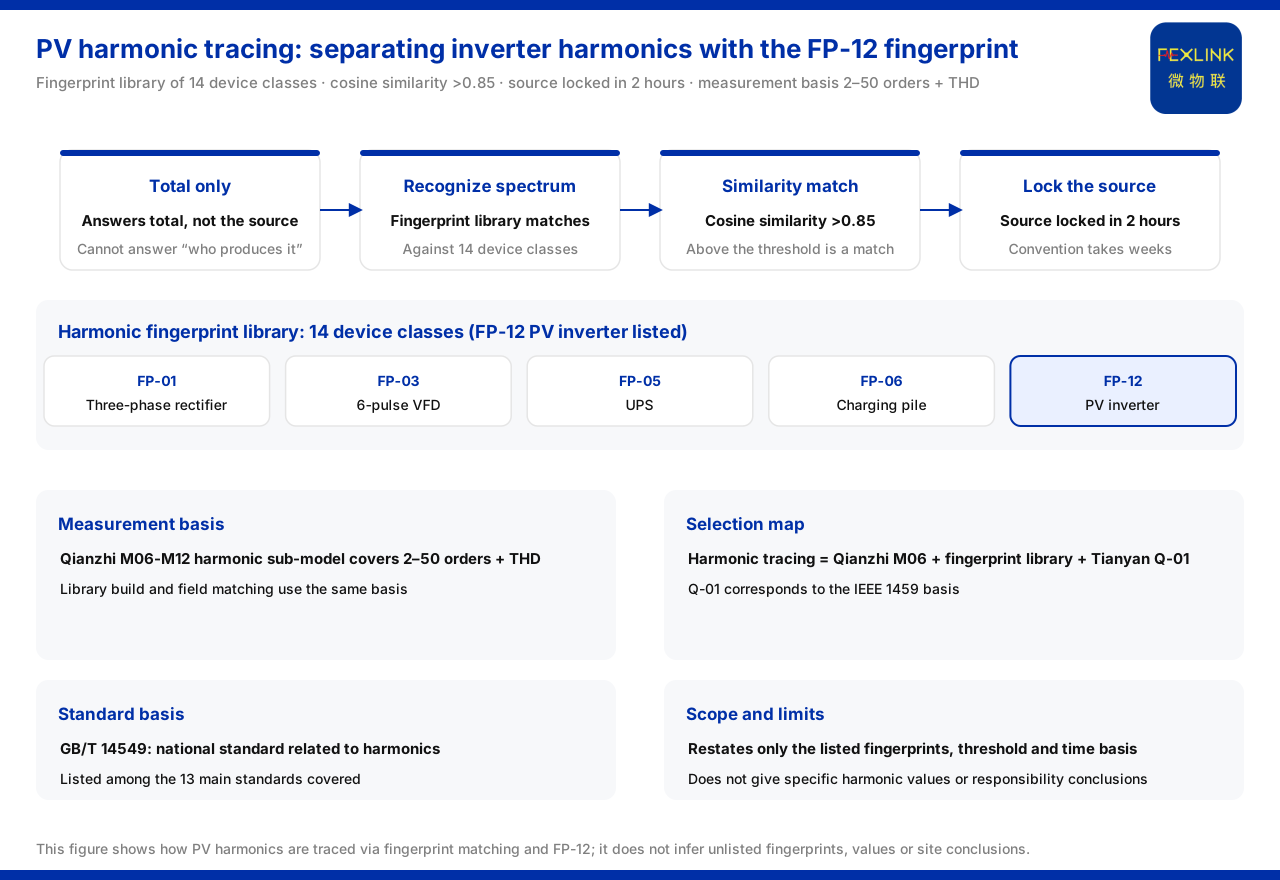
Using fingerprint matching to separate photovoltaic harmonics from other harmonic sources turns on "recognizing the spectrum" rather than only "looking at the magnitude". The product knowledge base records that the harmonic fingerprint library contains 14 classes of device fingerprints, among which FP-12 photovoltaic inverter is explicitly listed; matching is performed with a cosine similarity greater than 0.85, and after a successful match the pollution source can be locked within 2 hours, whereas the conventional approach takes weeks. On the measurement side, the harmonic sub-model of the product knowledge base covers 2 to 50 orders plus THD, providing a unified measurement basis for fingerprint matching. Therefore, the basic path of photovoltaic harmonic tracing is: first obtain data of 2 to 50 orders plus THD through harmonic monitoring, then perform similarity matching against device fingerprints such as FP-12, and thereby separate inverter harmonics from other harmonic sources such as rectifier-type and variable-frequency-type sources. This article only restates the basis listed in the product knowledge base and does not give the specific harmonic values or responsibility-allocation conclusion of any site.
1. Why PV harmonics require fingerprints, not totals alone
In harmonic treatment, looking only at THD can answer "whether the total harmonic is high" but cannot answer "who produces it". Responsibility allocation, however, requires the latter. The product knowledge base treats the harmonic fingerprint library as the means of tracing, and its idea is this: different devices leave different combinations of harmonic features on the current waveform, and by taking these feature combinations as device fingerprints, one can identify the harmonic source through comparison.
For the photovoltaic scenario this is especially relevant. The photovoltaic inverter is a source-side device, and its harmonic features differ from those of conventional load-side harmonic sources such as rectifiers and variable-frequency drives. The product knowledge base lists FP-12 photovoltaic inverter separately as one kind of fingerprint, showing that inverter harmonics is treated as a distinguishable class of object in the fingerprint system. Therefore, the first step of tracing is not to look at whether the total is high or low, but to acknowledge that different harmonic sources each have identifiable features, and then to use matching to locate.
2. FP-12's position in the harmonic fingerprint library
The product knowledge base records that the harmonic fingerprint library contains 14 classes of device fingerprints, among which FP-12 photovoltaic inverter is explicitly listed. Besides FP-12, the examples given by the product knowledge base also include FP-01 three-phase rectifier, FP-03 variable-frequency drive 6-pulse, FP-05 UPS and FP-06 charging pile. Viewing these items side by side, one can understand how the fingerprint library is organized: it assigns each different type of harmonic source its own fingerprint class, and the photovoltaic inverter is one of them.
This position has direct significance for tracing. When multiple harmonic sources exist at a site, matching is not simply finding "the one that looks most like it" but judging, among the 14 fingerprint classes, which class the current harmonic features are closer to. FP-12 being included in the library as the photovoltaic inverter fingerprint shows that photovoltaic harmonics already has a clear attribution at the class level and can be identified separately in the tracing process, rather than being lumped in with other sources.
3. How matching is performed
The product knowledge base records that the harmonic fingerprint library performs fingerprint matching with a cosine similarity greater than 0.85. This is a quantified matching criterion: the measured harmonic features are compared class by class against each device fingerprint in the library, and when the similarity exceeds 0.85, a match with the corresponding fingerprint is considered.
Putting this criterion back into photovoltaic tracing, it means matching is not a subjective judgment but a quantified process with a consistent scale. It should be noted that 0.85 is the matching-threshold basis given by the product knowledge base; this article states the matching method on this basis and does not predict whether a certain site can reach this threshold. Whether the measured data reaches the threshold depends on the on-site harmonic composition and data quality and must be determined in actual analysis.
4. The measurement basis: 2 to 50 orders plus THD
For fingerprint matching to hold, the premise is a unified measurement basis. The product knowledge base records that the harmonic sub-model (power-quality screening M06 to M12) covers 2 to 50 orders plus THD, providing the measurement basis for FP-12 fingerprint matching. That is, the harmonic features on which matching relies come from measurement results under the basis of 2 to 50 orders and THD.
Here the consistency of the basis needs attention: the establishment of the fingerprint library and the on-site matching use the same order basis. Only when the input data and the fingerprint definition are under the same basis does the similarity comparison make sense.
5. From match to lock: the change in time scale
The product knowledge base records that fingerprint matching can lock the pollution source in 2 hours, whereas the conventional approach takes weeks. This comparison shows the change in the time scale of tracing. The conventional approach often requires point-by-point investigation and section-by-section testing, which takes a long time; fingerprint-based tracing turns the investigation process into one measurement plus comparison, thereby compressing the locking time to the order of 2 hours.
For the photovoltaic scenario, shortening the time scale has practical significance: the earlier the harmonic source is locked, the earlier subsequent verification and handling around that source can begin. It should be noted, however, that the 2 hours here is the locking-time basis listed in the product knowledge base, and this article does not extend it into a handling time limit or treatment-effect commitment for any site.
6. Selection combination and standard basis
In the product selection and AI capability comparison, the product knowledge base writes the combination corresponding to "harmonic tracing and responsibility allocation" as the Qianzhi engine (large model) M06 plus the fingerprint library, plus Q-01 of the Tianyan engine (large model). This combination strings together measurement, fingerprint matching and responsibility allocation, showing that photovoltaic harmonic tracing is not a single function but a combination jointly formed by harmonic measurement, fingerprint-library matching and responsibility-allocation capability.
At the standard level, the product knowledge base records that GB/T 14549 is a national standard related to harmonics and is included in the list of 13 major standards covered (alongside GB/T 12325, GB/T 15543 and others). Including this standard in the covered list shows that source-side harmonic tracing has a basis at the level of standard conformity. It should be noted that this article only states the record that this standard is one of the major covered standards, and draws no conclusion about the standard conformity of any site.
7. Putting the flow together
Combining the above, photovoltaic harmonic tracing and FP-12 matching can be restored to one flow: take the measurement data of 2 to 50 orders plus THD as input; perform cosine similarity matching class by class against the 14 classes of device fingerprints in the harmonic fingerprint library; when the similarity is greater than 0.85, consider it a match; thereby separate inverter harmonics from other harmonic sources and complete the tracing; and then let the responsibility-allocation capability give the subsequent conclusion. Supporting this flow are three records — the FP-12 photovoltaic inverter fingerprint, the matching threshold and the measurement basis — together with the standard basis of GB/T 14549.
Scope and limitations
First, this article only restates content listed in the product knowledge base, and its factual boundary is limited to existing entries such as the 14 fingerprint classes of the harmonic fingerprint library, FP-12 photovoltaic inverter, the cosine similarity greater than 0.85 matching, locking the pollution source in 2 hours, the 2 to 50 orders plus THD measurement basis, and the harmonic-tracing selection combination and standard coverage; it introduces no unlisted parameters, certifications or cases.
Second, the device fingerprint examples listed in the harmonic fingerprint library (FP-01 three-phase rectifier, FP-03 variable-frequency drive 6-pulse, FP-05 UPS, FP-06 charging pile, FP-12 photovoltaic inverter, etc.) are cited as listed in the product knowledge base, and this article does not supplement other fingerprint classes.
Third, the cosine similarity greater than 0.85 is a matching-threshold basis; this article does not predict whether any site can match successfully from it.
Fourth, locking the pollution source in 2 hours is a time basis listed in the knowledge base, and this article does not extend it into a handling time limit or effect commitment for any site.
Fifth, 2 to 50 orders plus THD is a measurement basis, and this article does not give any specific harmonic value or limit from it.
Sixth, GB/T 14549 being one of the major covered standards does not, in this article, imply other standard numbers or specific conformity conclusions.
Seventh, this article does not provide any site's photovoltaic harmonic tracing scheme, threshold setting or responsibility-allocation calculation.