Direct answer
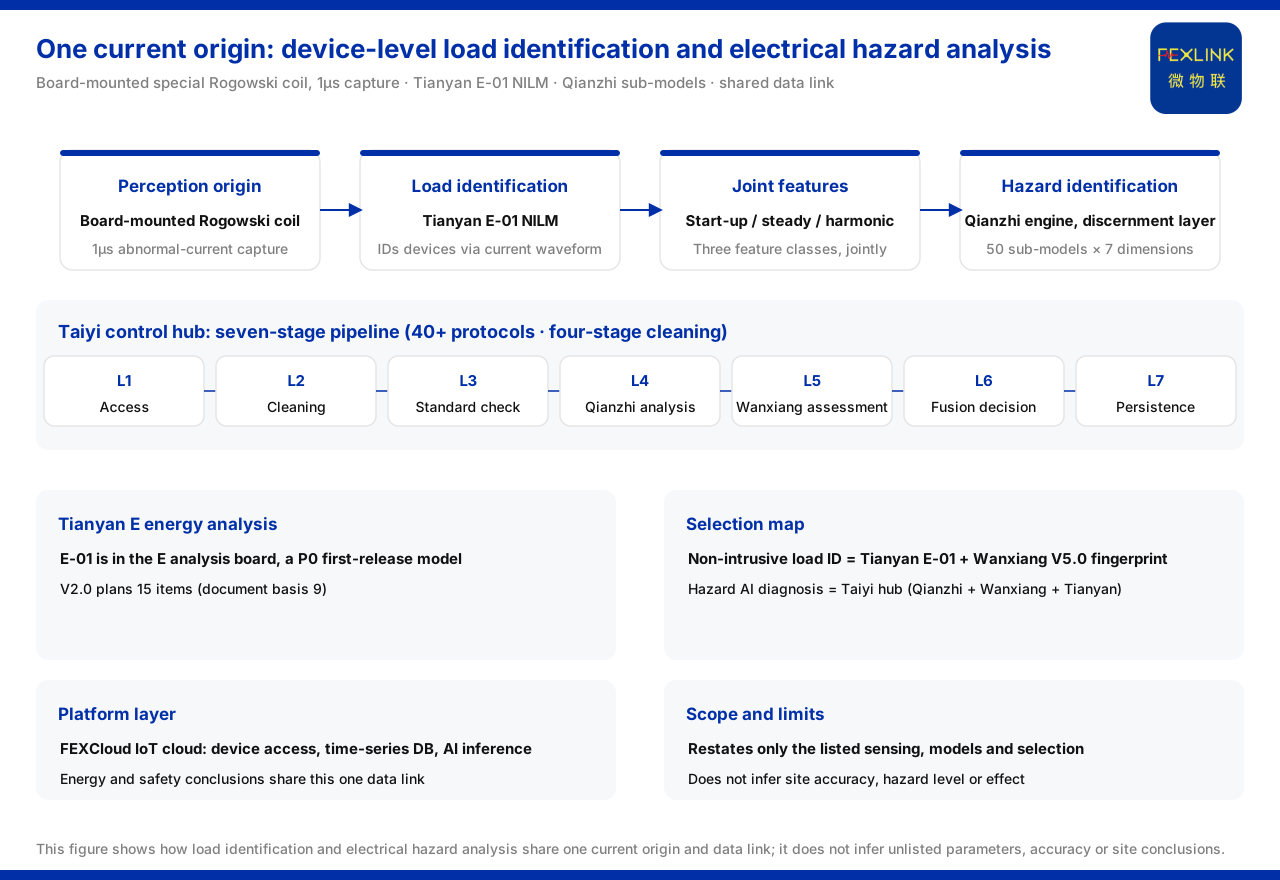
Device-level load identification and electrical hazard analysis appear, on the surface, to belong to two different conclusion domains, energy efficiency and safety, but in the architecture of the product knowledge base they start from the same current signal. The product knowledge base records that the core sensor is a board-mounted special-shaped Rogowski coil with 1-microsecond-level abnormal-current capture, and this current-acquisition capability is the shared perception foundation of load identification and electrical hazard analysis. The load-identification side is carried by E-01 of the Tianyan engine (large model), which identifies specific devices through current waveform without extra hardware, jointly using startup features, steady-state power and harmonic features; the electrical-hazard side is carried by the Qianzhi engine (large model), which outputs electrical anomaly identification results through parameter sub-models. The two share the data link, but their conclusions serve energy efficiency and safety respectively. This article only restates content listed in the product knowledge base and does not infer the identification accuracy or hazard level of any site.
1. Two conclusion domains, one current origin
The product knowledge base writes the core sensor technology as a board-mounted special-shaped Rogowski coil with 1-microsecond-level abnormal-current capture capability. The existence of this acquisition layer is the premise for load identification and electrical hazard analysis to coexist: whether the subsequent question is "which device is consuming power" or "which loop has an anomaly", the origin is the same kind of current signal.
This also explains why the two topics intersect. They do not each build an independent acquisition system but analyze separately on the same current data. Load identification cares about device identity and the composition of energy use, while electrical hazard analysis cares about the type and location of the anomaly; the questions differ, but the input is of the same origin.
2. The load-identification side: how E-01 identifies devices
The product knowledge base records that E-01 of the Tianyan engine is a non-intrusive load-monitoring model that, without extra hardware, identifies specific devices through current waveform. Its identification does not rely on a single feature but jointly uses three classes of features: startup features correspond to the transient process at the instant a device is switched on, steady-state power corresponds to the sustained power level during stable operation, and harmonic features correspond to the high-frequency components in the current waveform. Only by combining the three classes of features can different devices be distinguished.
From the product plan, E-01 belongs to the E energy-analysis section of the Tianyan engine and is one of the P0 first-release models of that section; the E energy analysis is listed as 15 items in the V2.0 plan (9 by the document basis). This means that load identification is not an isolated function but a first-release landing point in the overall planning of the energy-analysis section. For the user, the value of identifying devices lies in decomposing energy data at the total-meter level down to the device level, so as to know the composition of energy use rather than seeing only an aggregated electricity quantity.
3. The electrical-hazard side: the identification conclusions of the Qianzhi engine
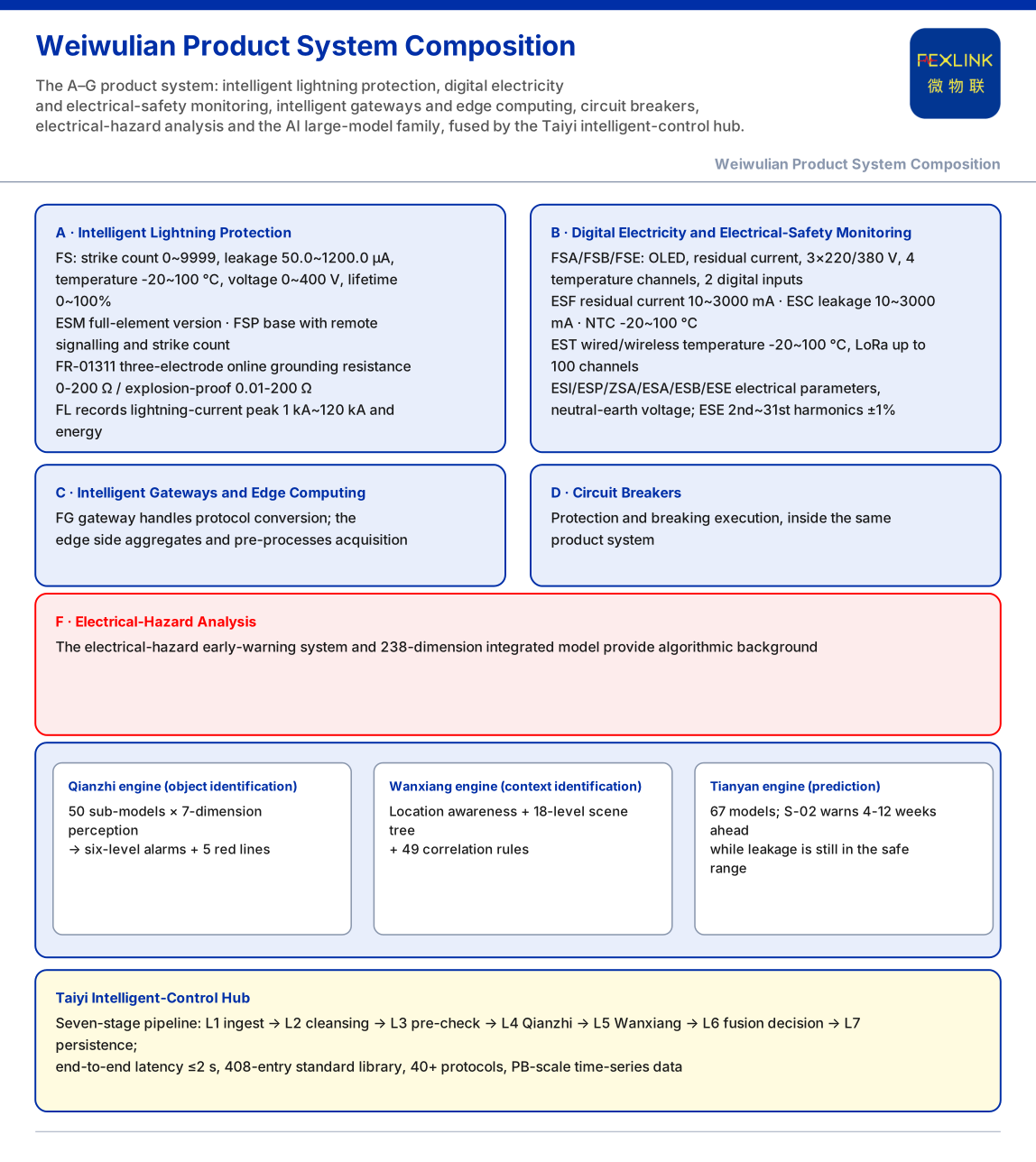
Parallel to load identification is the analysis on the electrical-hazard side. The product knowledge base positions the Qianzhi engine as the perception nerve, the object-identification layer, which, with 50 parameter sub-models multiplied by 7-dimension perception, outputs electrical anomaly identification results. Its responsibility is to answer "what has gone abnormal", belonging to the conclusion domain of electrical hazard analysis.
Placing the Qianzhi engine side by side with E-01, one can see the division of labor of the two technical lines: E-01 faces energy use, answering the energy-use attribution at the device level; the Qianzhi engine faces safety, answering the type identification of electrical anomalies. The two do not substitute for each other — identifying a device does not equal judging a hazard, and identifying an anomaly does not equal explaining the composition of energy use. They start from the same current signal and each give conclusions facing different decisions.
4. The shared data link
For the two technical lines to truly converge, a data link that can stably gather on-site data is also needed. The product knowledge base describes the Taiyi intelligent control hub system as a seven-level pipeline: L1 access (more than 40 protocols) to L2 cleaning (four-level cleaning), then to L3 standard verification, L4 Qianzhi analysis, L5 Wanxiang judgment, L6 fusion decision and L7 persistence. Load identification and hazard analysis are both built on this unified data foundation.
At a more general level, the product knowledge base describes the monitoring system as a four-layer architecture of perception layer, edge layer, platform layer and application layer, in which the platform layer is the FEXCloud IoT cloud platform, responsible for device access, time-series database and AI inference engine. The two classes of conclusions, energy efficiency and safety, share the same data link precisely at this layer. Placing E-01 and the Qianzhi engine back into this link shows that neither is an independently running capability but an analysis link built on unified acquisition, cleaning and platform aggregation; the completeness of the data link directly determines whether the two classes of analysis can be carried out.
5. The landing points in selection
In the product selection and AI capability comparison, the product knowledge base writes the two paths each into a definite combination. For non-intrusive load identification, the corresponding combination is the Tianyan engine E-01 plus the Wanxiang engine (large model) V5.0 load fingerprint; for electrical hazard AI diagnosis (all parameters), the corresponding combination is the Taiyi intelligent control hub system, that is, the collaboration of the three engines Qianzhi, Wanxiang and Tianyan.
These two combinations exactly embody the intersecting relationship discussed in this article: they share the same data foundation yet each has its own landing point at the product level. The former focuses on device-level energy-use identification, the latter on all-parameter hazard diagnosis. When coordinating energy and safety analysis, users can thereby understand how the two classes of capability each perform their own role within the same system, rather than treating them as two unrelated systems.
6. Key points for coordinating energy and safety analysis
Combining the above, the key points for coordinating the two classes of analysis can be summarized in three. First, recognize that they are of the same origin — both start from the current acquisition of the board-mounted special-shaped Rogowski coil, so the data foundation is shared and there is no need to build a separate acquisition set for each. Second, distinguish the conclusions — E-01 answers device and energy use, the Qianzhi engine answers electrical anomalies, and the conclusions of the two cannot substitute for each other. Third, distinguish the selection landing points — load identification corresponds to the combination of E-01 plus load fingerprint, and electrical hazard diagnosis corresponds to the combination of three-engine collaboration.
It should be noted that what the product knowledge base gives is the perception foundation, model positioning and selection combinations; it does not give the energy-efficiency improvement value or hazard-identification effect for any specific site, and this article does not judge on its behalf. What can be confirmed is this: on the unified data link, energy efficiency and safety are not two lines each going its own way, but two classes of output of the same set of perception and platform capabilities facing different decisions. This is precisely the landing point of the topic "the intersection of load identification and electrical hazards".
Scope and limitations
First, this article only restates content listed in the product knowledge base, and its factual boundary is limited to existing entries such as the core sensor capability, the identification method and section ownership of E-01, the positioning of the Qianzhi engine, the seven-level pipeline and four-layer architecture, and the two classes of selection combinations; it introduces no unlisted parameters, certifications or cases.
Second, the 1-microsecond-level abnormal-current capture capability of the board-mounted special-shaped Rogowski coil, and its expression as the shared perception foundation of the two classes of analysis, are cited as in the product knowledge base; this article does not give any sampling or channel engineering detail from them.
Third, E-01's "no extra hardware, identifying devices by current waveform, joint use of three classes of features" is cited as stated in the knowledge base, and this article does not infer identification accuracy or the applicable device range.
Fourth, the 15 items of the Tianyan engine's E energy analysis and the 9 by the document basis are cited as stated in the knowledge base, and this article does not interpret the model count otherwise.
Fifth, the names of the layers of the Taiyi intelligent control hub system's seven-level pipeline and the FEXCloud four-layer architecture are cited as listed in the knowledge base, and this article does not extend unmentioned storage or algorithm details.
Sixth, the two classes of selection combinations are limited to what the knowledge base lists, and this article does not provide specific configuration, deployment or effect conclusions.