Direct answer
Lightning current monitoring records the lightning current or transient current event itself: the FL lightning current / transient current monitor (e.g., FL-01222-R) records peak value, energy or waveform according to its detection range and function position. It cannot replace state-type monitoring. In the knowledge base, surge protection is carried by the FSS intelligent surge protective device and the YSE series surge protective devices, grounding resistance measurement is carried by the FR grounding resistance monitor, and the FL only carries the monitoring and recording of lightning current / transient current. Thus, the answer in the knowledge base to "if lightning current monitoring is installed, is other monitoring still needed" is affirmative: the state of the SPD and the state of the grounding still need to be collected by the FS surge protective device monitor, the ESM intelligent lightning-protection monitoring terminal, the FR grounding resistance monitor and others. Treating lightning current monitoring as a substitute for state-type monitoring would miss two kinds of information, device state and grounding state. This article only restates the capability boundary listed in the knowledge base and does not infer unlisted functions.
1. What lightning current monitoring records: detection range and function
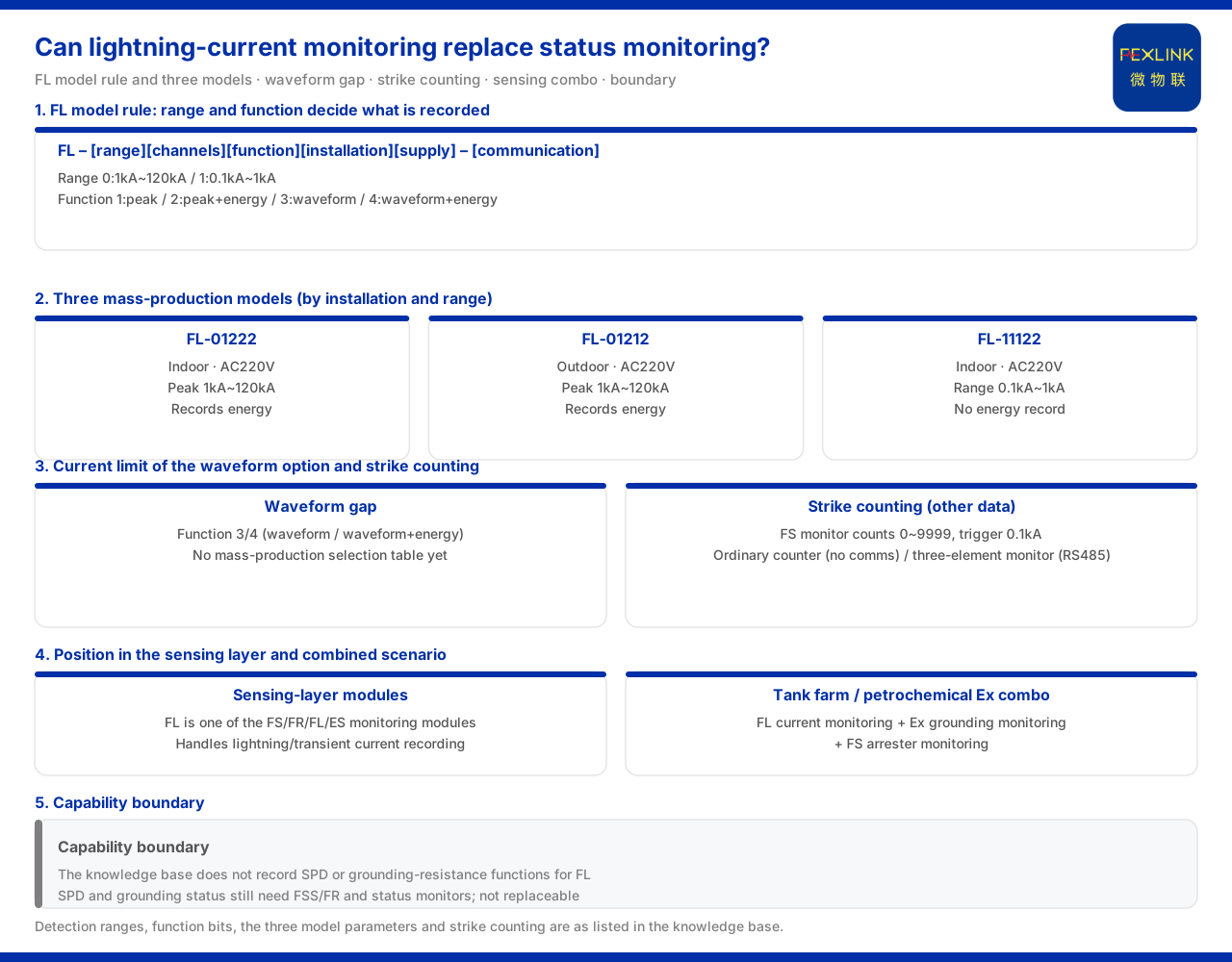
The model rule of the FL lightning current / transient current monitor is "FL–[detection range][channels][function][installation method][power supply]–[communication]". Here the detection range is 0:1kA~120kA and 1:0.1kA~1kA; the functions are 1:peak, 2:peak plus energy, 3:waveform and 4:waveform plus energy. The detection range and function position together determine what is recorded: the detection range decides how large a current event can be captured, while the function position decides whether what is recorded is the peak, the peak and energy, or the waveform. Putting these two items together makes clear the positioning of lightning current monitoring — it is a record of "what current event happened", not an acquisition of "what state the device is in now". The former faces events, the latter faces state, and this is exactly the starting point of the boundary question.
2. Three mass-production models
The FL model table in the knowledge base lists three models. FL-01222 is indoor installation, AC220V supply, peak range 1kA~120kA, with energy recording supported; FL-01212 is outdoor installation, AC220V supply, the same peak range of 1kA~120kA, with energy supported; and FL-11122 is indoor installation, AC220V supply, with a range of 0.1kA~1kA and no energy recording. The differences among the three focus on installation method and range: the model for large currents takes 1kA~120kA, while the model for weak transient currents takes 0.1kA~1kA. In selection, whether the site needs to record a large-current event such as the main discharge of a lightning strike or a smaller transient current directly determines which range tier applies.
3. The current limitation of the waveform option
The function positions include waveform (3) and waveform plus energy (4). It should be noted that the knowledge base, in its known information gaps, explicitly states that the waveform-option FL models (functions 3/4) currently have no mass-production selection table. In other words, the waveform function currently has a limitation in selection basis: although the model rule lists waveform as an optional function, the mass-production model table does not cover the waveform option. If a project needs waveform recording, it should, per the knowledge base's basis, state that this option currently has no mass-production selection table, rather than directly assuming a stock model from the model rule. Only by stating this gap clearly can one avoid equating "a function present in the rule" with "a model currently selectable" during selection.
4. The relationship between lightning-strike counting and lightning current monitoring
Alongside lightning current event recording, there is also a function such as lightning-strike counting. In the knowledge base, the lightning-strike counting parameter of the FS surge protective device monitor (e.g., FS-00011-R) is 0~9999 times, with a minimum trigger of 0.1kA; the model table of the FSP SPD lightning-protection base (e.g., FSP-21000-R) also includes a lightning-strike counting function. In addition, the supporting system also has an ordinary surge counter (no communication) and a three-element SPD monitor (counting plus breaker status plus SPD status, RS485). This shows that "count" and "event record" are two different kinds of information: the count gives the number of occurrences, while lightning current monitoring gives the magnitude or waveform of the event. Both are related to lightning strikes, but what they record differs, and they cannot substitute for each other.
5. Its position in the perception layer and combined scenarios
The knowledge base classifies the FL lightning current / transient current monitor into the perception layer of the monitoring system, as one of the monitoring modules of the perception layer. In the "tank farm / petrochemical lightning and explosion protection" scenario, FL lightning current monitoring is recommended in combination with explosion-proof grounding monitoring and FS surge protective device monitoring. From this combination it can be seen that lightning current monitoring is one link placed alongside other monitoring in the scheme, rather than the only acquisition item: it is responsible for lightning current events, explosion-proof grounding monitoring for grounding state, and FS surge protective device monitoring for SPD state. The three assume different acquisition objects in the same scenario and appear in combination, which precisely shows that they are complementary rather than substitutive.
6. The boundary: what lightning current monitoring does not replace
Back to the core question: what lightning current monitoring can do and what it cannot replace. The knowledge base does not record that the FL has surge protection (SPD) or grounding resistance measurement functions. In the division of capabilities in the knowledge base, surge protection is carried by the FSS intelligent surge protective device and the YSE series surge protective devices, grounding resistance measurement is carried by the FR grounding resistance monitor, and the FL only carries the monitoring and recording of lightning current / transient current. Therefore, lightning current monitoring cannot replace SPD state monitoring, nor can it replace grounding state monitoring. If lightning current monitoring is taken as "all of lightning-protection monitoring", one would miss state information directly related to protection effectiveness, such as whether the device has degraded and whether the grounding is reliable.
7. Stating the boundary clearly
Reducing the above threads to one judgment: lightning current monitoring is an event-recording capability, while state-type monitoring is a state-acquisition capability, and the two are carried by different products in the knowledge base. In selection, if the goal is to record lightning current events, the landing point is the FL lightning current / transient current monitor, determined position by position through detection range, function, installation method and power supply, while noting the gap that the waveform option currently has no mass-production selection table; if the goal is to know the SPD or grounding state, state-type monitoring products must be configured separately. The knowledge base does not give a conversion or substitution relationship between lightning current monitoring and state monitoring; the above boundary is induced from the division of capabilities among the various products.
Scope and limitations
First, this article only restates content listed in the product knowledge base, and its factual boundary is limited to the model rule and model table of the FL lightning current / transient current monitor, the record of the waveform-option information gap, the lightning-strike counting parameters of the FS and FSP, the supporting counter and monitor entries, the perception-layer division of the monitoring system and the tank-farm scenario combination.
Second, the knowledge base does not record that the FL has surge protection (SPD) or grounding resistance measurement functions; the statement about "cannot replace" in this article is induced from the knowledge base's division of capabilities for surge protection and grounding measurement, and does not mean that the knowledge base gives a formal judgment of substitution.
Third, the detection ranges 0:1kA~120kA and 1:0.1kA~1kA, the functions 1/2/3/4, the installation method and range of the three models, and the lightning-strike counting 0~9999 times with a minimum trigger of 0.1kA are all based on the knowledge base's stated basis, and this article does not infer the specific configuration of unlisted models from them.
Fourth, that the waveform option (functions 3/4) currently has no mass-production selection table is listed in the knowledge base's known information gaps, and this article does not infer the timing or scope of future selectability for this option.
Fifth, this article does not constitute a commitment to the monitoring effect or on-site performance of any specific project; actual capability is subject to the latest product documentation and project scheme.