Direct answer
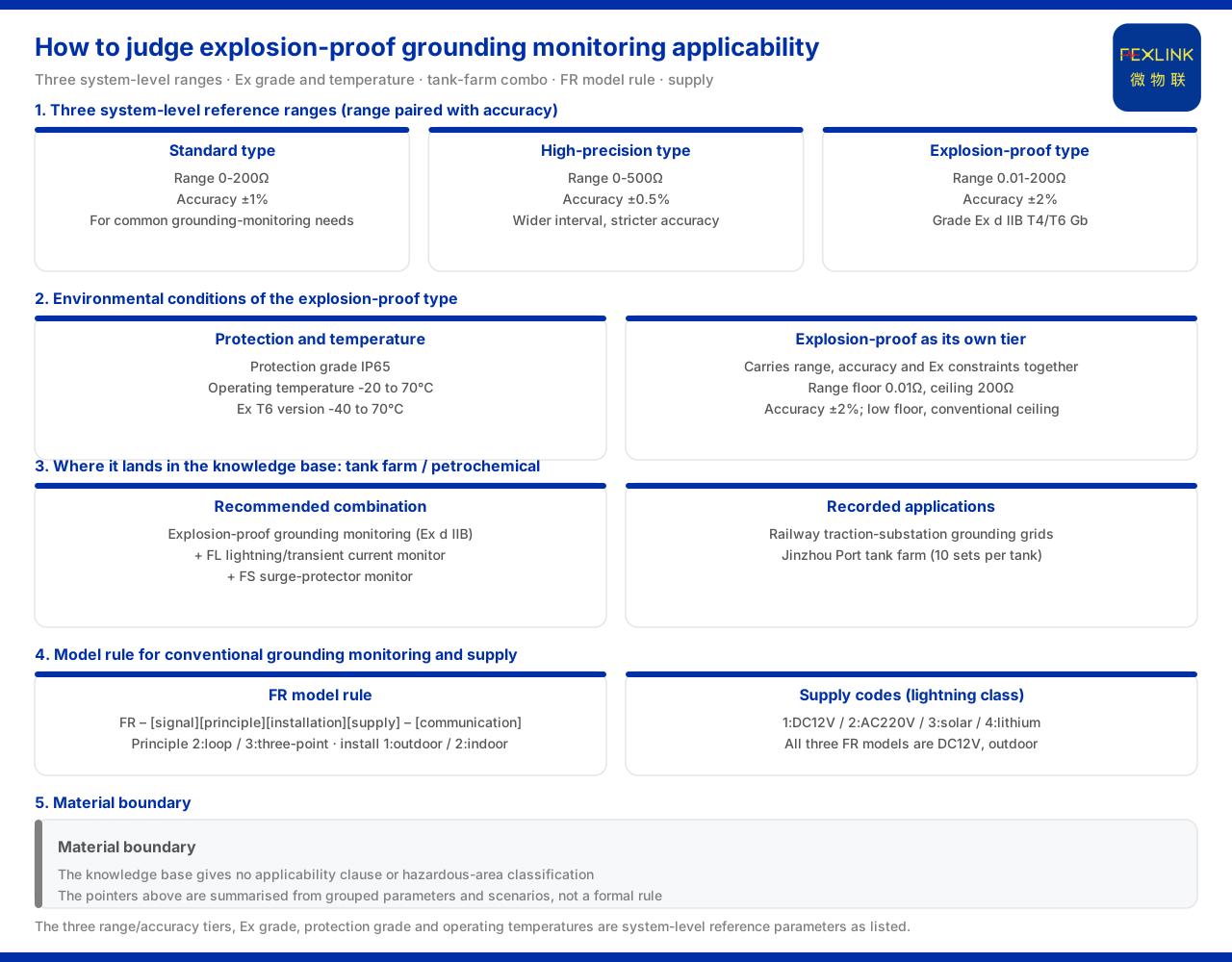
The product knowledge base gives reference parameters for the monitoring unit of the grounding resistance monitoring system in three tiers: standard type 0-200Ω (±1%), high-precision type 0-500Ω (±0.5%) and explosion-proof type 0.01-200Ω (±2%). Among these, the explosion-proof type occupies its own tier and carries the explosion-proof rating Ex d IIB T4/T6 Gb, with the operating temperature of the T6 model reaching -40~70℃. The scenario in which the knowledge base recommends explosion-proof grounding monitoring is "tank farm / petrochemical lightning and explosion protection", whose recommended combination is explosion-proof grounding monitoring (Ex d IIB) plus FL lightning current monitoring plus FS surge protective device monitoring. In other words, to judge whether explosion-proof grounding monitoring is needed, one can start from two clues in the knowledge base: first, whether the site is a tank farm, petrochemical or similar place with flammable and explosive risk; second, whether the chosen monitoring unit needs the Ex d IIB T4/T6 Gb explosion-proof rating and the corresponding wide temperature range. It should be specially noted that the knowledge base does not give a written "applicable conditions" clause of judgment; the two clues above are induced from the parameter sets and scenario combination.
1. The position of the explosion-proof type among system-level parameters
Among the system-level reference parameters of the grounding resistance monitoring system, the range and accuracy of the monitoring unit appear as a set. The standard type is 0-200Ω (±1%), the high-precision type is 0-500Ω (±0.5%), and the explosion-proof type is 0.01-200Ω (±2%). The three tiers stand side by side, showing that the explosion-proof type is not a simple replacement of the standard or high-precision type but forms a set of its own in range start, upper limit and accuracy: its lower range limit is as low as 0.01Ω, its upper limit is 200Ω, and its accuracy is ±2%. In selection, if the site is sensitive to small resistance changes, the low range start of the explosion-proof type is a usable feature; for ordinary grounding-grid resistance monitoring, the standard and high-precision types each already have a corresponding tier.
2. Environmental conditions: protection rating and operating temperature
The protection rating of the grounding resistance monitoring system is IP65, and the operating temperature is -20~70℃; the operating temperature of the explosion-proof T6 model extends down to -40~70℃. This set of conditions, together with range and accuracy, forms the parameter portrait of the explosion-proof type. IP65 indicates that the system is designed as dust-proof and splash-proof; -20~70℃ is the regular operating temperature, while the T6 model extends the low-temperature end to -40℃. For tank farms and petrochemical plant areas in cold regions or with large day-night temperature differences, whether the low-temperature end suffices directly affects selection; the explosion-proof T6 model is precisely what sets this item apart. In other words, the applicable conditions of the explosion-proof type lie not only in the "hazardous area" dimension but also in the temperature dimension: the operating-temperature table distinguishes the explosion-proof T6 model from the regular model.
3. The scenario landing point in the knowledge base: tank farms and petrochemicals
Among the typical application scenarios in the knowledge base, the recommended product combination for "tank farm / petrochemical lightning and explosion protection" is explosion-proof grounding resistance monitoring (Ex d IIB) plus the FL lightning current / transient current monitor plus the FS surge protective device monitor. This is the scenario combination in which the knowledge base explicitly lists explosion-proof grounding monitoring as a recommended item. It shows the landing point of explosion-proof grounding monitoring: in tank farms and petrochemical sites with flammable and explosive risk, grounding monitoring is not configured in isolation but appears in combination with lightning current monitoring and surge protective device monitoring. The combination also suggests that the judgment of explosion-proof selection is not made by looking at a single device but by asking whether the whole monitoring scheme needs to obtain grounding, lightning current and SPD state within an explosion-proof area.
4. The model rule for conventional grounding monitoring
What follows up conventional scenarios is the FR grounding resistance monitor (e.g., FR-01311-R). The model rule given by the knowledge base is "FR–[signal acquisition][detection principle][installation method][power supply]–[communication]", where the detection principle is 2:loop method and 3:three-point method; installation is 1:outdoor and 2:indoor; and signal acquisition 01 is grounding-grid resistance. The model table lists the FR grounding resistance monitor (FR-01311-R/Z/E), all of which are DC12V, outdoor installation and three-electrode measurement, with an aluminum housing of 204×202×72mm. This rule encodes the detection principle, installation method and power supply position by position. The division of labor between the explosion-proof type and the conventional type is reflected in the knowledge base as the clue "the explosion-proof tier for explosion-proof scenarios, the FR series models for conventional scenarios".
5. Grounding-monitoring scenarios already applied
Under the grounding resistance monitor entry, the knowledge base notes that this series has been applied to on-line grounding-grid monitoring of railway traction substations and to projects such as the Jinzhou Port tank farm (10 sets per tank). This record links conventional grounding monitoring with the tank-farm scenario: the tank farm shows both a deployment quantity of 10 sets of grounding monitoring per tank and a scenario combination in which explosion-proof grounding monitoring is listed as a recommended item. This shows such places have a real demand for grounding monitoring, and the explosion-proof type is precisely the tier oriented to such places. It should be noted that the above is an application record listed in the knowledge base, and this article does not infer how other projects should be configured from it.
6. Power supply is an independent selection dimension
The power supply of lightning-protection products is encoded in the knowledge base as 1:DC12V, 2:AC220V, 3:solar and 4:lithium battery. Grounding monitoring belongs to lightning-protection products, and power supply is a dimension to be confirmed in selection. The three models listed in the FR series model table are all DC12V, while lightning-protection products also offer options such as AC220V, solar and lithium battery. This means that in explosion-proof scenarios the power supply must likewise be taken into account: whether power is conveniently available on site and whether solar or lithium-battery supply is required both affect the final configuration. Power supply stands alongside range, accuracy, explosion-proof rating and operating temperature, forming the dimensions to be confirmed one by one in the selection of explosion-proof grounding monitoring.
7. How to judge the applicable conditions
Bringing the clues together, the judgment of explosion-proof grounding monitoring can unfold in the following order: first see whether the site is a tank farm, petrochemical or similar place with flammable and explosive risk, which is the direction given by the knowledge base's scenario combination; then see whether the monitoring unit needs the Ex d IIB T4/T6 Gb explosion-proof rating and whether the low-temperature end of the operating temperature needs to reach -40℃; then determine the tier among standard, high-precision and explosion-proof by range and accuracy, with the explosion-proof type corresponding to 0.01-200Ω (±2%); and finally confirm power supply, installation and communication conditions. It should be emphasized that the knowledge base does not give a clause for judging "applicable conditions", a hazardous-area classification method or corresponding standard clauses; the above order merely organizes the parameters and scenarios already listed in the knowledge base for checking item by item during selection, rather than being a judgment procedure specified by the knowledge base.
Scope and limitations
First, this article only restates content listed in the product knowledge base, and its factual boundary is limited to the system-level reference parameters of the grounding resistance monitoring system, the protection rating and operating temperature, the tank farm / petrochemical lightning and explosion protection scenario combination, the FR series model rule and applied records, and the power-supply codes for lightning-protection products.
Second, the knowledge base does not give a clause for judging the "applicable conditions" of explosion-proof grounding monitoring, a hazardous-area classification method or corresponding standard clauses; the application direction in this article is induced from grouped parameters such as range, explosion-proof rating and operating temperature together with the scenario combination, and does not mean that the knowledge base provides a formal judgment rule.
Third, the explosion-proof type's 0.01-200Ω (±2%), Ex d IIB T4/T6 Gb and T6 operating temperature -40~70℃, the protection rating IP65, and the standard type's 0-200Ω (±1%) and high-precision type's 0-500Ω (±0.5%) are all based on the knowledge base's stated basis, and this article does not extend them into a guarantee for any site or any model.
Fourth, the on-line grounding-grid monitoring of railway traction substations and the 10 sets per tank at the Jinzhou Port tank farm are application records listed in the knowledge base, and this article does not infer from them the configuration quantity or form that other projects should adopt.
Fifth, this article does not constitute a commitment to the applicability of explosion-proof certification, deployment effects or on-site performance of any specific project; actual conditions are subject to the latest product documentation, the project scheme and on-site safety requirements.