Direct answer
In the Micro-IoT product knowledge base, the intelligent surge protective device and the conventional surge protective device (SPD) belong to two different product lines: the intelligent surge protective device belongs to the in-house intelligent lightning-protection line, while the conventional SPD belongs to the outsource-supported YSE series surge protective devices line. The starting point for selection therefore differs. The FSS intelligent surge protective device (e.g., FSS-24100) carries its own display and leakage-current monitoring, so the device state is given by the unit itself; the ordinary surge counter of the YSE series, however, is recorded in the knowledge base as "no communication" and does not produce a readable state output of its own, so a separate monitoring product is required. In other words, the first question in choosing between an intelligent and a conventional type is "does this kind of device carry state and communication by itself"; if device-level state and networking are required, the landing point given by the knowledge base is the FSS intelligent surge protective device, not an outsource-supported conventional SPD.
1. Two product lines: in-house intelligent lightning protection and outsource-supported SPDs
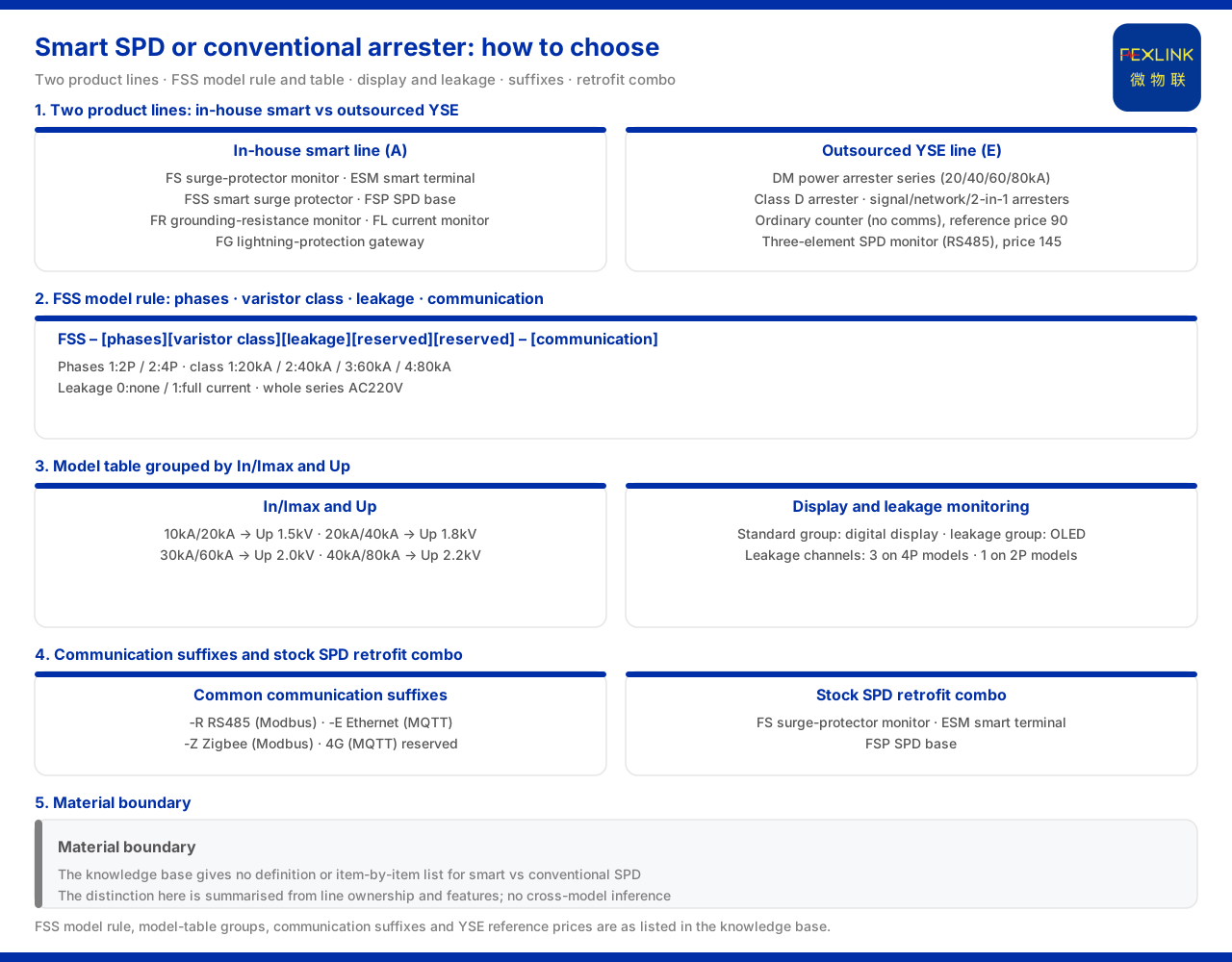
The product knowledge base divides lightning-protection products into two lines. One is "intelligent lightning protection", covering the FS surge protective device monitor (e.g., FS-00011-R), the ESM intelligent lightning-protection monitoring terminal (e.g., ESM-21001-R), the FSS intelligent surge protective device, the FSP SPD lightning-protection base (e.g., FSP-21000-R), the FR grounding resistance monitor (e.g., FR-01311-R), the FL lightning current / transient current monitor (e.g., FL-01222-R) and the FG lightning-protection smart gateway. The other is "surge protective devices (outsource-supported YSE series)", covering power, signal, network and two-in-one SPDs, plus surge counters and three-element SPD monitors. The intelligent SPD is an in-house product of the former line, while the conventional SPD is an outsource-supported product of the latter. The first dividing line in selection therefore falls on this in-house versus outsourced ownership: at the same protection point, one may choose either an in-house intelligent device or an outsourced conventional SPD plus a monitoring combination.
2. The criterion for "intelligent": display and leakage-current monitoring
To judge whether a device belongs to the "intelligent" class, the knowledge base gives functional items rather than a term definition. The model table of the FSS intelligent surge protective device is grouped into four sets by In/Imax and Up: 10kA/20kA corresponds to Up 1.5kV, 20kA/40kA to Up 1.8kV, 30kA/60kA to Up 2.0kV and 40kA/80kA to Up 2.2kV. Among these, the standard model group uses a digital-tube display, while the leakage-current model group uses an OLED display and includes leakage-current monitoring — 3 channels for the 4P type and 1 channel for the 2P type. That is, the intelligent device builds "visible state" directly into the unit: it has both a display and leakage-current monitoring channels. This item is the watershed between it and devices without a state output in selection: if the device's working state must be read directly on the unit, the intelligent model table already lists this capability under its functions.
3. Where the state of a conventional SPD comes from
The outsource-supported YSE series surge protective devices cover the new-generation power SPD DM series (single-phase/three-phase, 20/40/60/80kA), the class-D power SPD, and signal/network SPDs. In the supporting system, the knowledge base records two kinds of state schemes, non-communicating and communicating: the ordinary surge counter (no communication) has a reference price of 90, while the three-element SPD monitor (counting plus breaker status plus SPD status, RS485) has a reference price of 145. The former has no communication of its own, whereas the latter can output state over RS485. This shows that a conventional SPD is not incapable of obtaining state; rather, its state either rests on a non-communicating counter or must be supplemented by a communicating monitor. If a conventional SPD is retained in selection, the state capability must be traded off between these two supporting items: whether to read only the number of operations, or to read the breaker status and SPD status as well.
4. How the model rule encodes "intelligence"
The model rule of the FSS intelligent surge protective device is "FSS–[poles][varistor class][leakage][reserved][reserved]–[communication]". Here the poles are 1:2P and 2:4P; the varistor classes are 1:Imax 20kA, 2:40kA, 3:60kA and 4:80kA; the leakage item is 0:none and 1:full current; and the whole series is supplied at AC220V. The "leakage" position in the model code echoes the "intelligent" positioning of the product line: whether leakage-current monitoring is included is written directly into the model, while the varistor class raises the Imax ceiling to 80kA. The model rule encodes intelligent capability into the part number, so selection no longer relies on supplementary notes to identify it.
5. Communication and networking: another dividing line for the intelligent type
The general suffix rules in the product knowledge base specify that -R is RS485 (Modbus), -E is Ethernet (MQTT) and -Z is Zigbee (Modbus), with 4G (MQTT) optionally available (reserved) for some products. The whole FSS series supports RS485 for communication, with Zigbee and Ethernet selected by suffix. This means the intelligent SPD can not only present state on the unit but also connect to the network with the chosen suffix. Where device state must be fed into a system, the intelligent type has a "built-in entry" in the communication dimension; in the supporting system of a conventional SPD, by contrast, only the three-element SPD monitor explicitly carries RS485. If "can it be networked" is made a selection condition, the difference between the two lines in this item becomes visible: one has communication on the device itself, the other pairs the device with a communicating supporting item.
6. The combination given by the retrofit scenario
In the scenario "SPD state monitoring (retrofit of existing SPDs)", the knowledge base recommends the combination of the FS surge protective device monitor, the ESM intelligent lightning-protection monitoring terminal and the FSP SPD lightning-protection base. That is, when an existing conventional SPD on site cannot be replaced yet state monitoring is required, the knowledge base's landing point is not to modify the SPD unit but to cover the state monitoring of the existing SPD with three intelligent monitoring products. This combination differs from the "intelligent SPD" case in that the former is a supplementary implementation over existing devices, while the latter directly selects a device that carries state at the time of new-build selection. The two paths solve a similar problem from different starting points — one begins from existing assets, the other from new devices.
7. Reducing the choice to one sentence
Bringing the above threads together, the starting point of selection can be reduced to one sentence: first ask whether this kind of device should carry state and communication by itself. If yes, choose the FSS intelligent surge protective device within the intelligent lightning-protection line and determine it position by position through poles, varistor class, leakage and communication suffix; if not, or if the device cannot be replaced in an existing system, take the combination of an outsource-supported YSE SPD plus monitoring products, with the state supplemented by the communicating three-element SPD monitor or by intelligent monitoring products. It should be noted that the knowledge base does not give a term definition or an item-by-item comparison table for "intelligent SPD" versus "conventional SPD"; the above judgment is induced from the records of product-line ownership, model functional items and supporting state schemes.
Scope and limitations
First, this article only restates content listed in the product knowledge base, and its factual boundary is limited to the two product lines of intelligent lightning protection and outsource-supported SPDs, the model rule and model table of the FSS intelligent surge protective device, the general communication suffixes, the YSE series supporting items and the existing-SPD retrofit combination.
Second, the knowledge base does not give a term definition or an item-by-item comparison table for "intelligent SPD" versus "conventional SPD"; the distinction in this article is induced from existing entries and does not mean that the knowledge base provides a formal definition of these two terms.
Third, statements such as the whole FSS series being supplied at AC220V, the varistor class reaching a maximum Imax of 80kA, the leakage-current model having 3 channels for the 4P type and 1 channel for the 2P type, and the standard model using a digital-tube display while the leakage-current model uses an OLED display are all based on the knowledge base's stated basis, and this article does not infer the specific configuration of unlisted models from them.
Fourth, the reference prices of the YSE series supporting items are for cost reference only, and this article does not infer transaction prices, availability or substitution relationships from them.
Fifth, this article does not constitute a commitment to the selection result or on-site performance of any specific project; actual capability is subject to the latest product documentation and project scheme.