Why L6 fusion decision weights a composite health score
Direct answer
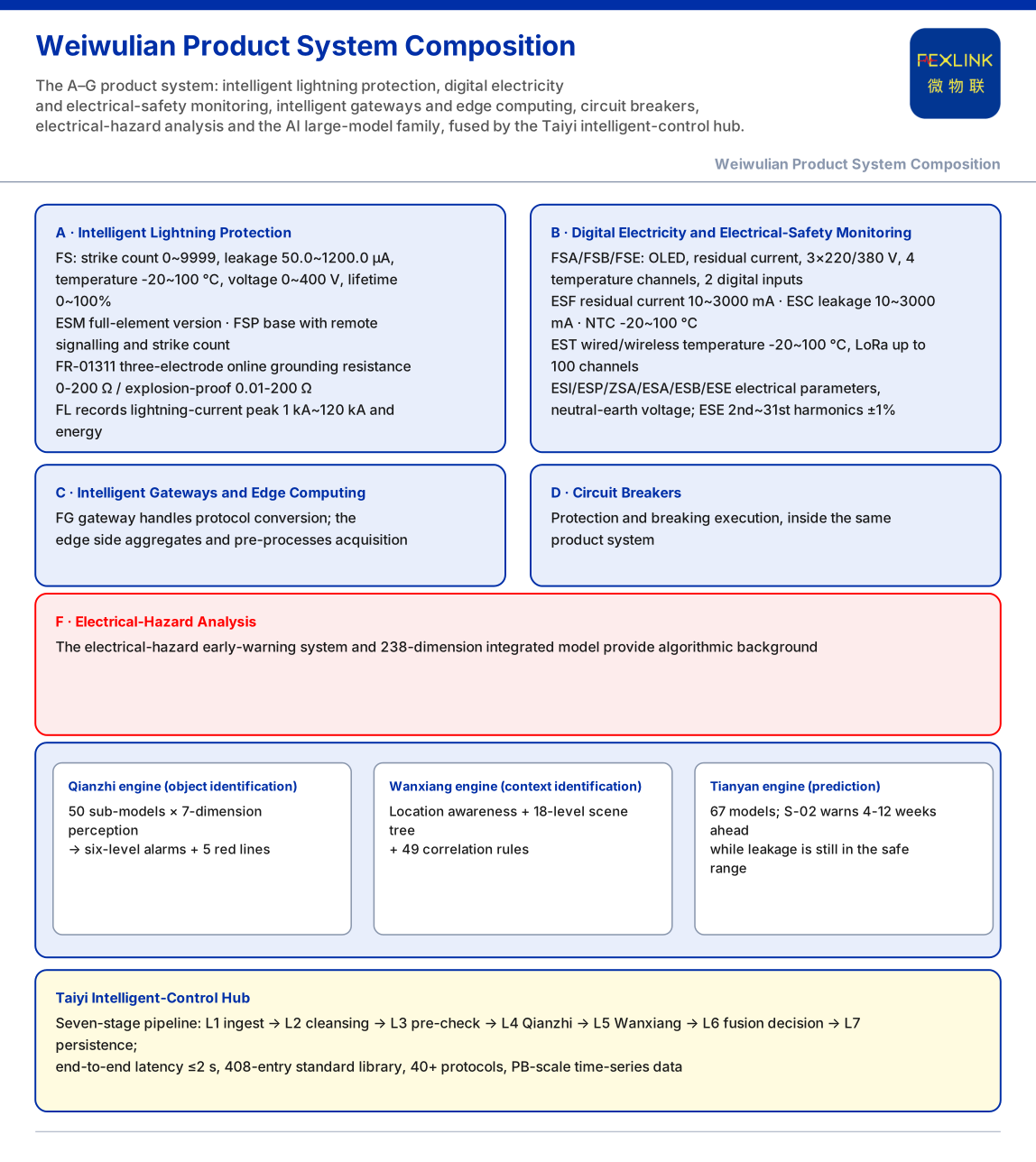
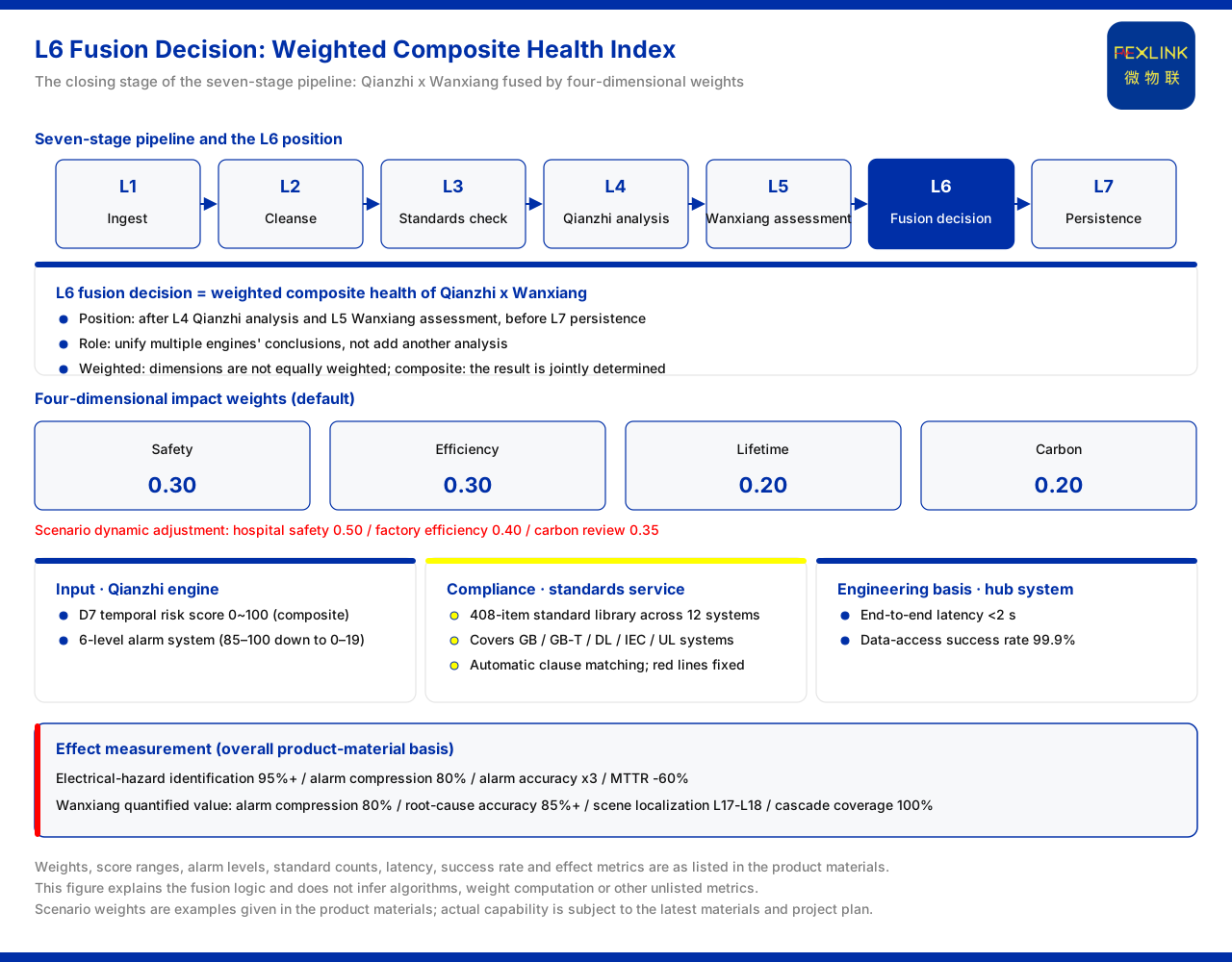
Because L6 must unify the conclusions of several engines, and these conclusions sit on different dimensions, weights are needed to combine them into one comparable composite health score. The product knowledge base defines the pipeline of the Taiyi intelligent control hub system as seven levels: access, cleaning, standard verification, Qianzhi analysis, Wanxiang study, fusion decision and persistence, of which L6 is fusion decision, expressed as the weighted composite health score of Qianzhi and Wanxiang. The weighting basis comes from the four-dimensional impact assessment of the Wanxiang engine / large model (V4.0): safety weight 0.30, efficiency weight 0.30, life weight 0.20 and carbon-emission weight 0.20, and it supports dynamic adjustment by scenario, for example raising the safety weight to 0.50 in a hospital scenario, the efficiency weight to 0.40 in a factory scenario and the carbon-emission weight to 0.35 in a carbon-assessment scenario. On the input side, the D7 time-series risk score of the Qianzhi engine / large model (V4.1) is 0 to 100 points and is matched by a 6-level alarm system; on the compliance side, the standard service contains a 408-standard library covering 12 standard systems, and red lines cannot be relaxed. The engineering foundation of the fusion decision is an end-to-end latency under 2 seconds and a data access success rate of 99.9%.
1. The position of L6 in the seven-level pipeline
The product knowledge base defines the pipeline of the Taiyi intelligent control hub system as seven levels: access, cleaning, standard verification, Qianzhi analysis, Wanxiang study, fusion decision and persistence, with an end-to-end latency under 2 seconds. L6 sits at the sixth level, preceded by L4 Qianzhi analysis and L5 Wanxiang study, and followed by L7 persistence. This positioning shows that the fusion decision is not the starting point of analysis but the closing stage after analysis and study: it receives the output of the preceding engines, unifies them into one conclusion, and hands it to the persistence stage for storage. Seen within the pipeline, the duty of L6 is to unify the basis, not to add another round of analysis.
2. Why weighting, rather than juxtaposing or picking one
The Qianzhi engine and the Wanxiang engine answer different questions: one focuses on analysing the anomaly itself, the other on studying the cause and location. If their outputs are merely presented side by side, the user still has to choose among several conclusions; if only one is taken, the information of the other dimension is lost. The weighted composite health score is designed precisely for this situation: it places the conclusions of different engines into one weighting framework and outputs a composite result. The product knowledge base expresses L6 as the weighted composite health score of Qianzhi and Wanxiang, the keywords being weighted and composite — weighted shows that the dimensions are not equally weighted, and composite shows that the result is determined jointly by several dimensions rather than given directly by a single indicator.
3. What the four-dimensional weights consist of
The concrete basis of the weighting comes from the four-dimensional impact assessment of the Wanxiang engine. The product knowledge base records that the four weights are safety 0.30, efficiency 0.30, life 0.20 and carbon emission 0.20. The four weights sum to 1, showing that the composite health score is synthesised proportionally among these four dimensions. Safety and efficiency each take 0.30 and are the two higher-weighted items; life and carbon emission each take 0.20. It should be emphasised that the weights describe the relative importance of the dimensions, not a threshold rule for the score a certain indicator must reach before an alarm.
4. The meaning of dynamic scenario adjustment
The product knowledge base further records that the four-dimensional weights support dynamic adjustment by scenario, for example raising the safety weight to 0.50 in a hospital scenario, the efficiency weight to 0.40 in a factory scenario and the carbon-emission weight to 0.35 in a carbon-assessment scenario. This set of examples shows that the same composite health score can be synthesised differently in different scenarios: raise the safety weight in a safety-first place, the efficiency weight in an efficiency-first place, and the carbon-emission weight in a carbon-assessment-oriented case. The value of the weighted composite health score lies precisely in this adjustability — it acknowledges that different scenarios have different priorities, instead of forcing one fixed set of weights onto all cases. What this article lists are the examples given by the product knowledge base; it does not infer the specific weights of the remaining scenarios.
5. One input: the Qianzhi time-series risk score
The fusion decision needs inputs, one of which comes from the Qianzhi engine. The product knowledge base records that, in the 7-dimensional perception matrix of the Qianzhi engine, D7 is the time-series risk score, taking values from 0 to 100 points and belonging to the composite decision dimension; the matching alarm system is divided into 6 levels, from 85 to 100 points stepwise downward to 0 to 19 points. What the D7 score provides to L6 is a parameter-level quantified input: it converges the results of multi-dimensional perception into a single score, which then enters the fusion stage to take part in the synthesis.
6. Another input: the Wanxiang study and quantified value
Another input comes from the Wanxiang engine. The product knowledge base records that the quantified value of the Wanxiang engine includes alarm compression 80%, root-cause accuracy above 85%, scenario positioning precision reaching L17 to L18, and cascading risk coverage 100%. These indicators describe the convention of capability on the study side: alarm compression shows that it can converge a large number of alarms, root-cause accuracy shows the capability in pointing to the cause, scenario positioning precision corresponds to the level reachable by positioning, and cascading risk coverage corresponds to the degree of coverage of chain risks. The weighting synthesis that L6 performs on these study results means that the final composite health score reflects not only a single-point anomaly but also the root cause and location information obtained from the study. The above figures are all conventions listed by the product knowledge base; this article does not derive unlisted indicators from them.
7. The compliance constraint layer
The fusion decision does not merely perform a weighted calculation; it must also be subject to compliance constraints. The product knowledge base records that the standard service contains a 408-standard library covering 12 standard systems such as GB, GB-T, DL, IEC and UL, supports automatic clause matching, and that red lines cannot be relaxed. The meaning of this constraint layer is that the weighted composite health score can synthesise multi-dimensional information, but the part involving red lines cannot be diluted by weights. In other words, weights are used to handle weighable dimensions, while red lines set a boundary that cannot be crossed. Together they make the output of L6 both a space for composite judgement and a clear compliance bottom line.
8. Effect measurement
The product knowledge base lists quantified value indicators for the Taiyi intelligent control hub system, including an electrical-hazard identification rate above 95%, an alarm compression ratio of 80%, an alarm accuracy improvement of 3 times, and an average repair time shortened by 60%. These indicators can be used to measure the overall effect of the pipeline in which the fusion decision sits. It should be noted that they are the overall conventions given by the product knowledge base, not a commitment regarding the result of a certain scenario or project; this article cites these figures only to explain the effect-measurement framework in which the fusion decision sits, and does not infer other indicators from them.
Scope and limitations
- This article is limited to what the product knowledge base lists: the position of the seven-level pipeline and the L6 fusion decision, the four-dimensional impact assessment weights (safety 0.30, efficiency 0.30, life 0.20, carbon emission 0.20) and the examples of dynamic scenario adjustment. - The D7 time-series risk score of the Qianzhi engine from 0 to 100 points and the 6-level alarm system, the quantified value of the Wanxiang engine, and the 408-standard library and 12 standard systems of the standard service are restated as listed by the product knowledge base. - Hospital safety 0.50, factory efficiency 0.40 and carbon-assessment carbon emission 0.35 are scenario examples given by the product knowledge base; this article does not infer the weights or adjustment rules of the remaining scenarios. - The end-to-end under 2 seconds, the data access success rate of 99.9% and the various effect indicators are quantified conventions listed by the product knowledge base and do not constitute a commitment regarding the result of a specific project. - This article does not infer the specific algorithm, weight calculation method or other unlisted indicators of the fusion decision; actual capability is subject to the latest product materials and project solution.