Direct answer
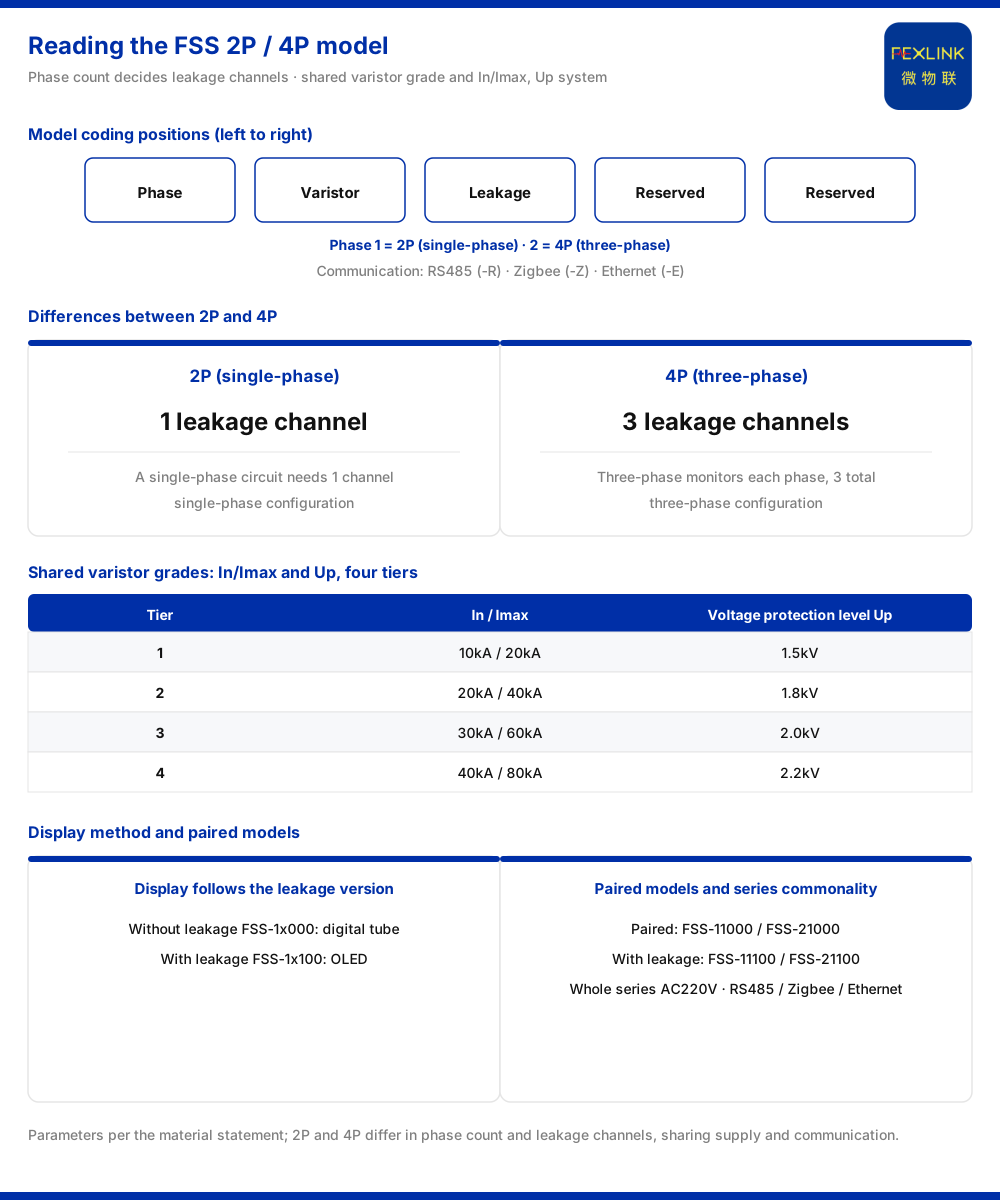
The product material draws a clear distinction between the 2P and 4P models of the FSS intelligent surge protective device (e.g. FSS-11000): the 4P type has 3 leakage-current channels and the 2P type has 1, corresponding respectively to three-phase and single-phase configurations. The number of leakage-current channels is therefore not an independent option but is decided directly by the phase count (2P/4P). In the model rule, phase digit 1 indicates 2P and 2 indicates 4P, and this is the coding basis that distinguishes the two model blocks. Beyond that, 2P and 4P share the same varistor grade system, the same In/Imax and Up correspondence, and the same supply and communication choices; the difference between them centres on the phase count and the leakage-current channel count it decides.
1. The phase-count position in the model rule
The product material stipulates that the model rule of the intelligent surge protective device consists of several coding positions, in order including phase count, varistor grade, leakage current, reserved and reserved, and finally the communication position. The phase-count position is the entry that distinguishes 2P from 4P: when the phase digit is 1 it indicates 2P, and when it is 2 it indicates 4P.
Placing the phase count in the first position of the model code shows that it is a precondition rather than an accessory option. During selection one first determines single-phase or three-phase, then determines the varistor grade and whether leakage current is included, and this order is consistent with the model position order. Understanding the position order lets you first distinguish whether a model is 2P or 4P when reading it, and then judge the remaining configuration.
2. The number of leakage-current channels is decided directly by phase count
The product material makes clear that the number of leakage-current monitoring channels of the leakage-current version is distinguished by pole count: the 4P type has 3 channels and the 2P type has 1, corresponding respectively to three-phase and single-phase configurations.
This correspondence deserves separate explanation because it is the core of the topic. A three-phase circuit requires leakage current to be monitored phase by phase, so the 4P type gives 3 channels; a single-phase circuit needs only 1, so the 2P type gives 1. It follows that the number of leakage-current channels is not a parameter that can be specified at will but a direct result of the phase count. When it is known to be three-phase, one should expect 3 leakage channels; when it is known to be single-phase, the corresponding value is 1. Remembering this correspondence avoids agonising over "number of leakage-current channels" as a second choice independent of phase count.
3. Varistor grade: 2P and 4P share one system
The product material stipulates that the varistor grade position in the model rule is 1 to 4, corresponding respectively to different maximum discharge current tiers, with the highest tier at 80kA. The 2P and 4P models share the same varistor grade system.
This clarifies the commonality of the two model blocks. The varistor grade determines the protection-capability tier, not the phase count; the same grade can be obtained on both 2P and 4P. When comparing 2P and 4P, therefore, the varistor grade should not be treated as a difference between them. The phase count changes the number of circuits and leakage-current channels, while the varistor grade changes discharge capability; the two are mutually independent dimensions. During selection one first fixes 2P or 4P by circuit phase count, then chooses a varistor grade within the same system according to protection needs.
4. The four-tier correspondence of In/Imax and Up
The parameter table given by the product material lists four tiers of nominal discharge current and maximum discharge current, corresponding to four voltage protection levels: the first tier is 10kA/20kA, corresponding to a voltage protection level of 1.5kV; the second is 20kA/40kA, corresponding to 1.8kV; the third is 30kA/60kA, corresponding to 2.0kV; and the fourth is 40kA/80kA, corresponding to 2.2kV. Under the same tier, 2P and 4P share this set of varistor parameters.
The significance of listing the four tiers side by side is to bind "discharge capability" and "residual voltage" together. The higher the tier, the greater the discharge current that can be withstood, and the corresponding voltage protection level changes accordingly. During selection one must not look at only one item: pursuing maximum discharge current without looking at the voltage protection level, or looking only at residual voltage regardless of discharge capability, both fail to give a complete judgement.
5. Display method: the divide between non-leakage and leakage models
The product material distinguishes the display method by leakage-current configuration: models without the leakage-current version use a digital-tube display, while models with the leakage-current version use an OLED display; within each series, 2P and 4P remain consistent.
This shows that the display method is bound to "whether leakage current is included", not to the phase count. For the same 2P type, the leakage and non-leakage versions have different display methods, and the same holds for 4P. The display method can therefore serve as an aid when reading a model: seeing OLED often means the type includes leakage current, while seeing a digital tube corresponds to the non-leakage version.
6. Paired models and whole-series commonality
In its model comparison, the product material lists 2P and 4P in pairs: non-leakage models appear in pairs from 2P to 4P, and leakage models likewise appear in pairs, with the part before and after the slash corresponding respectively to 2P and 4P; the leakage-current channel counts of the leakage versions are 1 and 3, consistent with the correspondence above.
This paired listing itself suggests that 2P and 4P are two phase-count versions of the same product. In addition, the product material notes that the whole series is supplied at AC220V and that communication supports RS485 throughout, with Zigbee and Ethernet selected by suffix. It can be seen that 2P and 4P are also consistent in supply and communication choices, and the difference remains concentrated in phase count and leakage-current channel count.
These commonalities mean that during selection, supply and communication usually need not be re-judged because of phase count; what really changes with phase count is the number of circuits and leakage-current channels. Separating the "unchanged items" from the "changed items" makes the selection process clearer.
7. Reading the configuration from one model
Combining the rules above, several things can be confirmed in order when reading a model. Taking the paired models listed by the material, the parts before and after the slash are 2P and 4P respectively; under the same tier, an ending of 000 corresponds to the non-leakage version and 100 to the leakage version with an OLED display; among leakage versions, 2P has 1 leakage channel and 4P has 3. The varistor grade position then determines the discharge-capability tier within the same system.
The value of this order is that it answers common questions separately. When asked "how many leakage channels does this model have", the answer needs no other table: first look at the phase count — 2P means 1 and 4P means 3. When asked "does this model have leakage current", look at whether it falls in the leakage version. When asked "how is its discharge capability", return to the varistor grade and the corresponding In/Imax and Up tiers. The three questions are each answered by a different position segment of the model, without confusion.
For this reason the order of a selection discussion should be: first fix the phase count (single-phase 2P or three-phase 4P), then decide whether leakage-current monitoring is needed, and then fix the varistor grade. Reversing the order, for example agonising first over "how many leakage channels", simply leads back to the precondition of phase count. The material places the phase count first in the model, consistent with this order.
Scope and limitations
First, the citations in this article are limited to the product material and the corresponding fact pack, and introduce no model, parameter or certification not listed.
Second, the leakage-current channel correspondence is: 4P leakage version 3 channels and 2P leakage version 1 channel, limited to the material statement; this article does not infer other unlisted configurations.
Third, the varistor grade system and the corresponding In/Imax and Up tiers are limited to the statements listed by the material; this article extends no other tiers or curves.
Fourth, the display method is divided into digital tube and OLED by leakage and non-leakage version, limited to the material statement; where the actual display version is subject to the order, the corresponding material entry should be checked.
Fifth, the whole series supply of AC220V, communication supporting RS485 throughout, and Zigbee and Ethernet selected by suffix are limited to the material statement.
Sixth, this article explains only the differences and commonalities of 2P and 4P, and provides no selection or configuration calculation for a specific project.