Photovoltaic inverter harmonic fingerprint identification
Direct answer
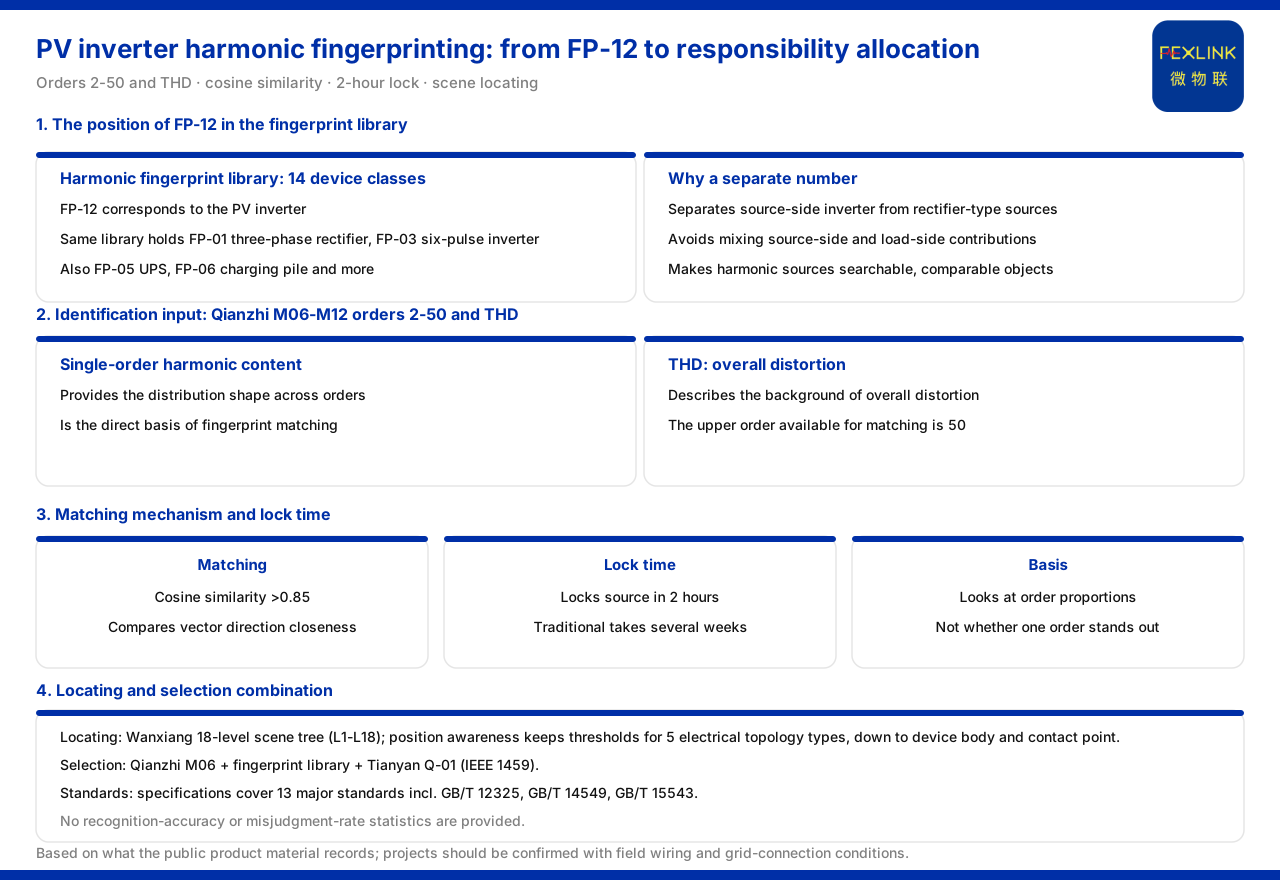
In source-side harmonic tracing, the photovoltaic inverter is represented by device fingerprint FP-12 in the harmonic fingerprint library. The knowledge base records that the harmonic fingerprint library contains 14 classes of equipment fingerprints, of which FP-12 corresponds to the photovoltaic inverter; the role of FP-12 is to distinguish source-side inverter harmonics from conventional rectifier-type harmonic sources. Identification matches with a cosine similarity greater than 0.85 and can lock the pollution source within 2 hours, whereas the traditional approach takes several weeks. The data input for identification comes from the 2nd-50th harmonics and THD covered by the Qianzhi M06 to M12 harmonic sub-models; the location result can land in the 18-level scene-location tree of the Wanxiang engine. For harmonic tracing and responsibility allocation, the selection comparison gives the combination of "Qianzhi M06 plus fingerprint library plus Tianyan Q-01 (IEEE 1459)".
1. The position of FP-12 in the fingerprint library
The knowledge base records that the harmonic fingerprint library contains 14 classes of equipment fingerprints, with FP-12 being the photovoltaic inverter. The same library also contains FP-01 three-phase rectifier, FP-03 six-pulse inverter, FP-05 UPS and FP-06 charging pile. Numbering these equipment types into the library one by one means that "which class of harmonic source this is" becomes a searchable, comparable object, rather than lumping source-side problems vaguely as "harmonic over-limit".
Listing the photovoltaic inverter separately as FP-12 matters for distinguishing the source side from the load side. The inverter is source-side equipment and its harmonic characteristics differ from conventional rectifier-type loads; using one broad class of "harmonic source" would mix the contribution of source-side inverters with that of load-side rectifier equipment. FP-12 allows source-side inverter harmonics to be attributed separately, which is the resolution needed for tracing in photovoltaic access scenarios.
2. Identification input: 2nd-50th orders and THD
Fingerprint matching needs the distribution data of each harmonic order as input. The knowledge base records that the harmonic convention in the Qianzhi M06 to M12 sub-models covers 2nd-50th harmonics and acquires THD at the same time. Harmonic fingerprint identification takes this individual harmonic content and total data as input.
The input falls into two classes: individual harmonic content provides the distribution shape of each order, and THD provides the overall distortion level. Fingerprint matching compares the distribution shape, so each order's content is the direct basis for matching, while THD describes the background. The coverage of 2nd-50th orders shows the upper limit usable for matching is the 50th order. This range is an analysis-side convention describing the harmonic sub-model's coverage, not the order index of any field device.
3. Matching mechanism: cosine similarity greater than 0.85
The knowledge base records that the harmonic fingerprint library matches with a cosine similarity greater than 0.85, and photovoltaic inverter harmonics are attributed to the FP-12 fingerprint through this similarity threshold. Cosine similarity compares the closeness of two feature vectors in direction and does not require point-by-point equality; therefore, as long as the overall shape of the measured harmonic distribution is close enough to the FP-12 fingerprint, exceeding the threshold gives a judgment of the corresponding device type.
A threshold of 0.85 is an engineering compromise between "rather under-report than misjudge easily": too low mixes sources of different nature, too high may miss real loads with slightly deviating shapes. For source-side inverters, the identification basis is not whether one order stands out but whether the proportional relationship among orders matches the shape of FP-12. Even if overall distortion is not high, it can still be attributed to FP-12 if the shape matches. This article only explains the matching mechanism and provides no recognition-accuracy or misjudgment-rate statistics, which the knowledge base does not list.
4. Timeliness: 2-hour locking versus several weeks
The knowledge base records that harmonic fingerprint identification can lock the pollution source within 2 hours, whereas the traditional approach takes several weeks. Source-side inverter harmonic tracing uses the same timeliness convention.
This difference comes from method. The traditional approach often relies on manual point-by-point investigation, device-by-device testing or offline analysis after long-term recording, and is therefore time-consuming; fingerprint identification identifies the device type first, and once the shape matches FP-12 the pollution-source scope narrows to that type, so verification need not exclude all loads one by one. Using the overall indicator for screening and the component indicator for fingerprint matching is the direct reason for shortening the locating time. The 2 hours and several weeks are conventions listed in the knowledge base, used to explain the method difference, and do not constitute a commitment to handling duration at a specific site.
5. Location: 18-level scene-location tree and position awareness
After identifying the device type, the result still needs to land at a specific position. The knowledge base records that the Wanxiang engine has an 18-level scene-location tree (L1 to L18) and position awareness, and position awareness maintains independent thresholds for 5 classes of electrical topology position types and can locate an alarm to the device body and the contact-point level. Source-side inverter harmonic tracing can land at this level.
The meaning of this capability is to advance from "which class of device" to "which unit and at which position". The same harmonic class carries different risks at different electrical positions, so position awareness maintains independent thresholds and risk models for different topology position types; the last two levels of the tree are the wiring-terminal and contact-point levels, refining location to the device body and contact point. For a photovoltaic plant, this lets harmonic attribution go beyond the type level and correspond to a specific position.
6. Selection combination and responsibility allocation
The product selection and AI capability comparison table of the knowledge base records that the selection combination for harmonic tracing and responsibility allocation is "Qianzhi M06 plus fingerprint library plus Tianyan Q-01 (IEEE 1459)". Source-side photovoltaic inverter harmonic identification falls into this combination.
This combination has three parts: Qianzhi M06 provides harmonic coverage and the data convention, the fingerprint library provides device-type identification, and Tianyan Q-01 handles responsibility allocation according to IEEE 1459. Putting the three together shows that "identifying which class of source" and "allocating responsibility" are adjacent but different links: the former answers where the source-side inverter's contribution comes from, the latter how it is allocated by the standard convention. The selection comparison gives a capability-matching relationship and does not commit to any specific project result.
7. Standard coverage
The knowledge base records that the technical specifications of the Qianzhi engine cover 13 major standards including GB/T 12325, GB/T 14549 and GB/T 15543. The GB/T 14549 cited in this article is a standard related to harmonics in public power grids and falls within its standard coverage. Standard coverage provides a basis source for harmonic limits and assessment.
Common misconceptions
The first is to group photovoltaic inverter harmonics with conventional rectifier-type sources, ignoring the distinguishing role of FP-12. The second is to take the identification basis as the magnitude of THD; the matching basis is the distribution shape compared by cosine similarity. The third is to take the 2-hour locking as a fixed duration achievable at any site; the convention explains the difference from the traditional approach. The fourth is to perform only fingerprint identification without position locating, ignoring that the 18-level scene-location tree and position awareness can land the result at the device body and contact-point level. The fifth is to conflate identification with responsibility allocation, which belong to different links in the selection combination.
Scope and limitations
First, this article restates only what the knowledge base lists: the harmonic fingerprint library contains 14 classes of equipment fingerprints, FP-12 is the photovoltaic inverter, and there are also types such as FP-01, FP-03, FP-05 and FP-06. Second, the matching mechanism is limited to the expression of cosine similarity greater than 0.85; this article does not provide statistical indicators such as recognition accuracy or misjudgment rate. Third, the timeliness convention is limited to locking the pollution source within 2 hours and the traditional approach taking several weeks, and does not constitute a commitment to the handling duration of a specific site. Fourth, the identification input is limited to the convention that Qianzhi M06 to M12 covers 2nd-50th harmonics and acquires THD; this range is an analysis-side convention, and the device-side orders and accuracy are limited to the records of the corresponding devices, with no conversion between the two. Fifth, the location capability is limited to the expression that the Wanxiang engine has an 18-level scene-location tree (L1 to L18) and position awareness maintaining independent thresholds for 5 classes of electrical topology position types. Sixth, the selection combination is limited to the expression "Qianzhi M06 plus fingerprint library plus Tianyan Q-01 (IEEE 1459)". Seventh, standard coverage is limited to the statements of the 13 major standards listed. Eighth, this article does not constitute a selection conclusion; specific projects should confirm each item together with field wiring, grid-connection conditions and compliance requirements.