How to build a device-level energy-consumption profile
Direct answer
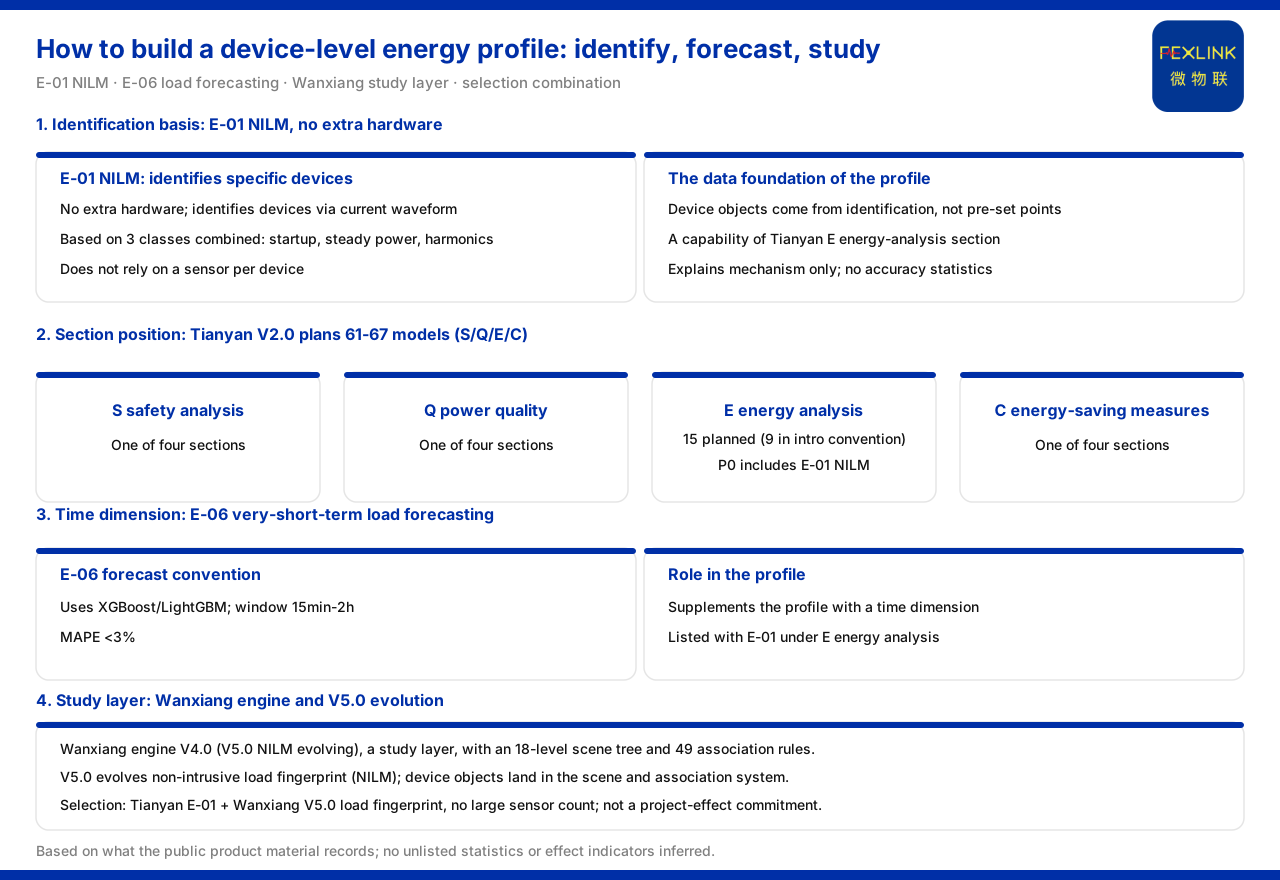
Without installing a large number of additional sensors, the path given by the knowledge base for building a device-level energy-consumption profile is the signature model E-01 NILM of the Tianyan engine. The model uses no additional hardware and identifies specific devices through current waveforms, on the basis of a combination of startup characteristics, steady-state power and harmonic characteristics; this forms the data foundation of the device-level energy-consumption profile. The identified device objects can land in the scene and association system of the Wanxiang engine for further study, and the V5.0 evolution direction of the Wanxiang engine further upgrades the non-intrusive load fingerprint. The selection comparison expresses this capability combination as "Tianyan E-01 plus Wanxiang V5.0 load fingerprint". That is, the profile is not built by stacking "one sensor per device" point by point, but by separating device objects from the total-circuit current waveform and then adding scene study and time-dimension prediction.
1. The identification basis of the profile: E-01 NILM
The knowledge base records that the signature model E-01 NILM of the Tianyan engine requires no additional hardware and identifies specific devices through current waveforms, with identification based on a combination of startup characteristics, steady-state power and harmonic characteristics. These three feature classes characterize different sides of a device's working process: startup characteristics correspond to the transient shape at device power-on, steady-state power to the power level during stable operation, and harmonic characteristics to the device's distribution shape in the frequency domain. Judging with the three combined is more robust than looking at a single feature, which also explains why it does not rely on installing a sensor for each device.
For an energy-consumption profile, this step is "identifying devices" rather than "measuring total electricity". The knowledge base expresses the capability of E-01 as "identifying specific devices", so the device objects of the profile come from the identification result rather than from pre-arranged point wiring. Note that this article only explains the mechanism and positioning of this capability and does not provide statistical indicators such as recognition accuracy, which the knowledge base does not list.
2. Which section E-01 belongs to
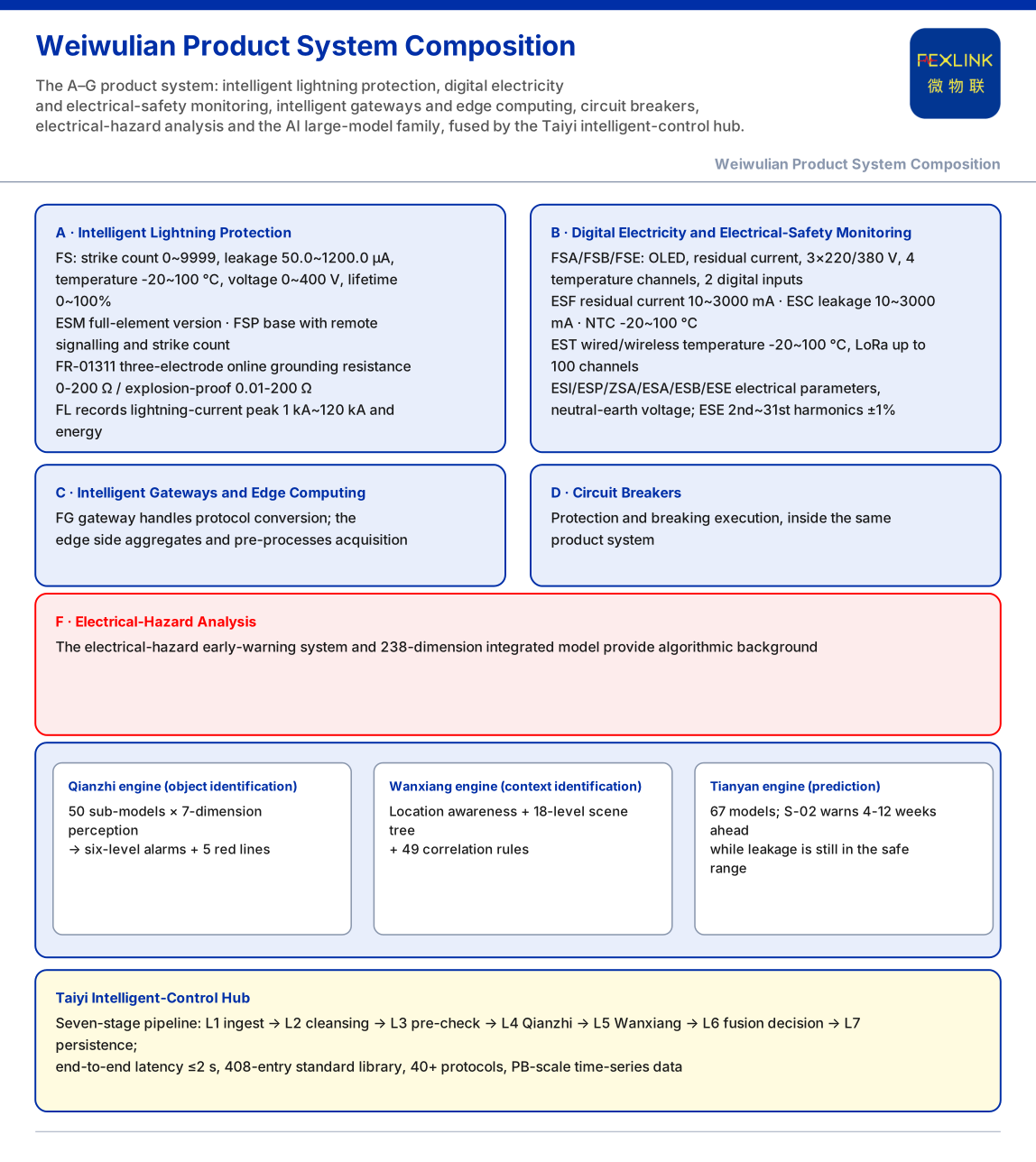
The knowledge base records that the Tianyan engine V2.0 is divided into four sections: S safety analysis, Q power quality, E energy analysis and C energy-saving measures, of which E energy analysis is planned at 15 items (9 under the document-introduction convention), and the P0 first release includes E-01 NILM. The device-level energy-consumption profile belongs to the capability of the E energy analysis section.
The section division shows the profile's position in the overall model system. E energy analysis focuses on "how much energy is used and where", and E-01 NILM handles precisely the device-level decomposition of "where". The knowledge base also records that the Tianyan engine V2.0 plans 61-67 models covering the four sections S, Q, E and C; E-01 is one of the first models to be implemented (P0 first release) in this plan. Placing the identification capability in the energy-analysis section shows that the profile output is a link in the energy-efficiency management chain rather than an isolated classification function.
3. Supplementing the time dimension: E-06 very-short-term load forecasting
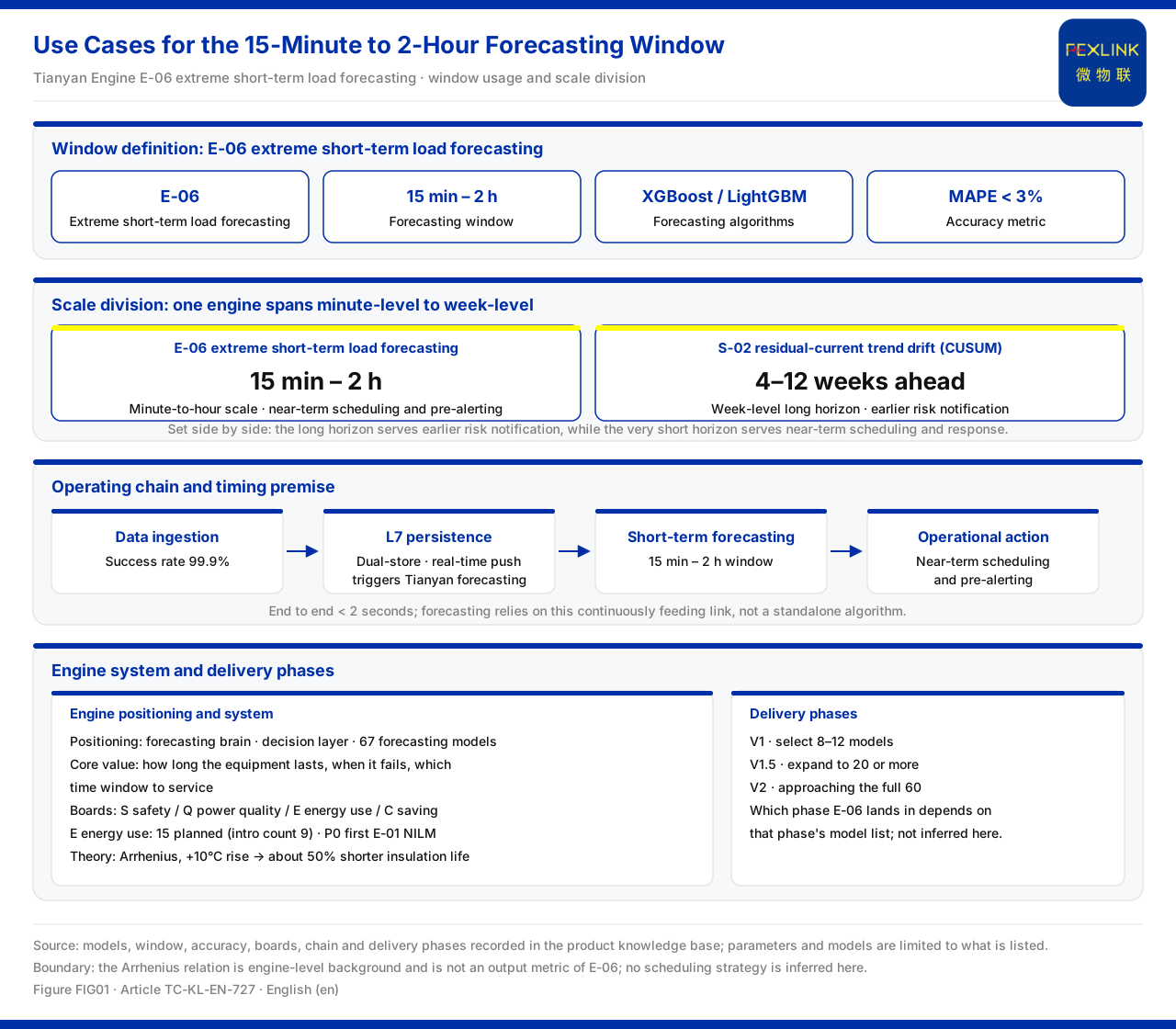
Knowing only "which device is using electricity now" is not enough; a profile usually also needs to answer "what happens next". The knowledge base records that the signature model E-06 very-short-term load forecasting of the Tianyan engine uses XGBoost/LightGBM, with a forecast window of 15 minutes to 2 hours and a MAPE of less than 3%. This load forecasting supplements the device-level energy-consumption profile with a time dimension.
The knowledge base lists E-01 NILM and E-06 together in the E energy analysis section, showing that the two are adjacent capability classes in the system: one identifies devices (spatial/object dimension) and the other forecasts load (time dimension). Taken together, the device-level energy-consumption profile has both the object information of "what device it is" and the time information of "how the short-term load changes". The MAPE of less than 3% and the window of 15 minutes to 2 hours are the convention description of the knowledge base for this forecasting model, used to define its scope of application.
4. The study layer: Wanxiang engine and V5.0 evolution
Beyond identification and forecasting, a framework for study is also needed. The knowledge base records that the version of the Wanxiang engine is V4.0 (V5.0 NILM evolving), positioned as the "scene-aware brain · study layer", with an 18-level scene tree and 49 association rules. The device objects in the device-level energy-consumption profile can land in this scene and association system for further study.
The knowledge base also records that the evolution direction of the Wanxiang engine V5.0 is to upgrade the non-intrusive load fingerprint (NILM), with related documents including the Wanxiang Engine Upgrade Technical Plan V5.0 and the Wanxiang_V5_NILM 100% Advancement Plan. This shows that NILM does not exist only as a single model on the Tianyan side but also appears in the evolution direction of the Wanxiang engine: E-01 on the Tianyan side handles identification, and the load fingerprint on the Wanxiang side continues to be upgraded in V5.0. The two threads converge, forming the framework of the device-level energy-consumption profile from identification to study.
5. Typical selection combination
The product selection and AI capability comparison table of the knowledge base gives the selection combination for non-intrusive load identification (NILM) as "Tianyan E-01 plus Wanxiang V5.0 load fingerprint". The device-level energy-consumption profile is built by this combination, without installing a large number of sensors.
This combination brings together the two threads above: E-01 provides device-identification capability, and the load fingerprint of Wanxiang V5.0 provides the evolving fingerprint capability. The selection comparison gives a capability-matching relationship, answering "which capabilities should be combined to build a profile", and does not represent a commitment to the effect of any specific project. Whether and how to adopt it still needs to be confirmed together with field conditions and the manufacturer.
Common misconceptions
The first misconception is to equate the device-level energy-consumption profile with installing sensors at many points. According to the knowledge base, E-01 NILM uses no additional hardware and identifies on the basis of the three classes of current-waveform features; the path itself does not depend on installing sensors device by device. The second is to regard E-01 and Wanxiang V5.0 as two mutually replacing schemes; by the selection comparison, their combination is the pairing for non-intrusive load identification. The third is to perform only device identification while ignoring the time dimension; E-06 very-short-term load forecasting is listed alongside E-01 in the E energy analysis section to supplement the time dimension. The fourth is to treat the V5.0 load fingerprint as a completed capability, ignoring that the knowledge base expresses it as an "evolution direction" and "evolving".
Scope and limitations
First, this article restates only what the knowledge base lists: E-01 NILM uses no additional hardware, identifies devices through current waveforms, and is based on a combination of startup characteristics, steady-state power and harmonic characteristics; E-06 uses XGBoost/LightGBM, with a forecast window of 15 minutes to 2 hours and a MAPE of less than 3%. Second, the section and quantity conventions are limited to what the knowledge base lists, namely that the Tianyan engine is divided into four sections S, Q, E and C, E energy analysis is planned at 15 items (9 under the document-introduction convention), V2.0 plans 61-67 models, and the P0 first release includes E-01 NILM. Third, the Wanxiang engine version and evolution are limited to what the knowledge base lists, namely V4.0 (V5.0 NILM evolving), positioned as the "scene-aware brain · study layer", with an 18-level scene tree and 49 association rules, and V5.0-related documents limited to the listed file names. Fourth, the selection combination is limited to the expression "Tianyan E-01 plus Wanxiang V5.0 load fingerprint". Fifth, this article does not provide statistical and effect indicators such as recognition accuracy, misjudgment rate or investment payback, which the knowledge base does not list. Sixth, this article does not constitute a selection conclusion; specific projects should be confirmed together with field metering conditions and the manufacturer.