Direct answer
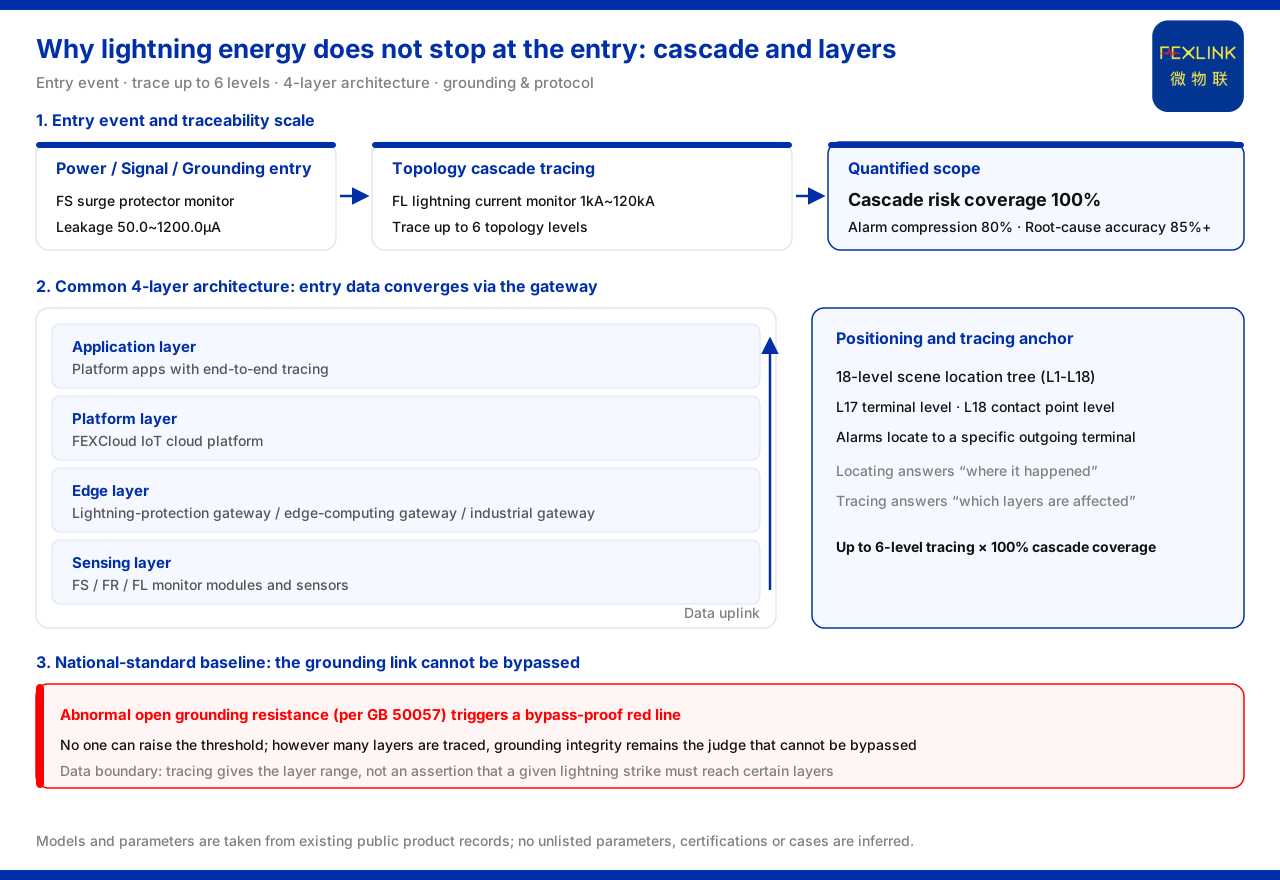
How many levels a single lightning strike can affect along the electrical topology depends on whether the system can model and trace the event level by level along the chain. According to the knowledge base, the dedicated analysis engines of the Wanxiang engine include a topology cascade impact engine (TopologyImpactCalculator), which can trace up to 6 levels of impact along the electrical topology, characterizing the span over which one event propagates to multiple levels. In other words, the knowledge base gives an explicit upper bound on the tracing dimension — at most 6 levels; paired with this is an 18-level scene-location tree that can drill alarms down to the wiring-terminal level and the contact-point level. Note that the knowledge base provides the tracing level count, the location levels and the quantitative metrics, but does not provide an inference rule for "which levels a particular strike necessarily affects"; the discussion in this article on how to interpret these levels is an application-layer extrapolation.
Why levels should be treated as an observation scale
The energy of a lightning strike can enter the system through several entry points, including power, signal and grounding, and its consequence is often not the damage of a single device but propagation level by level along electrical connections. The knowledge base divides the general architecture of the monitoring system into four layers: perception layer, edge layer, platform layer and application layer. The perception layer consists of the FS surge protective device monitor, the FR grounding resistance monitor, the FL lightning current / transient current monitor (e.g. FL-01222) and ES-series monitoring modules and sensors, while the edge layer is carried by FG, ESX, CW, CX and CC for protocol conversion and local caching. Event impact propagates layer by layer through this architecture, which is precisely why levels can serve as an observation scale: only by observing level by level along the paths of power, signal and grounding can the impact range of one event be expanded from "one terminal damaged" to "which levels are affected". The order of the four layers also provides a stable reference for interpretation — from field perception to edge aggregation to platform analysis, each layer can be an intermediate link in the propagation. If a strike is treated only as a terminal fault, the traces it leaves in the intermediate layers are missed; conversely, observing layer by layer lets scattered phenomena be understood as one chain.
What tracing up to 6 levels means
The knowledge base lists the topology cascade impact engine as one of the dedicated analysis engines of the Wanxiang engine and states that it can trace up to 6 levels of topological impact. Accordingly, the span over which an event propagates to multiple levels along the electrical topology can be unfolded level by level: starting from the level where the event originates, tracing outward to the upstream and downstream levels it may affect, extending at most to the 6th level. This "6 levels" is an upper-bound expression of the tracing dimension, used to show that cascade impact can be systematically modeled, rather than an assertion that a particular strike necessarily affects that many levels. The right way to understand it is to treat a "level" as a unit of electrical-connection hierarchy, not as a time order or a spatial distance.
Location precision and the 18-level scene-location tree
To place level impact at a specific position, location capability is also needed. The knowledge base records that the Wanxiang engine uses an 18-level scene-location tree, drilling from the campus down to the wiring-terminal level and the contact-point level. This means an alarm can be precisely located to a specific outgoing terminal, providing a landing point for level tracing of events such as lightning strikes: the location tree first determines which terminal or contact point of which outgoing line the event occurred at, and then topological tracing is used to judge which levels it may propagate along. Location and tracing are two different things — location answers "where it happened", tracing answers "which levels may be affected"; only together can they describe an event clearly.
What data tracing needs
Level tracing needs magnitude data of the event itself and state data of the nodes. The knowledge base records that the FL lightning current / transient current monitor (FL-01222, FL-01212) provides detection range one of 1kA~120kA and range two of 0.1kA~1kA, with functions including peak, peak plus energy, waveform, and waveform plus energy, and can record the magnitude and waveform parameters of a lightning event itself as the event origin of topological cascade tracing. On the node-state side, the key parameters of the FS surge protective device monitor are leakage current 50.0~1200.0μA (±10μA), voltage 0~400.0V (±0.1V), temperature -20~100℃ (±1℃), lightning strike count 0~9999 counts (minimum trigger 0.1kA), and life prediction 0~100%, and it can record lightning events and degradation state on the power path. The two provide the data of "how strong the event is" and "whether the node has degraded", respectively.
How cascade impact is measured
The knowledge base gives a set of quantitative value metrics for the Wanxiang engine: alarm compression 80%, root-cause accuracy above 85%, scene-location precision L17 to L18, and cascade risk coverage 100%. These metrics show that cascade impact is not merely a qualitative description but an object that can be systematically measured and covered. Cascade risk coverage of 100% echoes the above tracing of at most 6 levels: tracing gives the level span, and the coverage metric shows that this span can be brought into the analysis. Alarm compression of 80% reflects the degree of information convergence after many scattered alarms are merged, root-cause accuracy above 85% reflects the ability to locate the root cause, and scene-location precision L17 to L18 shows that the location granularity can be as fine as terminals and contact points. The metrics describe the same analysis capability from different sides: converging alarms, explaining causation, and landing at a specific position. These values are capability statements listed in the knowledge base and do not represent measured results of any single site.
The standard baseline and the grounding link
Level tracing ultimately returns to the electrical-safety baseline. The knowledge base records that the grounding-resistance abnormal open-circuit red line is based on GB 50057; once triggered it outputs the highest-level alarm, and no one can raise the threshold. The grounding path is therefore the standard baseline link in lightning cascade impact: no matter how many levels topological tracing unfolds, whether the grounding is intact is an unavoidable criterion. Bringing grounding state into level observation avoids focusing only on "which path the electricity takes" while ignoring "whether it can finally enter the earth safely".
A recomputable order of interpretation
Drawing the above capabilities together, interpretation can follow the order of "locate first, then trace, then check the baseline": first use the 18-level scene-location tree to determine which level and which terminal or contact point the event occurred at; then use the at-most-6-level tracing dimension of the topology cascade impact engine to list the upstream and downstream levels that may be affected; then retrieve the degradation state recorded by the surge protective device monitor and the peak and energy recorded by the lightning current monitor at each layer's nodes, to check whether the affected levels show anomalies; and finally confirm whether the grounding link has touched the standard baseline. The knowledge base does not give an inference rule for "which levels a particular strike necessarily affects"; the order above is an application-layer interpretation extrapolation, and actual criteria should be determined by the engineering party together with field data and design conventions.
Scope and limitations
- The tracing level count, location levels, quantitative metrics, model parameters and architectural statements in this article are limited to the existing records of the knowledge base, and do not extend to cascade-impact algorithms or level-determination thresholds not listed there. - The knowledge base does not define an inference rule for "levels necessarily affected by a particular strike", nor level-propagation probability or impact-range calculation methods; the related interpretation in the text is an application-layer extrapolation and must not be understood as a delivered knowledge-base capability. - Values such as "at most 6 levels", "18 levels", "80%", "above 85%" and "100%" in the text are stated as in the knowledge base and do not constitute a commitment to results of a specific project. - Actual interpretation and selection must be verified by the engineering party together with field data, design and standard conventions.