Direct answer
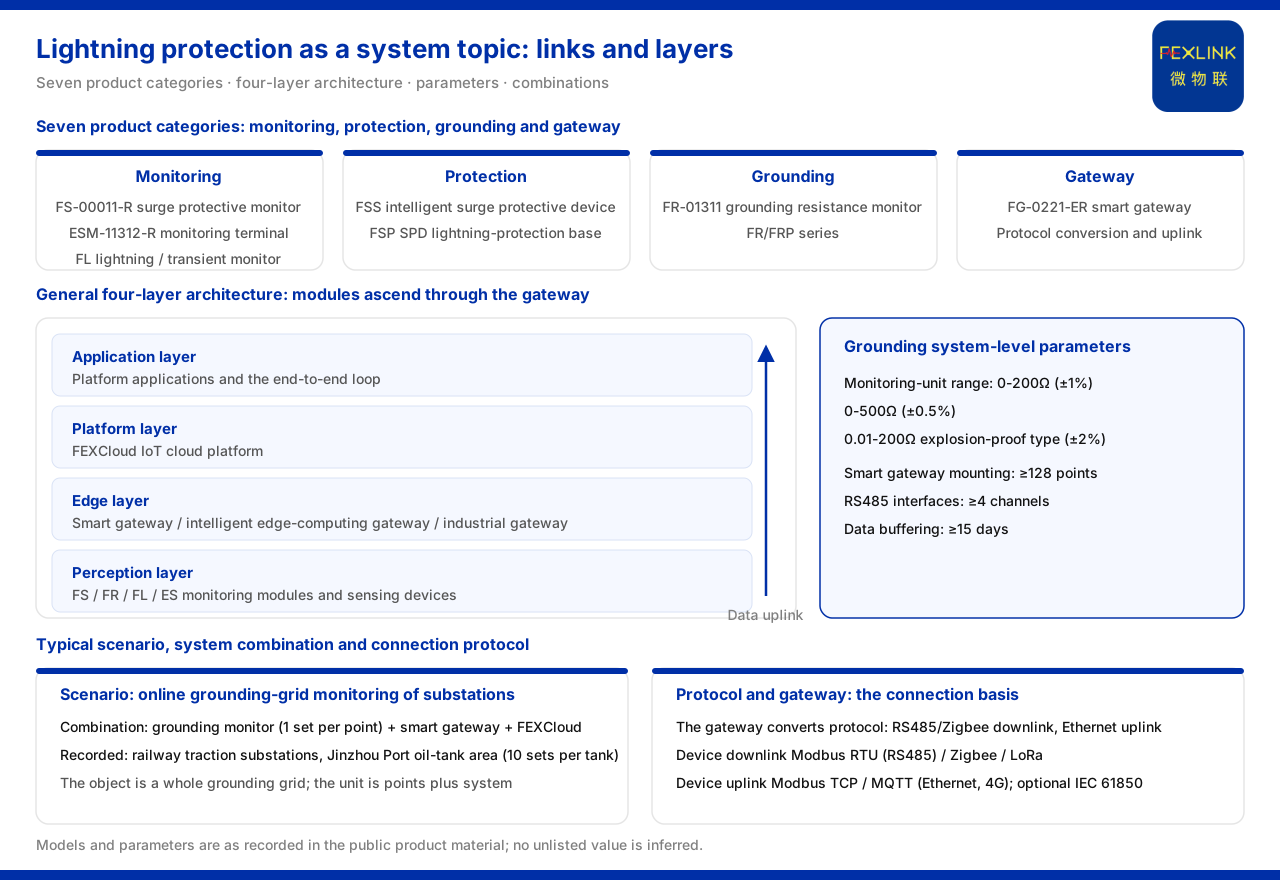
Lightning protection has to cover not a single entry point but several links along one chain, and those links must cooperate through architecture and protocol. The product material lists the intelligent lightning-protection product line as seven categories, covering multiple links such as monitoring, protection, grounding and gateway; and it summarises the monitoring system as a four-layer architecture of perception layer, edge layer, platform layer and application layer, in which the various lightning-protection monitoring modules ascend through a gateway into the cloud platform. Any single product can cover only one of these links, so the protection outcome depends on the cooperation of the links, not on the quality of one product. The argument of this article is therefore about composition and interfaces rather than about any individual device: the object that performs the protection function is the assembled system.
1. The product line is itself a combination of several links
The product-line overview of the product material lists intelligent lightning protection as seven categories of products: the FS surge protective device monitor (e.g. FS-00011-R), the ESM intelligent lightning-protection monitoring terminal (e.g. ESM-11312-R), the intelligent surge protective device, the SPD lightning-protection base, the FR grounding resistance monitor (e.g. FR-01311), the lightning current / transient current monitor and the FG lightning-protection smart gateway (e.g. FG-0221-ER). They fall in different links such as monitoring, protection, grounding and gateway, which shows that "lightning protection" is in the product system itself a combination rather than a single device. If any link is missing, the chain is no longer complete. The naming of seven categories is not a catalogue convenience; it is a statement that the protection function is distributed across the categories, and that each category carries a different part of it.
2. The four-layer architecture strings modules and platform into end-to-end
The product material summarises the monitoring system as a general four-layer architecture: perception layer, edge layer, platform layer and application layer. The perception layer consists of the various lightning-protection monitoring modules and sensing devices; the data ascend through the lightning-protection smart gateway, the intelligent edge-computing gateway and the industrial gateway, and are onboarded to the FEXCloud cloud platform. The architecture strings the front-end devices and the back-end platform into an end-to-end system, and a single product can form a complete chain only after entering this system. The four layers are connected stage by stage, so a product that spans any one layer cannot complete the closed loop from acquisition to application on its own. This is exactly why the architecture is the natural way to describe a lightning-protection system: it makes the dependencies between the layers explicit.
3. Reading system properties through the grounding monitoring system
The reference parameters the product material gives for the grounding resistance monitoring system express a system-level rather than a single-product scope: the monitoring-unit range is 0-200Ω (±1%), 0-500Ω (±0.5%) and 0.01-200Ω for the explosion-proof type (±2%); the smart gateway mounts no fewer than 128 points, provides no fewer than 4 RS485 channels, and buffers no fewer than 15 days of data. Beyond the range, it also specifies mounting capability, interfaces and buffering, which shows that the object being deployed is a system. A single instrument has a measurement range, but it does not have a mounting count or an uplink channel count; those parameters exist only for the assembled system, and their presence is the clearest evidence that the unit of deployment is the system.
4. Typical scenarios are recommended as system combinations
In the scenario "online grounding-grid monitoring of substations and traction substations", the recommended combination the product material gives is the grounding resistance monitor (1 set per point), the lightning-protection smart gateway and the FEXCloud platform, which is a typical end-to-end combination. The material also records that the grounding resistance monitor has been applied to projects such as online grounding-grid monitoring for railway traction substations and the Jinzhou Port oil-tank area (10 sets per tank). Such scenarios take an entire grounding grid as their object, and the "1 set per point" scope also shows that the unit of configuration is a combination of points and a system, not a single product. The recommended combination is itself a system specification, and it is given as a combination precisely because the parts are meant to work together.
5. Protocol and gateway are the connection basis of the system
The product material records that the lightning-protection smart gateway performs protocol conversion, supports RS485/Zigbee on the downlink and Ethernet on the uplink, and is used to connect the front-end lightning-protection monitoring devices with the platform. The communication protocol matrix further lists the device downlink Modbus RTU (RS485) / Zigbee (Modbus) / LoRa and the device uplink Modbus TCP / MQTT (Ethernet, 4G) together with the gateway-level optional IEC 61850. The existence of the protocols shows that the links must cooperate through a unified interface before a usable system can be formed. Interface agreement is the mechanism by which otherwise separate links become one chain; without it, the modules and the platform would remain a collection of devices rather than a system.
Taken as a whole, the five observations point in one direction. The product line distributes the function across several links, the architecture connects those links into an end-to-end chain, the system-level parameters describe a deployed system rather than a single unit, the typical scenarios are recommended as combinations, and the protocols and gateway provide the interfaces that hold the combination together. None of these observations asserts how well a given configuration performs; each describes the composition and the interfaces, which is what makes lightning protection a system topic in the first place.
Scope and limitations
First, this article explains only why lightning protection is a system topic; the factual boundary is limited to the product material, and no standard clause, parameter, certification or case not listed there is introduced.
Second, the product material gives no quantitative relationship between "system configuration" and "protection outcome"; the statement that the outcome depends on the cooperation of the links is a general induction drawn from the listed product line, architecture and scenario combinations.
Third, the models and parameters in this article are all as recorded in the material; this article does not infer the specifications of unlisted models from them, nor does it make performance or effect inferences.
Fourth, the actual lightning-protection system scheme must be determined in conjunction with the on-site entry points, grounding conditions and operation and maintenance requirements; this article provides no selection or configuration calculation.