Direct answer
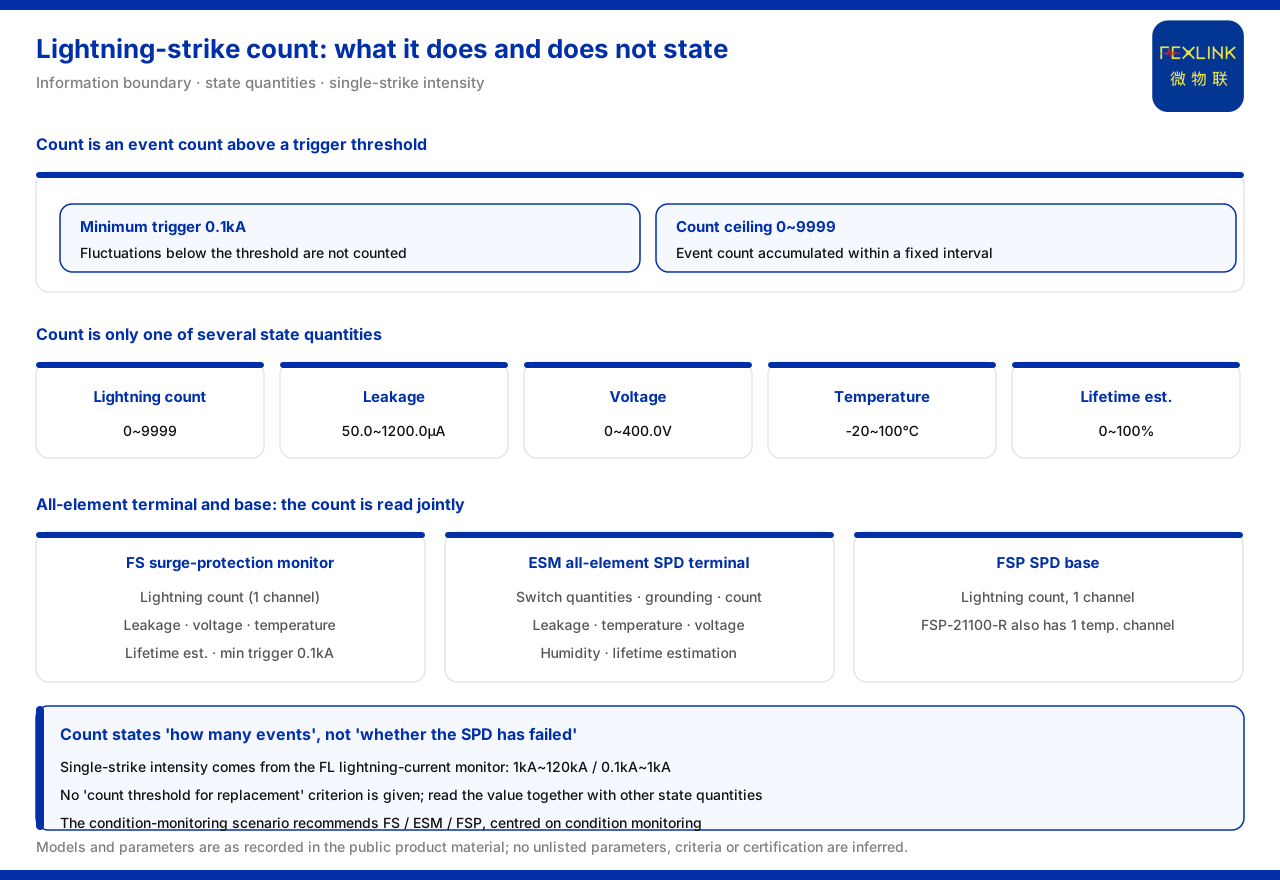
A lightning counter reports how many events have accumulated above a given trigger threshold; it does not report whether the surge protective device can still be used. The product material records that the FS surge protective device monitor (e.g. FS-00011-R) has a lightning count range of 0~9999 and a minimum trigger of 0.1kA, which shows that the count is a threshold-based event accumulation. In the same material, the monitoring elements of the surge protective device monitor also include leakage current, voltage, temperature and lifetime estimation, and the lightning count is only one of them. A high count therefore does not by itself mean that replacement is required; the reading has to be interpreted together with the remaining state quantities. Put another way, it answers "how many events occurred", not "whether the device has already failed". The distinction is operational rather than semantic: a maintenance decision read from the count alone would treat a number that merely tallies events as if it were a health verdict, and that is exactly the misreading this article sets out to remove.
The opening already fixes the boundary of the question. The count is a counter, not a judgement; the judgement, if any, has to be assembled from several readings. The sections below first establish what the count measures, then show how it is positioned among the other elements, and finally locate it in the monitoring scenario the material describes.
1. The count is a tally of threshold-crossing events
The product material defines the key parameters of the surge protective device monitor (the lightning-protection device monitoring module) as a lightning count of 0~9999 and a minimum trigger of 0.1kA. The count accumulates only for events that reach or exceed the minimum trigger; fluctuations below the threshold do not enter the count. The 0.1kA minimum trigger defines which events are recorded, while the 0~9999 upper limit shows that the count is a reading accumulated within a fixed interval. Taken together, the two decide that what the figure reflects is event count, not energy magnitude or device health. A threshold-gated counter is a familiar engineering object: it deliberately ignores small disturbances so that the tally stays meaningful, and it saturates at a fixed ceiling so that the reading stays bounded. Neither property says anything about how much stress each counted event imposed.
2. The count is only one of several state quantities
In the model table of the surge protective device monitor, the same material lists leakage current, voltage, temperature and lifetime estimation alongside the lightning count. The count stands at the same level as these quantities, which shows that it cannot by itself form a conclusion. The reference ranges are listed side by side rather than ranked, so no single row is given priority over the others.
| State quantity | Reference range | | --- | --- | | Lightning count | 0~9999 (minimum trigger 0.1kA) | | Leakage current | 50.0~1200.0μA | | Voltage | 0~400.0V | | Temperature | -20~100℃ | | Lifetime estimation | 0~100% |
The table is the clearest statement of the point: the count is one row among several, and the other rows describe different physical conditions of the same device. Leakage current, voltage and temperature are continuous measurements, whereas the count is an accumulated event total. Because they are different kinds of quantities, they cannot substitute for one another.
3. In a full-element terminal the count must be read together with the other quantities
For the ESM intelligent lightning-protection monitoring terminal (SPD monitor, e.g. ESM-11312-R), the product material lists switch quantities, grounding state, lightning count, leakage current, temperature, voltage, humidity and lifetime estimation model by model. That the elements are listed item by item means that a count value needs to be read in combination with the remaining elements, rather than taken in isolation. A full-element terminal is organised around exactly this idea: it presents a set of related quantities for one device so that the reader forms a combined picture. The count remains part of that picture, not a summary of it.
4. Count and temperature combined in the base form factor
In the SPD lightning-protection base (e.g. FSP-21000-R), every model carries 1 lightning-count channel; the model that carries temperature (FSP-21100-R) additionally carries 1 temperature channel. The count can therefore appear in combination with temperature and other state quantities, which further shows that "count" is one of the optional monitoring elements. The form factor shows the same principle at the hardware level: the count channel is a selectable feature that may be accompanied by a temperature channel, and the two are presented together when both are fitted.
5. The count does not describe the strength of a single event
The product material records that the FL lightning current / transient current monitor (e.g. FL-11122-R) has a detection range of 1kA~120kA or 0.1kA~1kA and provides peak, energy (charge / specific energy) and waveform functions. The strength information of a single lightning event is supplied by this path; the lightning count itself does not carry the strength description. This division of labour is the point: one function counts events, another measures their magnitude. Reading a large count as if it meant "a large strike" would merge two different measurements into one.
6. Where the count sits in a status-monitoring scenario
In the scenario "lightning-protection device status monitoring (retrofit of existing SPDs)", the product material gives a recommended combination of the surge protective device monitor, full-element SPD monitoring and the SPD lightning-protection base. Its landing point is status monitoring, not single-event counting. The material also distinguishes an ordinary lightning counter (no communication) from a three-element SPD monitor (count + air-switch state + SPD state, RS485), showing that "count" is only one of the optional monitoring elements. This also means that not every count value is accompanied by state-quantity acquisition; only a count that enters the monitoring system can be read and interpreted together with the other state quantities. The practical consequence is that a count without a monitoring link is an isolated local figure, while a count inside a monitoring system becomes one input among several.
Scope and limitations
First, this article explains only the meaning of the lightning count and the boundary of its interpretation; the factual boundary is limited to the product material, and no standard clause, parameter, certification or case not listed there is introduced.
Second, the product material gives no criterion for "how high a count must be before replacement"; the statement that the count does not equal a need for replacement is a general induction drawn from the listed monitoring elements and does not mean the material prescribes a handling threshold.
Third, the models and parameters in this article are all as recorded in the material; this article does not infer the specifications of unlisted models from them, nor does it make performance or effect inferences.
Fourth, the actual handling must be determined in conjunction with the on-site lightning-protection configuration, the lightning environment and the device state; this article provides no judgement or selection calculation.