Direct answer
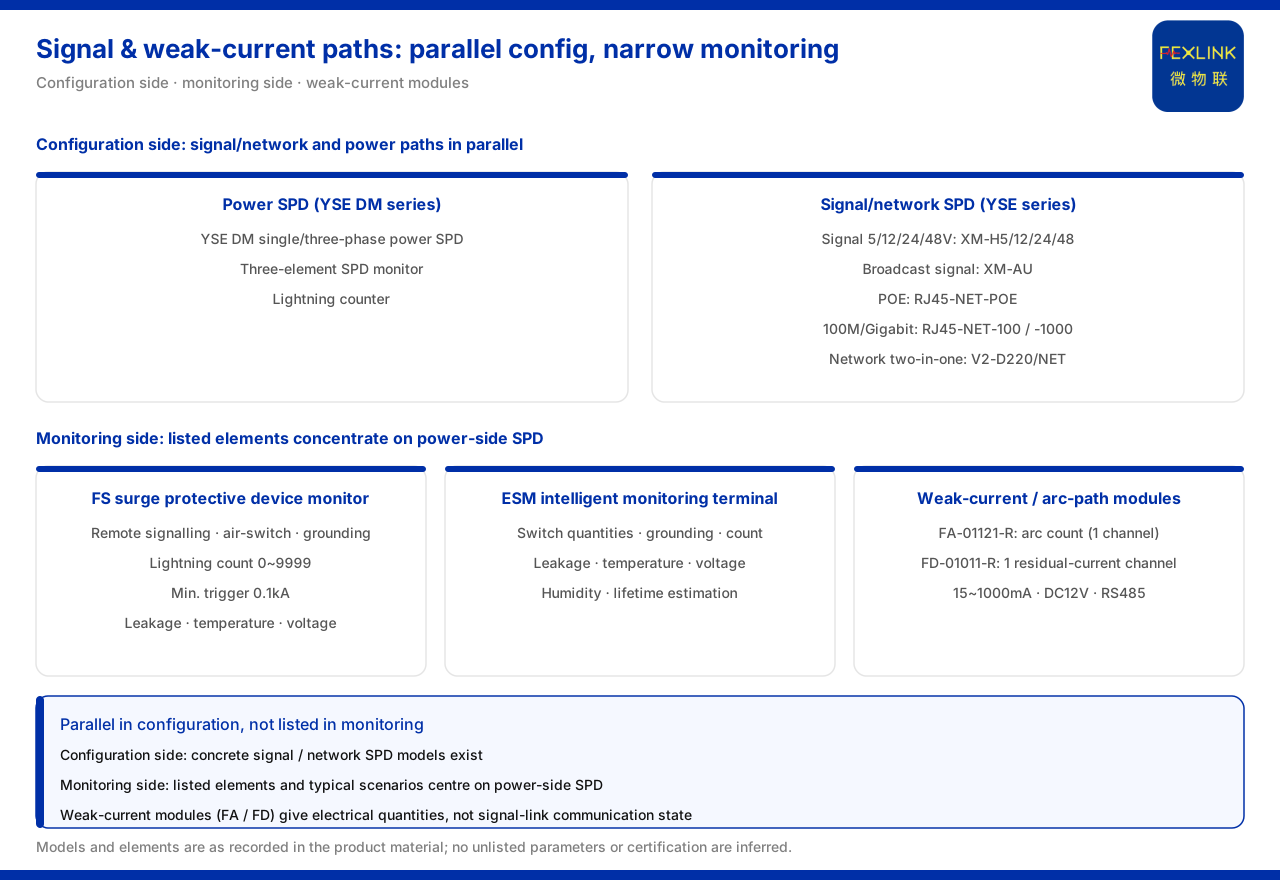
Signal and weak-current paths likewise introduce lightning energy. In its configuration objects for surge protective devices, the product material lists signal surge protective devices, network surge protective devices, two-in-one surge protective devices and power surge protective devices side by side, and gives concrete signal and network surge protective device models; but on the status-monitoring side, the monitoring elements and typical-scenario recommended combinations listed in the material fall mainly on power-side surge protective devices, and no online monitoring combination for signal or network paths is listed separately in the retrofit scenario. This gap—side by side in configuration, narrower in monitoring—is the direct reason lightning risk in weak-current and signal systems is easily overlooked.
1. Signal paths and power paths are listed side by side in configuration
In the product-line overview, under surge protective devices (outsourced, the YSE series) the material lists at the same level power surge protective devices (YSE DM series, single-phase / three-phase), signal surge protective devices / network surge protective devices / two-in-one surge protective devices, and lightning counters / three-element SPD monitors. That is, in terms of configuration objects, the signal and network paths and the power path are not in a master–slave relationship but stand side by side as configuration objects of the surge protective device line. The placement is significant because it means the signal path is a first-class protection target in configuration, not an afterthought attached to the power side.
2. Concrete models already exist for signal and network surge protective devices
The signal / network surge protective device table in the product material gives models, already refined to voltage level and network rate, as shown below.
| Type | Model | | --- | --- | | 5V/12V/24V/48V signal surge protective device | YSE XM-H5/12/24/48 | | Broadcast signal surge protective device | YSE XM-AU | | POE network surge protective device | YSE X/RJ45-NET-POE | | 100M network surge protective device | YSE X/RJ45-NET-100 | | Gigabit network surge protective device | YSE X/RJ45-NET-1000 | | 220V/24V/12V network two-in-one surge protective device | YSE V2-D220/NET |
Models refined to this level show that protection of the signal path is not without available products. A voltage-graded signal line and a 100M or gigabit network link are distinguished by model, so the protection object can be matched to the link rate rather than treated as one generic signal port.
3. The monitoring elements fall on the power-supply side
A distinction must be drawn between "can be protected" and "can be observed". The monitoring elements the product material lists for the surge protective device monitor (e.g. FS-00011) concentrate on the remote signalling, air-switch state, grounding state, lightning count and leakage current, temperature and voltage of the power-side SPD; the ESM intelligent lightning-protection monitoring terminal (SPD monitor, e.g. ESM-21312) covers switch quantities, grounding state, lightning count, leakage current, temperature and voltage, and additionally humidity and lifetime estimation. These elements describe the state of the surge protective device body and its power circuit, and do not form an equivalent online visualisation for the signal or network path. The monitored quantities therefore answer whether the SPD itself is healthy and has operated, which is a different question from whether the signal link still carries its surge path.
4. Weak-current paths have their own independent monitoring modules
The product material also lists monitoring modules aimed at weak-current and arc paths: the FA arc-fault monitoring module (e.g. FA-01121-R) monitors arc count on one current channel, with DC12V and RS485; the FD mains residual-current monitoring module (e.g. FD-01011-R) monitors one residual-current channel over 15mA~1000mA, with DC12V and RS485. They show that the weak-current path has collectable state quantities, but these modules remain dominated by electrical quantities and are not on the same footing as the communication state of a signal link. An electrical quantity answers what current flowed; a link state would answer whether the path is intact, and the two are not the same measurement.
5. Where these capabilities sit in the system architecture
The product material summarises the monitoring system as a general four-layer architecture, whose perception layer consists of various lightning-protection monitoring modules (the surge protective device monitor, the grounding resistance monitor, the lightning current / transient current monitor, and so on), smart meters and sensors; the core sensor technologies include a board-mounted special-shaped Rogowski coil (1μs-level abnormal-current capture) and microamp-level leakage-current acquisition. If state quantities on the signal and weak-current side are to enter the system, they must likewise land at the perception layer. The architecture therefore fixes the admission point for such quantities without implying that a dedicated signal-path monitoring module already exists there.
6. The typical-scenario recommended combination does not yet list signal paths
In the typical scenario "lightning protection device status monitoring (retrofit of existing SPDs)", the recommended combination the product material gives is the surge protective device monitor, full-element SPD monitoring and the SPD surge protection base, and it does not list a signal / network path online monitoring combination under that scenario. Models exist on the configuration side while the monitoring side is not brought into the scenario, and this is precisely the structural reason the risk is easily overlooked. Configuration coverage and monitoring coverage advance at different paces, and the gap between them is where the oversight lives.
Scope and limitations
First, this article explains only the difference in positioning of signal / weak-current paths between lightning-protection configuration and status monitoring; the factual boundary is limited to the product material, and no standard clause, parameter, certification or case not listed there is introduced.
Second, the product material gives no independent monitoring-element list or scenario-based criterion for the signal / network path as an object; the statement that monitoring-side visualisation is narrower is a general induction drawn from the listed monitoring elements and scenario combinations and does not mean the material defines a threshold for the signal path.
Third, the models and parameters in this article are all as recorded in the material; this article does not infer the specifications of unlisted models from them, nor does it make performance or effect inferences.
Fourth, the actual lightning-protection configuration and monitoring scheme must be determined in conjunction with the on-site signal type, link structure and operation and maintenance requirements; this article provides no selection or configuration calculation.