Direct answer
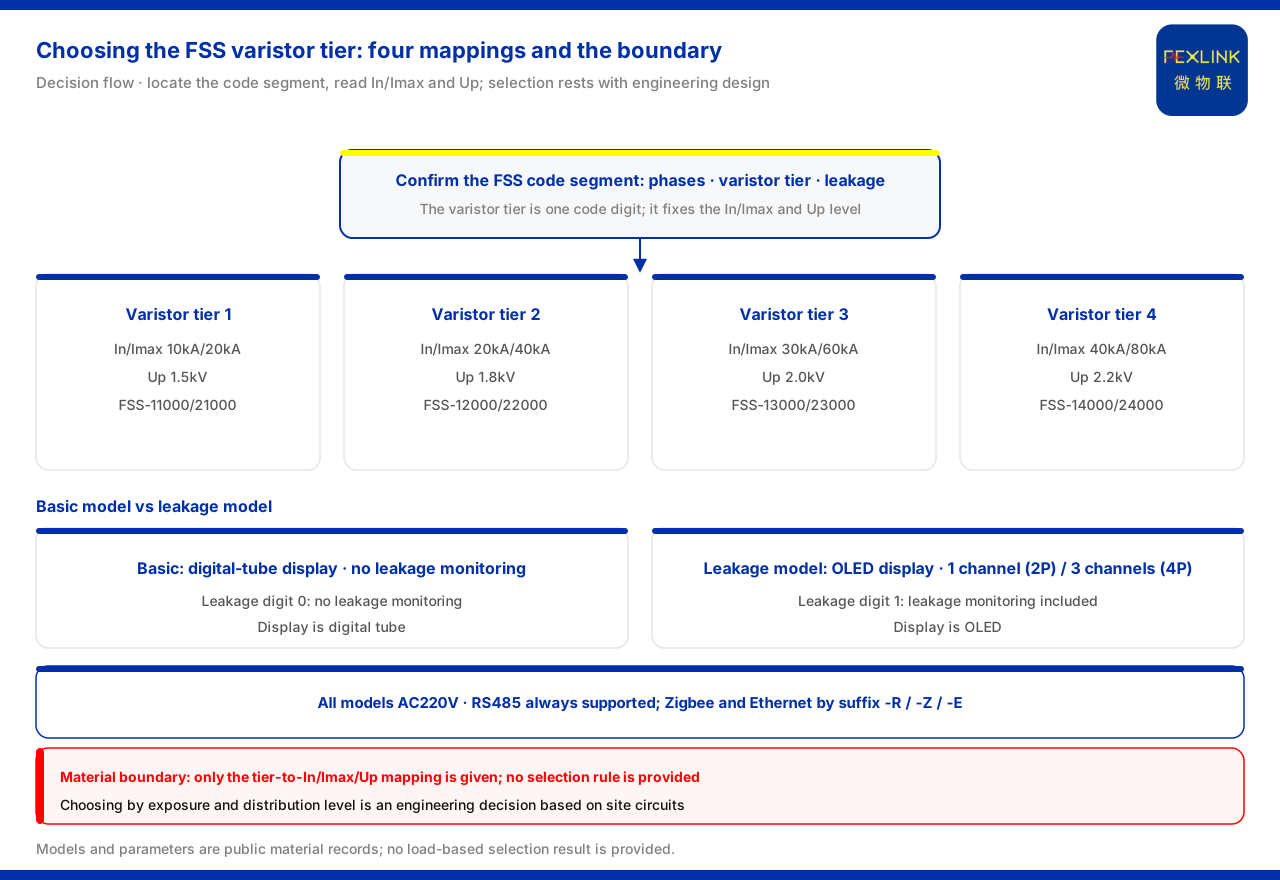
The choice of varistor class should first be read from the four-tier correspondence given in the product material and then combined with the exposure of the circuit and the distribution level. The model rule of the FSS intelligent surge protective device (e.g. FSS-11000) encodes phase count, varistor class and leakage current into field positions: varistor classes 1 to 4 correspond to maximum discharge currents Imax of 20kA, 40kA, 60kA and 80kA respectively; nominal discharge current In and Imax are grouped as 10/20, 20/40, 30/60 and 40/80kA; and the voltage protection level Up is correspondingly 1.5kV to 2.2kV. The material gives only the parameter correspondence, not a rule for selecting a tier by exposure.
1. Where the varistor class sits in the model rule
The product material specifies the model rule of the FSS intelligent surge protective device as FSS–[phase count][varistor class][leakage current][reserved][reserved]–[communication]. The phase-count code 1 denotes 2P and 2 denotes 4P; the varistor-class code 1 to 4 corresponds to Imax 20kA, 40kA, 60kA and 80kA; the leakage-current code 0 denotes none and 1 denotes full current. From left to right the fields are phase count, varistor class, leakage current, two reserved positions and communication. In other words, the varistor class is one digit in the model code, and selecting it fixes the tiers of In/Imax and Up at the same time. Because several parameters are fixed by that single digit, the model rule acts as a compact selection key: reading the code recovers the parameter tier without a separate lookup, and changing the digit changes the tier as a whole rather than one value in isolation.
2. Correspondence between the four tiers and the models
According to the product material, the four tiers of In/Imax appear as groups and correspond one-to-one with specific model groups, as shown in the table below. The table is a correspondence rather than a recommendation: it states which model group carries which tier, and leaves the choice of tier to the project. Reading it as a menu of preferences would invert its role.
| Varistor class | In/Imax | Voltage protection level Up | Corresponding model group | | --- | --- | --- | --- | | 1 | 10kA/20kA | 1.5kV | FSS-11000/21000 | | 2 | 20kA/40kA | 1.8kV | FSS-12000/22000 | | 3 | 30kA/60kA | 2.0kV | FSS-13000/23000 | | 4 | 40kA/80kA | 2.2kV | FSS-14000/24000 |
3. Up rises with the varistor class
The four voltage protection levels Up listed in the product material are 1.5kV, 1.8kV, 2.0kV and 2.2kV, corresponding in turn to varistor classes 1 to 4. As the class rises, In and Imax increase and Up rises with them. This means a stronger discharge capability corresponds to a higher value of the protection level, and a single parameter is not enough when selecting a tier.
The four Up values correspond one-to-one with the varistor classes, showing that the protection level and the discharge capability are given as a group. Reading the class is therefore equivalent to reading the whole parameter group rather than one row of the table.
4. Difference between the basic model and the leakage-current model
The product material records that the basic model uses a digital-tube display and has no leakage-current monitoring, while the leakage-current model uses an OLED display, in which the 2P type has 1 leakage-current channel and the 4P type has 3. That is, leakage-current monitoring is not present in every tier; it appears with the choice of the leakage-current field in the model, and the display method changes accordingly.
If a site needs leakage-current data together with body protection, the leakage-current field should be included in the model. The material lists the basic model and the leakage-current model side by side, which indicates that they are two configurations under the same series rather than two separate product families. The display method is an outcome of the configuration rather than an independent choice, so it should not be used as the primary selection criterion.
5. Supply and communication suffixes
The product material shows that the whole FSS intelligent surge protective device series is supplied at AC220V; communication supports RS485 (-R) throughout, with Zigbee (-Z) and Ethernet (-E) selected by model suffix. Once the tier is fixed, the communication suffix still has to be confirmed against the on-site networking conditions before the model is fully determined. A complete model therefore combines three independent decisions — phase count, varistor class and communication — together with the leakage-current field when it is required. Treating the suffix as part of the model rather than an optional extra keeps the order complete.
6. Product-line attribution and companion scenarios
The product material places the FSS in the "A. Intelligent lightning protection" product line as an intelligent surge protective device. In the recommended combination for "surge protective device status monitoring (retrofit of existing SPDs)", the material lists the FS surge protective device monitor, the ESM intelligent lightning-protection monitoring terminal (full-element SPD monitoring) and the FSP SPD lightning-protection base.
In the overall scheme, the FSS therefore carries body protection while status monitoring is implemented by the companion products. The division of work is a statement about how the combination is built, not a ranking of the products. Keeping that division in view prevents the body-protection role from being conflated with the monitoring role and makes clear why the companion products appear alongside the protective device.
7. Boundary of the selection basis
The product material gives only the parameter correspondence between the varistor class and In/Imax/Up; it does not give a decision rule or threshold for "selecting 20/40/60/80kA according to the exposure of the protected circuit and the distribution level". Which tier to select is therefore an engineering decision: the material provides a parameter comparison but not a numerical selection criterion.
Actual tier selection should be determined by engineering design in conjunction with circuit exposure conditions and distribution level. The correspondence table is the input to that decision, not a substitute for it. Where the material is silent, this article does not fill the gap with an assumed rule; the absence of a decision rule is itself part of what the material states.
Scope and limitations
First, this article explains only the correspondence between the varistor classes and parameters of the FSS intelligent surge protective device; the factual boundary is limited to the product material, and no standard clause, parameter, certification or case not listed there is introduced.
Second, the product material does not give a decision rule or threshold for tier selection by exposure or distribution level; the statement that selection should be combined with exposure and distribution level is an editorial framing and does not mean the material gives a numerical criterion.
Third, the models and parameters in this article are all as recorded in the material; this article does not infer the specifications or protection effects of unlisted models from them.
Fourth, specific selection must be determined by engineering design in conjunction with on-site circuit conditions; this article does not provide selection-calculation results.