Direct answer
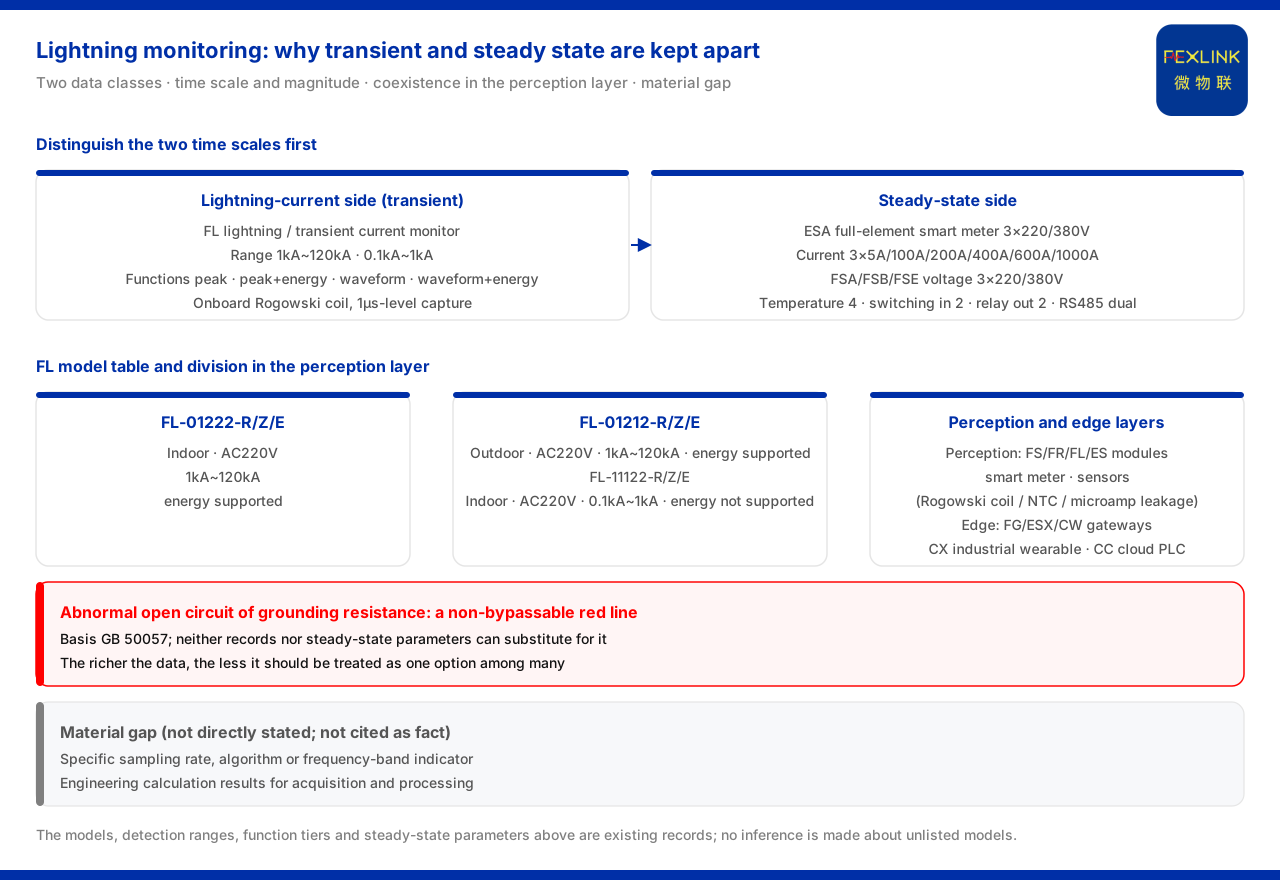
Lightning current monitoring must be distinguished from steady-state electrical monitoring, and the fundamental reason is that the two classes of data differ in time scale and in magnitude. The product material shows that the FL lightning current / transient current monitor (e.g. FL-01222) faces lightning current and transient current, and its model rule encodes detection range, channel count, function, installation and supply into field positions, with the detection range divided into two tiers of 1kA~120kA and 0.1kA~1kA, and the function divided into peak, peak plus energy, waveform and waveform plus energy; whereas the ESA all-parameter smart meter (e.g. ESA-22111-R) and the FSA/FSB/FSE multi-element electrical intelligent controller face steady-state electrical quantities and power quality. The two sets of data cannot share the same acquisition and processing method.
1. Distinguish the two time scales first
Lightning current is a transient event of extremely short duration, while steady-state electrical quantities are operating quantities that exist continuously. The material places this division in the product positioning: the FL series faces lightning current and transient current, and the ESA and FSA/FSB/FSE series face steady-state electrical quantities and power quality. The order cannot be reversed: first distinguish which class the data belongs to, then discuss acquisition and processing. Mixing the two before the distinction is made is what leads to a sampling regime that is wrong for one of them.
2. The lightning-current side: kA magnitude and fast waveform
The model table of the FL lightning current / transient current monitor lists FL-01222-R/Z/E (indoor, AC220V, 1kA~120kA, energy supported), FL-01212-R/Z/E (outdoor, AC220V, 1kA~120kA, energy supported) and FL-11122-R/Z/E (indoor, AC220V, 0.1kA~1kA, energy not supported), and all provide R, Z and E communication options. The detection range is divided into the two tiers of 1kA~120kA and 0.1kA~1kA, and the function into peak, peak plus energy, waveform and waveform plus energy. The material also lists the onboard special-shaped Rogowski coil's 1μs-level abnormal-current capture and microamp-level leakage-current acquisition as core sensor technologies, used to capture fast-changing abnormal current. The range tiers decide which amplitude band the event falls in, and the function tiers decide which parameters of the event are retained; the acquisition front end decides whether the event is caught in time at all.
3. The steady-state side: voltage, current and power quality
The acquired object on the steady-state side is entirely different. The ESA all-parameter smart meter faces steady-state electrical quantities: its voltage is 3×220/380V, its current specifications include 3×5A/100A/200A/400A/600A/1000A, and the whole series is AC220V with OLED display and RS485 (Modbus), supporting voltage, current and electricity-consumption monitoring. The FSA/FSB/FSE multi-element electrical intelligent controller likewise faces steady-state electrical quantities and power quality, and its common functions include voltage 3×220/380V, temperature monitoring on 4 channels, switching-quantity input on 2 channels, relay output on 2 channels and dual RS485 (Modbus). These are operating parameters that persist, and their meaning lies in the continuing condition rather than in a single event. The current specifications of the ESA meter, taken together with its voltage and electricity-consumption monitoring, describe a load that runs for long periods; the controller's temperature, switching-quantity and relay channels describe a continuing electrical environment. Both therefore belong to a different observational regime from the lightning current monitor, and this is why they are listed here as a separate steady-state side rather than as an extension of the FL series.
4. Why one acquisition method cannot be shared
The difference between the two classes of data determines that the acquisition methods cannot be interchanged: lightning current is a transient event on the kA scale and of extremely short duration, and the material realises its capture at the 1μs level with the onboard special-shaped Rogowski coil; the steady-state side consists of voltage, current and power-quality parameters that exist continuously. Using the cadence of steady-state sampling to capture a transient event, or using the standpoint of a transient quantity to describe steady-state operation, will both distort the result. Distinguishing transient from steady state is therefore an independent precondition of data processing. The distinction is not a matter of preference between two techniques; the time scale of the phenomenon itself requires a corresponding acquisition path, and neither path covers the other.
5. Both acquisitions coexist in the same perception layer
In the general four-layer architecture of the monitoring system given by the material, the perception layer contains the FS/FR/FL/ES series monitoring modules, smart meters and sensors (the Rogowski coil, the NTC and the microamp-level leakage-current sensor), while the edge layer consists of the FG/ESX/CW gateways, the CX industrial wearable and the CC cloud PLC. It can be seen that the two classes of acquisition, transient and steady state, coexist within the same perception layer, differing only in their division of labour: one watches fast-changing events, the other watches stable operation. Coexistence does not mean interchangeability; the two paths share a layer and a data chain while remaining specialised for their own time scale.
6. Bottom line: an abnormal open grounding circuit
Whatever class of data is acquired, one bottom line does not change. The material lists an abnormal open circuit of grounding resistance as a safety red line that cannot be bypassed, with GB 50057 as the governing standard. Neither the recording of lightning current nor the monitoring of steady-state parameters can substitute for keeping this bottom line. The richer the acquired data becomes, the easier it is to lose sight of the fact that this condition is a precondition rather than one indicator among many.
Scope and limitations
First, this article explains only why lightning current monitoring must be distinguished from steady-state electrical monitoring; its factual boundary is limited to what the product material lists, and it introduces no standard clause, parameter, certification or case that is not listed.
Second, the model rules, detection ranges, function tiers and steady-state parameters in this article are existing records of the material; on that basis this article does not infer the specifications of unlisted models, nor does it make any performance or result inference.
Third, this article gives no specific sampling rate, algorithm or frequency-band indicator for transient and steady-state data; the material provides no such parameters.
Fourth, the actual acquisition and processing method must be determined in conjunction with the site scenario and equipment conditions; this article does not provide engineering calculation results.