Direct answer
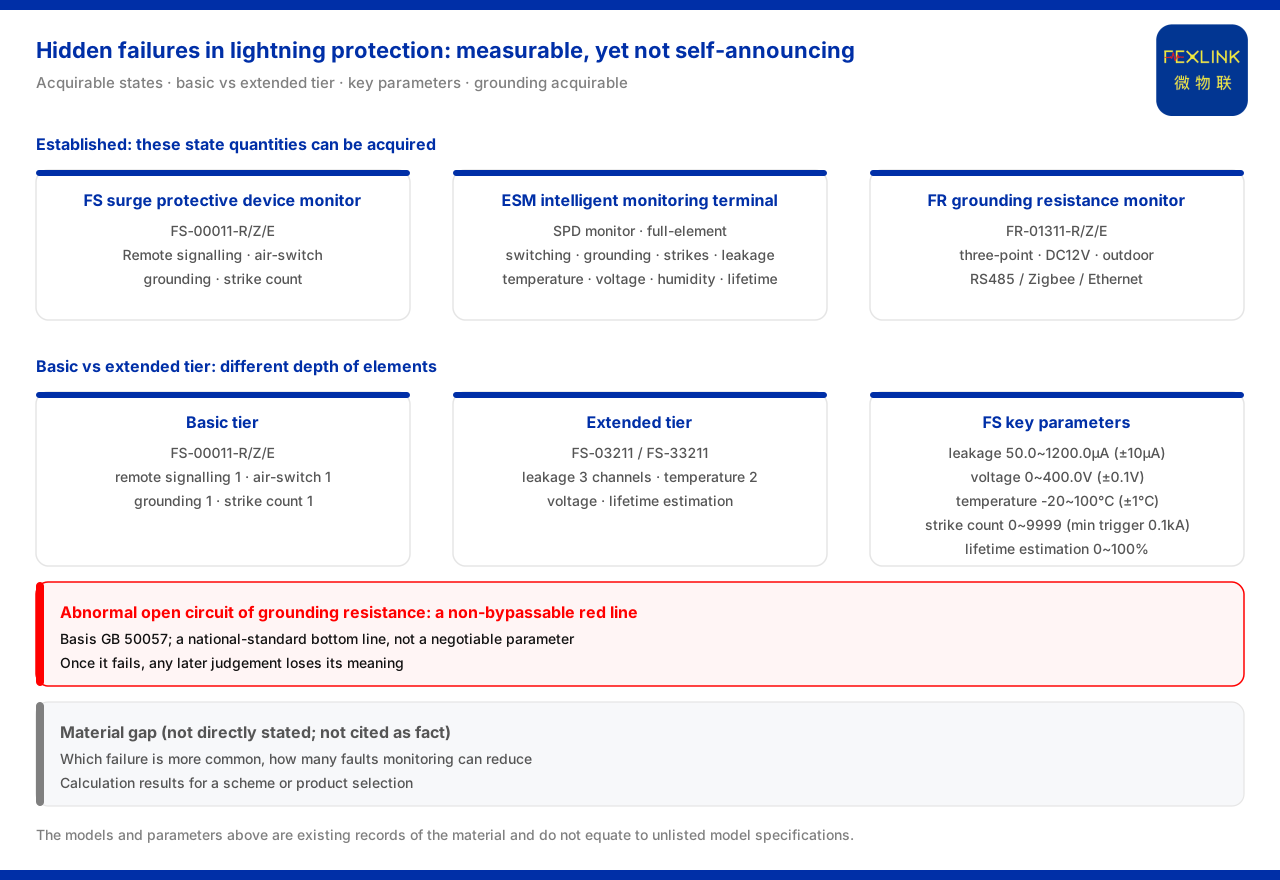
The hidden failure of a lightning protection system is not easy to discover, and the reason is not that it shows no sign, but that its sign is a state quantity rather than a shutdown signal. The product material shows that these state quantities can in fact be acquired: the FS surge protective device monitor (e.g. FS-00011-R) brings remote signalling, air-switch state, grounding state and lightning strike count into monitoring; the ESM intelligent lightning protection monitoring terminal (SPD monitor) covers a more complete set of elements; and the FR grounding resistance monitor (e.g. FR-01311-R) brings grounding-grid resistance into monitoring. Being measurable yet not self-announcing is precisely the crux of a hidden failure; without monitoring, one can only fall back on manual inspection.
1. The common trait of hidden failures: they change, but do not report themselves
Surge protective device degradation, a loosened grounding path, and the accumulation of lightning strikes all change over time, but unlike a trip they do not directly interrupt power use, so the site often cannot perceive them. The material lists lightning protection device status monitoring (retrofit of existing SPDs) as a typical application scenario, and its recommended product combination is the FS surge protective device monitor, the ESM intelligent lightning protection monitoring terminal and the FSP SPD surge protection base. This combination answers one and the same question: to turn an otherwise invisible failure into a state that can be returned. The word "retrofit" matters here, because the monitored device may already be installed and in service; the task is therefore not to replace the device but to add a path by which its existing state can come back. A shutdown signal is an event — it happens once and is noticed at the moment it happens; a state quantity is a continuing condition that may drift for a long time without producing any single noticeable moment. That is why a hidden failure can persist through ordinary operation, and it is also why the answer has to be an acquisition path rather than an inspection interval.
2. What state quantities a surge protective device specifically contains
The model rule of the FS surge protective device monitor encodes the voltage channels, leakage-current channels, temperature channels, switching quantity and grounding/lightning elements into field positions, and its state quantities comprise remote signalling, air-switch state, grounding state and lightning strike count. In the model table, the basic tier FS-00011-R/Z/E contains only remote signalling 1, air-switch state 1, grounding state 1 and lightning strike count 1; whereas FS-03211 and FS-33211 in the FS surge protective device monitor model table extend this with leakage current on 3 channels, temperature on 2 channels, and voltage and lifetime estimation elements. The distinction between the two tiers is not one of connectivity but of depth: the basic tier answers whether the device has operated and whether the switch has opened, which are discrete event-type quantities, while the extended tier adds continuously varying quantities that can describe how the device is behaving between events.
3. Measurable quantities also include leakage current, voltage, temperature and lifetime
From the parameter standpoint, the key parameters given for the FS surge protective device monitor include leakage current 50.0~1200.0μA (±10μA), voltage 0~400.0V (±0.1V), temperature -20~100℃ (±1℃), lightning strike count 0~9999 (minimum trigger 0.1kA) and lifetime estimation 0~100%. These quantities correspond exactly to several facets of lightning protection device degradation: rising leakage current, abnormal temperature, accumulated lightning strikes and declining lifetime. They belong to hidden failures because a change at a single point usually triggers no intuitive phenomenon, and only when continuously acquired does it form a trend that can be judged. A leakage-current reading, for example, is meaningful less as an isolated number than as a level that moves over time; a temperature reading is meaningful against the surrounding conditions; a count is meaningful as an accumulation; and a lifetime estimate is meaningful as a direction of travel rather than a single value.
4. Grounding state is likewise an acquirable quantity
A problem at the grounding terminal is even harder to perceive on site. The model rule of the FR grounding resistance monitor encodes signal acquisition, detection principle, installation and supply into field positions, with the detection principle divided into the loop method and the three-point method; FR-01311-R/Z/E all use the three-point method, DC12V and outdoor installation, with communication respectively as RS485, Zigbee and Ethernet. In other words, grounding-grid resistance need not be obtained only by periodic manual measurement; it is itself within the range of what can be monitored. The detection principle and the installation mode are part of the model rule because they determine the conditions under which a reading is valid; before readings are compared across points, their standpoints have to be confirmed to be consistent.
5. The more complete the elements, the better hidden failures are covered
If only a single-point state is considered, the terminal-level product offers a more complete standpoint. The model rule of the ESM intelligent lightning protection monitoring terminal (SPD monitor) encodes power, display, phase count, current parameters and version into field positions, and its monitoring elements cover switching quantity, grounding state, lightning strike count, leakage current, temperature, voltage, humidity and lifetime estimation. The more elements there are, the better what looks normal can be distinguished from what is actually degrading. The value of a fuller element set is not that any single element is decisive, but that the elements can be read together: a device that reports no operation may still be degrading, and that separation only becomes visible when several state quantities are acquired on the same terminal.
6. The bottom line: an abnormal open grounding circuit cannot be bypassed
Whatever the number of monitoring elements, one class of failure cannot be handled as an ordinary alarm. The material lists an abnormal open circuit of grounding resistance as a safety red line that cannot be bypassed, with GB 50057 as the governing standard. That means whether grounding holds is a national-standard bottom line, not a negotiable operating parameter; once it fails, any subsequent judgement loses its meaning. It is a precondition rather than one indicator among several, and no additional monitoring element can compensate for it. Monitoring increases what can be seen, but it does not change the fact that this particular condition has to hold in the first place.
Scope and limitations
First, this article explains only why the hidden failure of a lightning protection system is not easy to discover and which state quantities can be acquired; its factual boundary is limited to what the product material lists, and it introduces no standard clause, parameter, certification or case that is not listed.
Second, the product model rules and parameters in this article (including leakage current, voltage, temperature, lightning strike count and lifetime estimation) are existing records of the material; on that basis this article does not infer the specifications of unlisted models, nor does it make any performance or result inference.
Third, this article gives no conclusion such as which failure is more common or how many faults monitoring can reduce; the material provides no corresponding statistics.
Fourth, a specific monitoring scheme and product selection must be determined in conjunction with the site supply, structure and monitoring elements; this article does not provide selection calculation results.