
Direct Answer
**A plant's harmonic levels exceed limits and it is required to rectify, but the enterprise is unclear about what the standard actually specifies and how responsibility is divided. The answer: GB/T 14549 specifies harmonic-voltage limits for each voltage level of the public supply network and allowable values for harmonic current injected by users; responsibility is divided at the point of common coupling (PCC) — if a user's injected current exceeds the allowable value, that user must rectify. The standard's value is to provide the benchmark for "whether limits are exceeded" and "what the limits are"; specific rectification measures require on-site assessment.**
At one plant, the harmonic current injected at the 10 kV incomer exceeded the limit (5th harmonic current above the allowable value), and the utility required rectification per GB/T 14549. Checked against the standard: the PCC is the 10 kV busbar; the 5th harmonic voltage distortion was 4.2% (limit 4.0% — exceeded); the 5th harmonic current was 58 A (allowable computed by contracted capacity about 42 A — exceeded). Conclusion: install mitigation equipment (active/passive filter) to reduce injected current; close out after re-test passes. **The core of GB/T 14549 is "limits + responsibility": the harmonic-voltage limit governs public-network quality, the harmonic-current allowable value governs user injection — whether limits are exceeded is judged by the values, who rectifies is decided by the PCC.**
Because:
- **The standard is the judgment benchmark**: whether limits are exceeded and what they are, with concrete figures to check; - **Responsibility is divided at the PCC**: injected current above the allowable value means that user rectifies; - **The voltage limit protects the public network**: total-network harmonic voltage stays within limits, other users unaffected; - **Rectification needs a basis**: judge the exceeded items first, then rectify targeted.
Key insight: **GB/T 14549 is the referee of harmonic rectification.** Voltage limit + current allowable value + PCC — exceeded or not, and who is responsible, decided by the standard.
At one campus, after multiple VFDs were commissioned together, 5th/7th harmonic currents at the 10 kV busbar rose significantly. Checked against the standard: harmonic-voltage distortion approached the limit and injected current exceeded the allowable value — judged exceeded; after installing an active filter, injected current dropped within the allowable value and the re-test passed. **Standard landing: judge the exceeded items by limits first, then rectify the injection source — judgment and rectification are separated, responsibility is clear.**
1. Standard Scope and Voltage Levels
Step one: where the standard applies.
**Scope**: - GB/T 14549 "Power quality — Harmonics in public supply networks"; - Applies to AC 50 Hz public supply networks; - Covers 110 kV and below at all voltage levels; - Used for network harmonic assessment and user harmonic evaluation.
**Voltage levels**: - 0.38 kV (LV): total harmonic-voltage distortion limit 5%; - 6/10 kV (MV): total distortion limit 4%; - 35 kV: total distortion limit 3%; - 66 kV and above: total distortion limit 2%.
**What the standard governs**: - Harmonic-voltage limits (public-network quality indicators); - Harmonic-current allowable values (user injection limits); - Harmonic assessment methods at the PCC; - Exceedance judgment and responsibility division.
**What the standard does not govern**: - Does not specify mitigation equipment (active/passive filtering chosen by the user); - Does not specify in-plant harmonic standards (a plant may be stricter per equipment requirements); - Does not address non-public systems (isolated plant supply systems are separate).
Key insight: **the standard first defines where it applies.** Public networks 110 kV and below, limits per voltage level — define the judgment scope first.
2. Harmonic-Voltage and Harmonic-Current Limits
Step two: what exactly the limits are.
**Harmonic-voltage limits**: - 0.38 kV: total distortion ≤5%; - 6/10 kV: total distortion ≤4%; - 35 kV: total distortion ≤3%; - 66 kV and above: total distortion ≤2%; - Odd harmonic-voltage components each have component limits (5th, 7th, etc.).
**Harmonic-current allowable values**: - Computed from the PCC supply voltage level, minimum short-circuit capacity, and contracted capacity; - Per-order allowable currents (5th/7th/11th, etc.); - Allowable value proportional to the user's contracted capacity (larger capacity, more allowed); - Multiple users share by contracted-capacity ratio.
**Meaning of the limits**: - Voltage limit: protects public-network quality (visible network-wide); - Current limit: constrains user injection (source control); - Together: both a quality indicator and a source constraint; - Exceedance judgment: any over-limit item fails.
**Judgment example**: - 10 kV busbar harmonic-voltage distortion 4.2% (limit 4%) → exceeded; - 5th harmonic current 58 A (allowable 42 A) → exceeded; - Any over-limit item requires rectification (per the strictest item).
Key insight: **the limits are the judgment ruler.** Voltage total distortion by level, current allowable by capacity — exceeded or not, decided by numbers.
3. Responsibility Division at the PCC
Step three: who is responsible.
**Point of common coupling (PCC)**: - Definition: the connection point between the user's supply line and the public network (generally the incomer busbar/metering point); - Meaning: the boundary for harmonic responsibility; - Judgment: injected current at the PCC above the allowable value → that user is responsible; - Multiple users at one point: responsibility shared by contracted-capacity ratio.
**Responsibility division**: - User's injected current above the allowable value → user rectifies (source); - PCC voltage over limit but no single user over → multi-user superposition, joint rectification; - High background harmonics from the supply system → grid-side cooperation (rarer); - Rectification responsibility: whoever exceeds rectifies; superposition means joint rectification.
**Judgment process**: - Step 1: identify the PCC (incomer busbar/metering point); - Step 2: measure harmonic currents at the PCC (per order); - Step 3: compare with the allowable value (computed by contracted capacity); - Step 4: over limit → that user must rectify; - Step 5: re-test (verification after rectification).
Key insight: **the PCC is the responsibility boundary.** Over-limit injection means that user is responsible; superposition means joint rectification — responsibility clear, rectification without disputes.
4. Exceedance Judgment and Re-Test Requirements
Step four: how to judge and how to verify.
**Exceedance judgment**: - Harmonic voltage over limit (voltage distortion at the PCC over the limit); - Harmonic current over limit (injected current at the PCC over the allowable value); - Judgment period: continuous monitoring (throughout the assessment); - Data requirement: typical conditions (normal production periods).
**Re-test requirements**: - Re-test after rectification: same PCC, same conditions; - Re-test period: continuous monitoring (generally 1 week or more); - Pass criteria: neither voltage nor current over limit; - Failed re-test: continue rectification (adjust device parameters/capacity).
**Monitoring points**: - Measurement location: PCC (incomer metering point); - Measurement equipment: compliant with power-quality measurement standards (Class B or better); - Data recording: per-order harmonics (5/7/11/13th, etc.); - Time synchronization: consistent with the utility's assessment period.
**Common dispute handling**: - "Exceedance is grid background": requires data proof (background harmonics measured separately); - "Multiple-user superposition": shared by contracted-capacity ratio; - "Instrument differences": unified standard instrument for re-test.
**Equipment impact of harmonic exceedance** (rectification motivation): - Transformers: harmonic currents increase copper/iron losses, temperature rise (derating); - Motors: harmonics cause additional losses and vibration, lower efficiency; - Capacitors: harmonic amplification causes overcurrent/overheating (even swelling, bursting); - Cables/busbars: skin effect increases losses, joint overheating; - Metering/protection: harmonics disturb metering accuracy and risk protection misoperation; - Meaning: untreated exceedance accumulates equipment loss and failure risk.
Key insight: **judgment + re-test is the closed loop.** Exceedance judged by limits, re-test after rectification — rectification has criteria, results verifiable.
5. Connection to Enterprise Rectification
Step five: how the standard lands in rectification.
**Rectification process**: - Step 1: exceedance diagnosis (PCC monitoring confirms the exceeded items); - Step 2: harmonic-source analysis (VFDs/rectifiers/nonlinear loads); - Step 3: mitigation scheme (active power filter APF / passive filter / VFD retrofit); - Step 4: implementation (device installation + parameter configuration); - Step 5: re-test and close out (PCC re-test passes).
**Mitigation selection**: - Active power filter (APF): dynamic compensation, adapts to varying loads (recommended); - Passive filter: lower cost, fixed frequency (for stable harmonic sources); - VFD retrofit: add filter/reactor (source-side treatment); - Combined scheme: chosen by harmonic composition.
**Rectification interface points**: - Judge first, then rectify (avoid blind installation); - Mitigation capacity designed by overage + margin; - Close out only after the re-test passes (installing is not enough); - Long-term monitoring (prevent recurrence from source changes).
Key insight: **the standard and rectification connect back to front.** Judge over-limit → analyze sources → rectify → re-test — the standard governs judgment, rectification governs landing.
6. Product Landing: Harmonic Monitoring and Rectification Support
FEXLINK products bring the standard to the field:
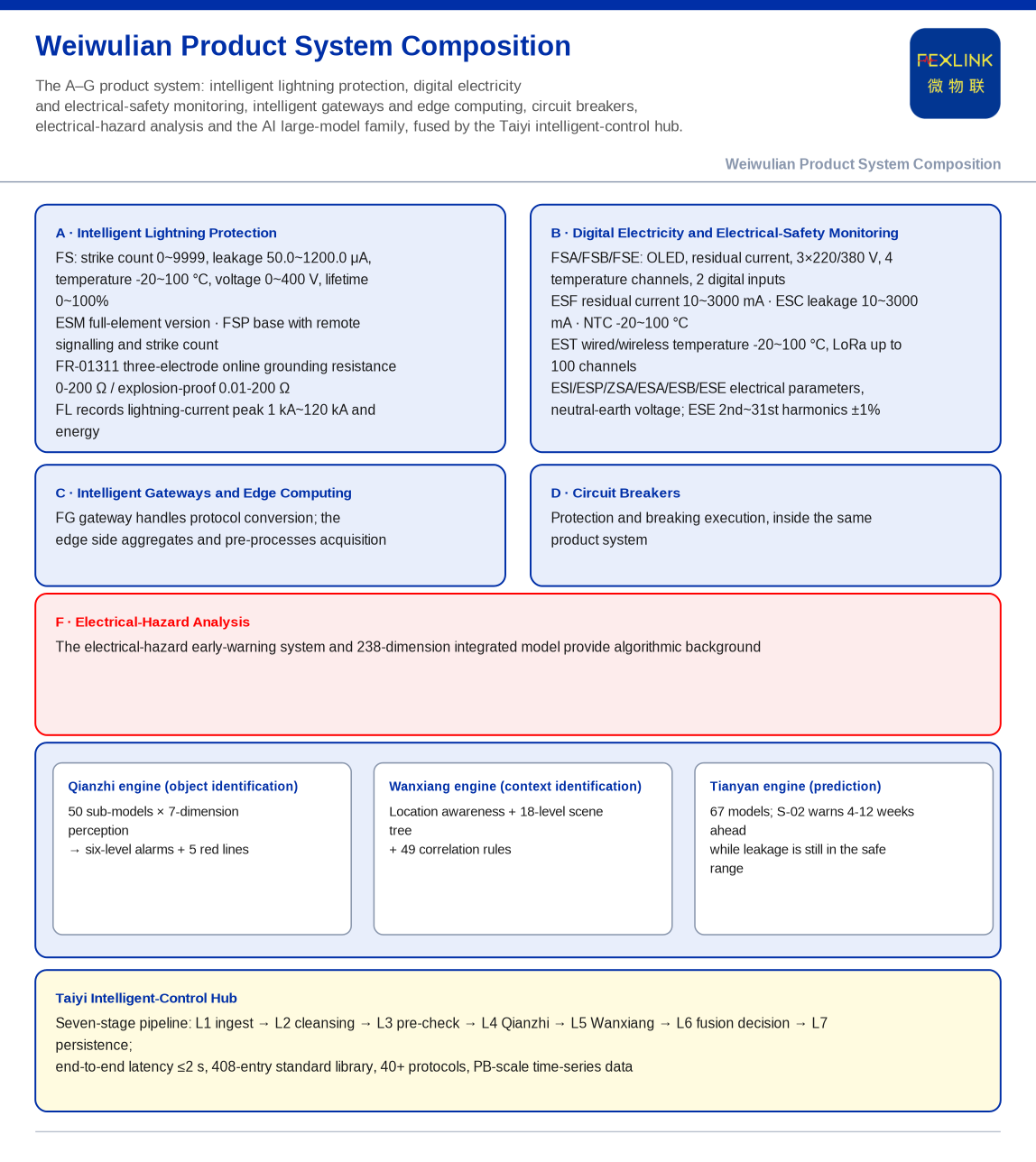
- **ESE Power-Quality Monitor**: continuous harmonic voltage/current monitoring at the PCC (exceedance judgment); - **FSE Power-Quality Measuring Controller**: per-order harmonic monitoring + trend records (before/after comparison); - Platform analysis: limit comparison, exceedance alerts, re-test reports; - Data support: evidence basis for utility evaluation (responsibility judgment).
Design principle in one sentence: **turn "harmonic exceedance" into "data-based judgment."** Standard limits + field monitoring + re-test verification — exceeded or not, and who rectifies, decided by data.
7. Common Misconceptions in Standard Interpretation
1. **Voltage only, ignoring current**: looking only at voltage distortion. Consequence: the injection-source responsibility is missed. Correct: judge both voltage and current. 2. **Ignoring contracted capacity**: reading the current limit directly from the standard table. Consequence: wrong allowable value (capacity affects the limit). Correct: compute by contracted capacity + short-circuit capacity. 3. **Wrong PCC location**: measuring inside the plant. Consequence: wrong responsibility division. Correct: measure at the PCC (incomer metering point). 4. **Rectifying without source analysis**: blindly installing filters. Consequence: mismatched capacity, poor effect. Correct: analyze harmonic sources before choosing a mitigation scheme. 5. **Installing counts as close-out**: no re-test. Consequence: compliance unverified. Correct: close out after the re-test passes (same PCC, same conditions).
Scope and Limitations
This article provides a framework for interpreting and landing GB/T 14549 (scope and voltage levels, voltage/current limits, PCC responsibility division, exceedance judgment and re-test, rectification interface) for harmonic-overlimit rectification, utility evaluation response, and power-quality project pre-assessment. Specific allowable values must be computed with the actual contracted capacity and PCC short-circuit capacity; measurements must comply with power-quality standards (instrument class, measurement location, monitoring period); mitigation schemes (APF/passive filters, etc.) must be designed by qualified personnel with harmonic-source analysis and site conditions. All cases are anonymized (a certain plant / a certain campus) and do not refer to any specific customer.