Direct answer
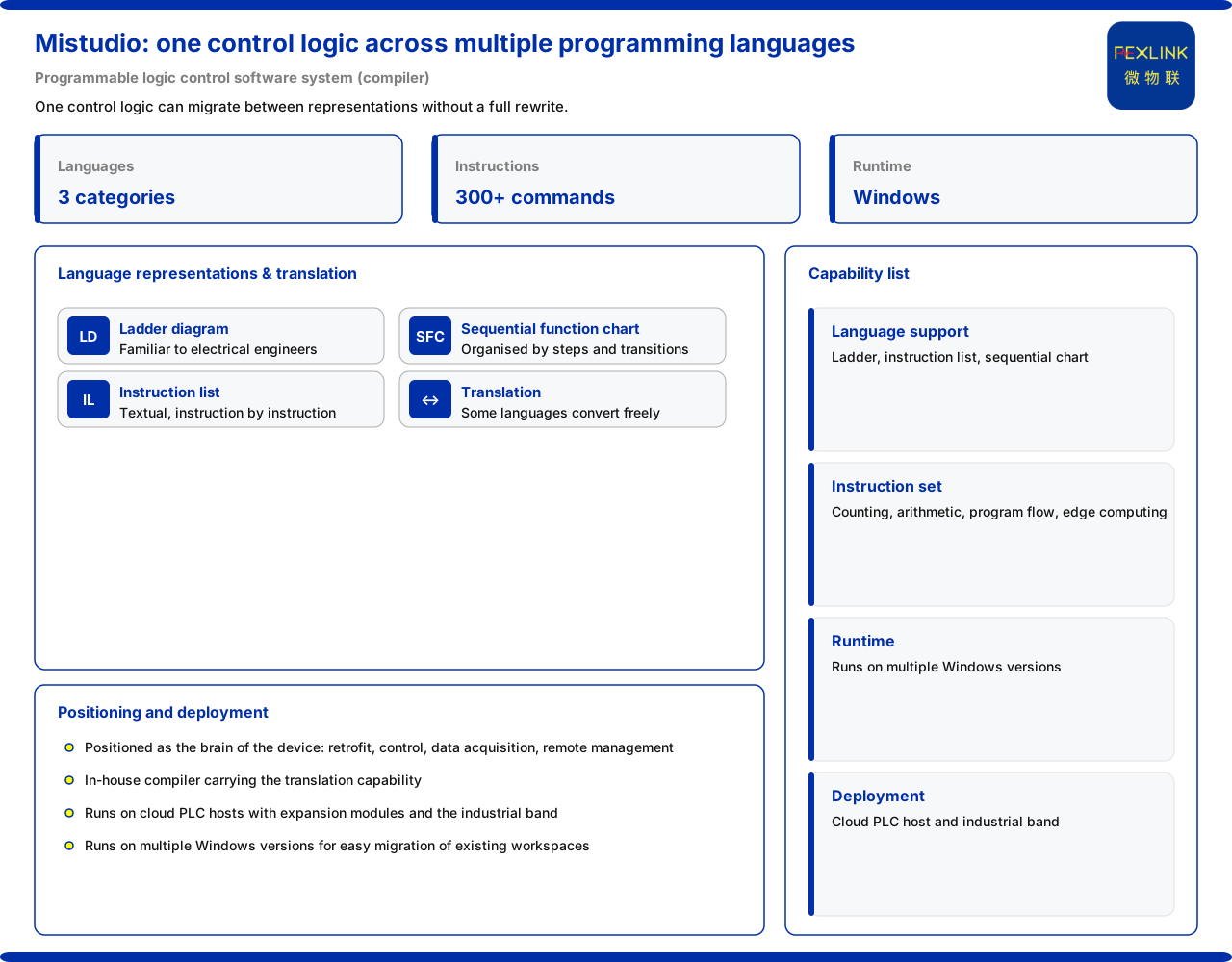
Once an industrial control program is written, it is often tied to one programming language and one toolchain, making migration costly. The product knowledge base states that the Mistudio programmable logic control software system (compiler) supports programming languages familiar to electrical engineers, such as the ladder diagram, the instruction list and the sequential function chart, and that some of these programming languages can be freely converted between one another. This capability gives the same set of control logic a chance to migrate between different forms of expression without a full rewrite. Based on the wording listed in the product knowledge base, this article explains Mistudio's positioning, the languages it supports, what language conversion means, the instruction scale, the runtime environment, and its deployment carriers as "the brain of the device"; it does not infer any specific project's program migration result.
1. What Mistudio is
The product knowledge base states that the Mistudio programmable logic control software system (compiler) is proprietary software. Two qualifiers define its nature: "software system (compiler)" shows that it does the work of compiling control logic into an executable program, rather than being a mere graphical editor; "proprietary" shows it is independently owned software that does not depend on an external compilation chain.
Understanding Mistudio as a compiler rather than an editor matters. An editor's output is text or graphics; a compiler's output is a program that can be downloaded and run. Language conversion is possible precisely because the compiler carries a unified intermediate representation in between: source programs in different languages are first normalized at the compilation layer, then a target program is generated. The product knowledge base states only that some languages can be freely converted, and does not expand the implementation details of the intermediate representation; this article therefore does not infer the conversion algorithm.
2. Which programming languages are supported
The product knowledge base states that Mistudio supports programming languages familiar to electrical engineers, such as the ladder diagram, the instruction list and the sequential function chart. These three forms match different habits: the ladder diagram is close to relay logic, presenting contacts and coils intuitively; the instruction list expresses logic as a sequence of instructions, compact and convenient for fine control; the sequential function chart organizes a flow by steps and transition conditions, suitable for process control with clear stages.
Supporting them side by side covers users with different engineering backgrounds. Electrical engineers often start from the ladder diagram, those used to text prefer the instruction list, and equipment control with strong process logic suits the sequential function chart. The product knowledge base describes this group as "programming languages familiar to electrical engineers", emphasizing closeness to existing engineering habits rather than requiring users to learn a new language first.
3. What language conversion means
The product knowledge base states that some of Mistudio's programming languages can be freely converted. Two keywords matter: "some", meaning not all language pairs can convert and boundaries exist; and "freely converted", meaning that within the supported range the conversion needs no manual rewriting segment by segment.
The engineering value of language conversion shows in several scenarios. One is maintenance handover: logic written by a predecessor in the ladder diagram can, if the successor prefers the instruction list, be converted and read within the supported range. Another is expression optimization: process-heavy sections become clearer in the sequential function chart. A third is migration and reuse: the same logic continues in use under another form of expression without rewriting. It should be noted that "freely convertible" is the capability description given by the product knowledge base; this article does not infer the equivalence and verification conclusion of the converted program in any specific engineering.
4. What 300+ instructions cover
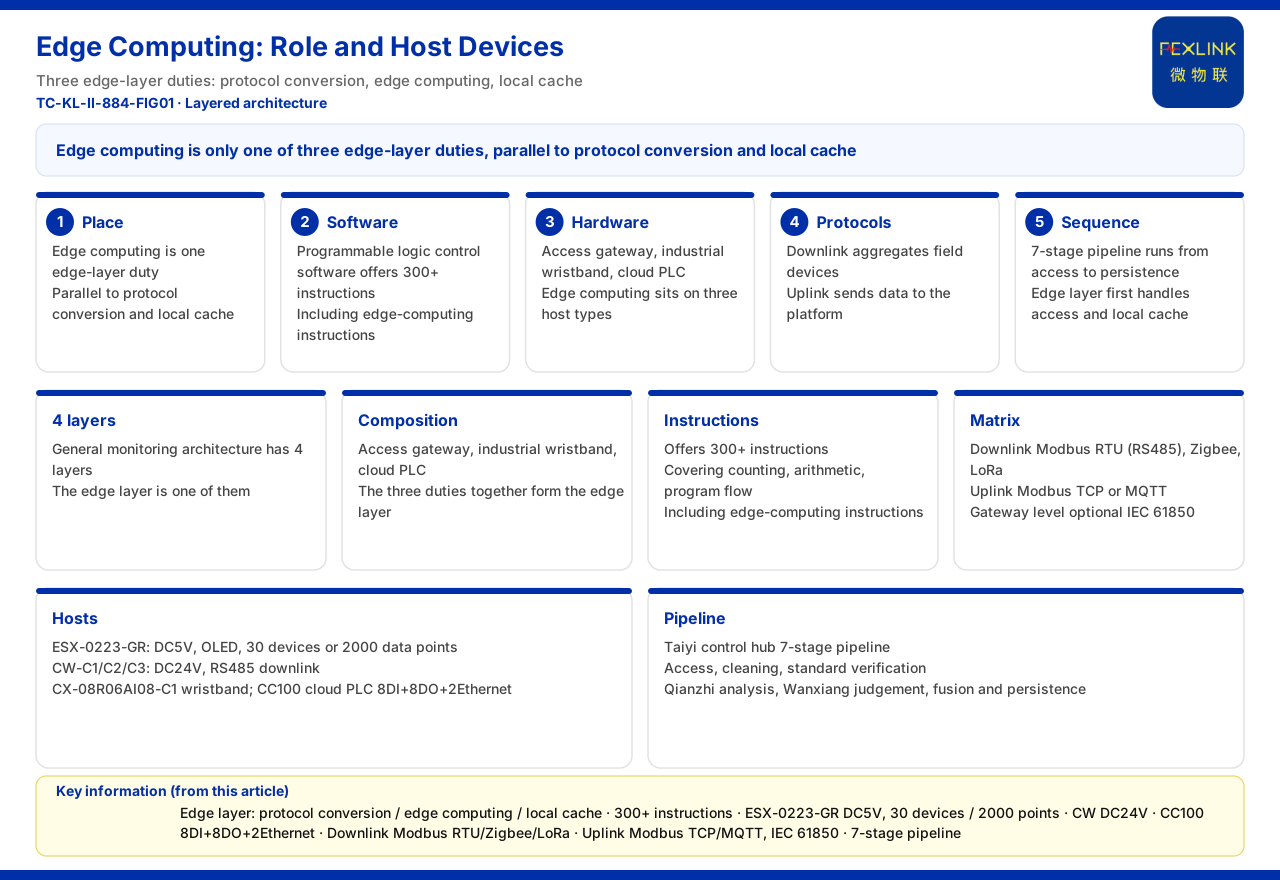
The product knowledge base states that Mistudio provides more than 300 instructions, covering counting, arithmetic operations, program flow control and edge-computing instructions. The instruction scale determines how complex a logic a control software can express. Taken together: counting corresponds to events and output statistics, arithmetic to data processing and conversion, program flow control to branching and looping, and edge-computing instructions to computation and judgement completed locally.
The "edge-computing instructions" class deserves separate attention. It shows that Mistudio not only downloads logic to the device but also supports completing part of the computation on the device side, reducing dependence on uplink data. The product knowledge base gives the scale as "more than 300"; this article uses it to describe instruction coverage, but does not enumerate the instruction list item by item, nor infer the execution behaviour of any instruction on specific hardware.
5. Runtime environment and engineering constraints
The product knowledge base states that Mistudio can run on Windows 10, Windows 8, Windows 7, Vista and XP. This set shows broad compatibility with operating-system versions common on engineering sites, making it convenient to deploy directly on existing engineering machines without upgrading the operating system just to use the software.
Two things must be distinguished: the runtime environment is the development environment where compilation and configuration happen, while the control program runs on the host on the device side. The product knowledge base describes the two separately — the former is Mistudio's host system, the latter the running hosts such as the industrial wearable and the cloud PLC. This article distinguishes the development environment from the runtime carrier, and does not infer the device's real-time performance.
6. "The brain of the device": uses and deployment carriers
The product knowledge base positions Mistudio as "the brain of the device", with uses including intelligent transformation, electrical system control, data acquisition management and remote management. This set shows its role: not a single-scenario tool, but the hub of device-side logic and data.
On deployment carriers, the product knowledge base states that the "industrial device intelligent transformation (device brain)" scenario recommends an industrial wearable (CX-08R06AI08-C1), a cloud PLC (with expansion modules) (CC100) plus Mistudio. The cloud PLC with expansion modules corresponds to the two hosts CC100 and CC101: CC100 is 8DI and 8DO plus 2 Ethernet; CC101 adds motion control on top. This shows language conversion is not a capability that stays at the software level — it ultimately runs on a concrete host: programs are written and converted in Mistudio and executed on the industrial wearable or cloud PLC. The existence of expansion modules shows the host's capability can be expanded by point count.
7. Putting language conversion back into the engineering flow
First, in Mistudio, choose an expression language by engineering habit — the ladder diagram, instruction list or sequential function chart can each be a starting point. Second, within the same software, invoke the appropriate categories from the more than 300 instructions as needed, completing counting, arithmetic, flow control and edge computing. Third, convert between supported language pairs so the logic exists in a form better suited to maintenance or expression. Fourth, compile and download to the runtime host (the industrial wearable or cloud PLC; the cloud PLC may be CC100 or the motion-control-enabled CC101, with expansion modules as needed). Fifth, place it into the scenarios of intelligent transformation, electrical system control, data acquisition management or remote management according to its use as "the brain of the device".
Scope and limitations
First, this article only restates wording listed in the product knowledge base, and its factual boundary is limited to: Mistudio supporting programming languages such as the ladder diagram, instruction list and sequential function chart; some programming languages being freely convertible; providing more than 300 instructions (counting, arithmetic operations, program flow control, edge-computing instructions, etc.); running on Windows 10/8/7/Vista/XP; being positioned as "the brain of the device" with uses including intelligent transformation, electrical system control, data acquisition management and remote management; being proprietary software, namely a programmable logic control software system (compiler); and the scenario recommendation of an industrial wearable (CX-08R06AI08-C1) and a cloud PLC (with expansion modules) (CC100) plus Mistudio, with CC100 being 8DI plus 8DO plus 2 Ethernet and CC101 adding motion control.
Second, this article does not infer which specific language pairs can convert, nor infer the equivalence, correctness or verification conclusion of the converted program.
Third, "more than 300" instructions is a scale wording; this article does not enumerate the instruction list item by item, nor infer the execution behaviour of any instruction on specific hardware.
Fourth, the runtime environment is the development-side host system; the actual running of the control program depends on the device-side host and the on-site configuration. Specific program design, download and commissioning are engineering implementation judgements, and this article does not replace project design and verification.