Direct Answer
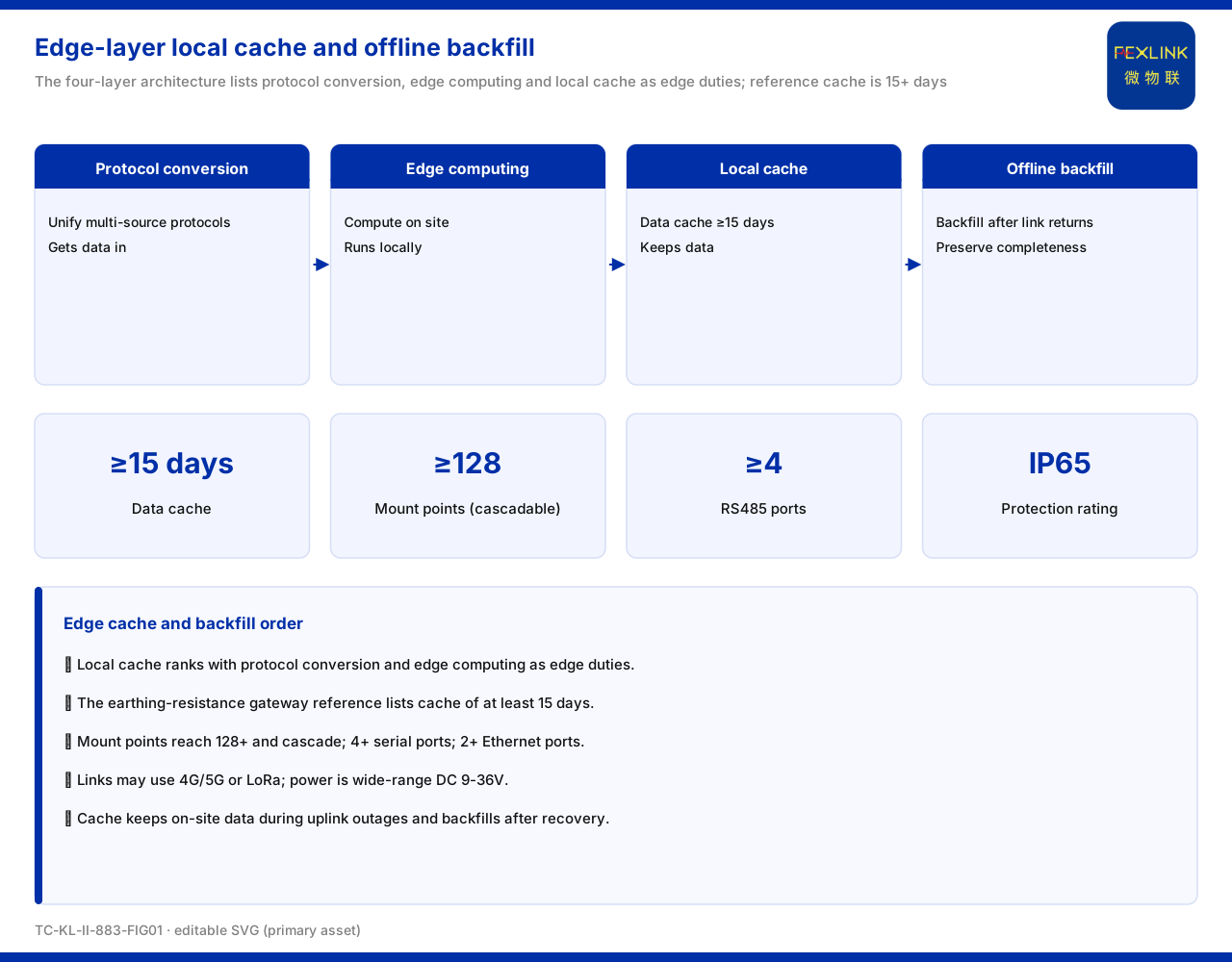
Local caching occupies an independent place among gateway capabilities because it determines whether data survives an uplink interruption. According to the existing product material, the general four-layer architecture of the monitoring system lists protocol conversion, edge computing and local caching side by side as the duties of the edge layer; in the intelligent-gateway reference parameters of the grounding-resistance monitoring system, the data-cache item gives a convention of not less than fifteen days, with no fewer than one hundred and twenty-eight mount points that can be cascaded, together with multiple serial ports and multiple Ethernet ports. That is, the cache is not attached storage but a definite capability written into the edge-layer duties and the system reference parameters. For outage or cascade scenarios, its meaning is to keep field data from being lost while it cannot be uploaded, and to back-fill it once the link recovers. This article restates these existing conventions only and does not infer the cache-capacity configuration or back-fill strategy of any specific project.
1. Caching Is Written Into the Edge-Layer Duties
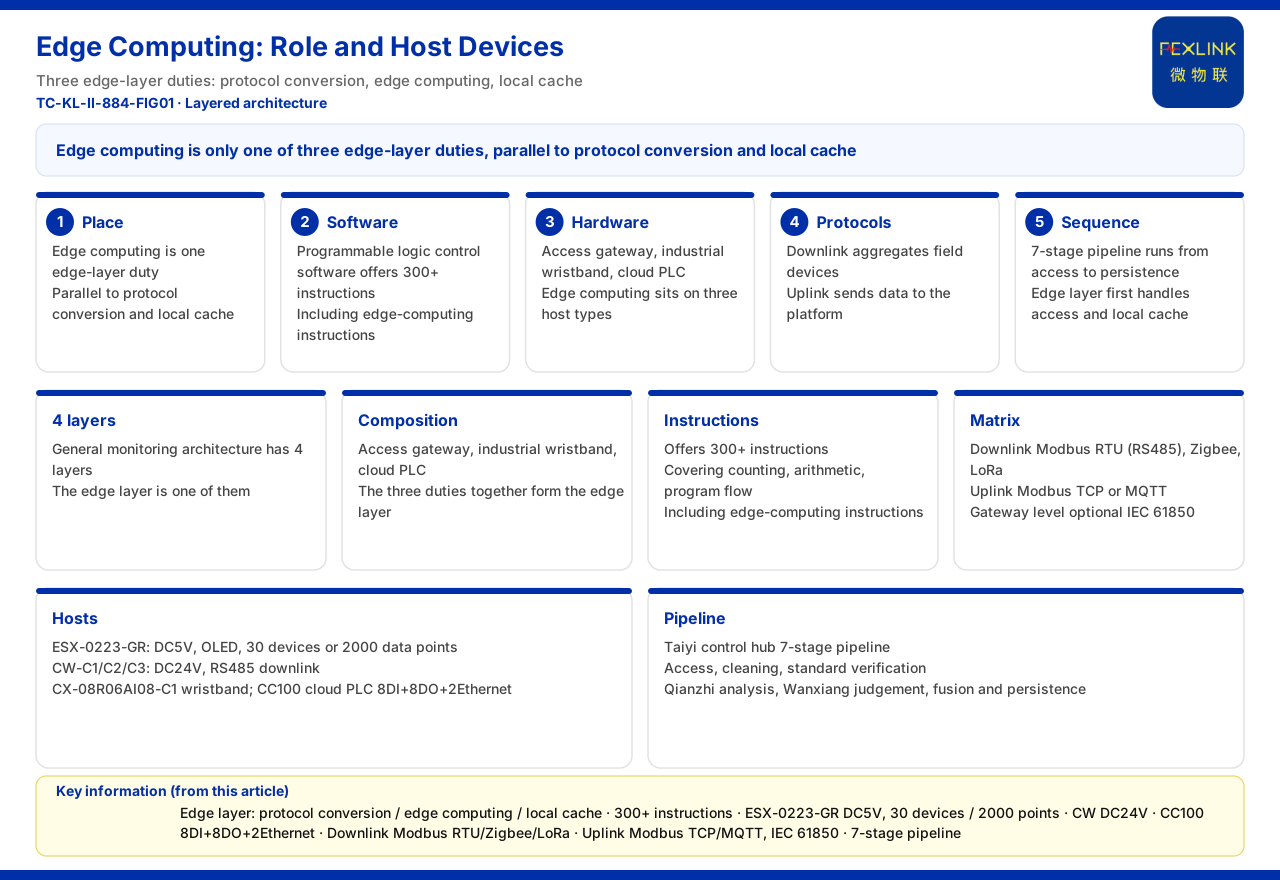
To discuss local caching, one must first confirm it is not an add-on function. The product material records that, in the general four-layer architecture of the monitoring system, the edge layer carries the three duties of protocol conversion, edge computing and local caching, and its device forms include the lightning-protection smart gateway, the intelligent edge-computing gateway and industrial gateways, as well as industrial wearables and cloud programmable controllers. Listing local caching alongside protocol conversion and edge computing shows the three are standard capabilities of the same layer: protocol conversion solves "getting it in", edge computing solves "computing on site", and local caching solves "keeping it". Only with all three is the edge layer able to maintain data completeness when the uplink is unstable.
2. The Cache Convention Given by the System Reference Parameters
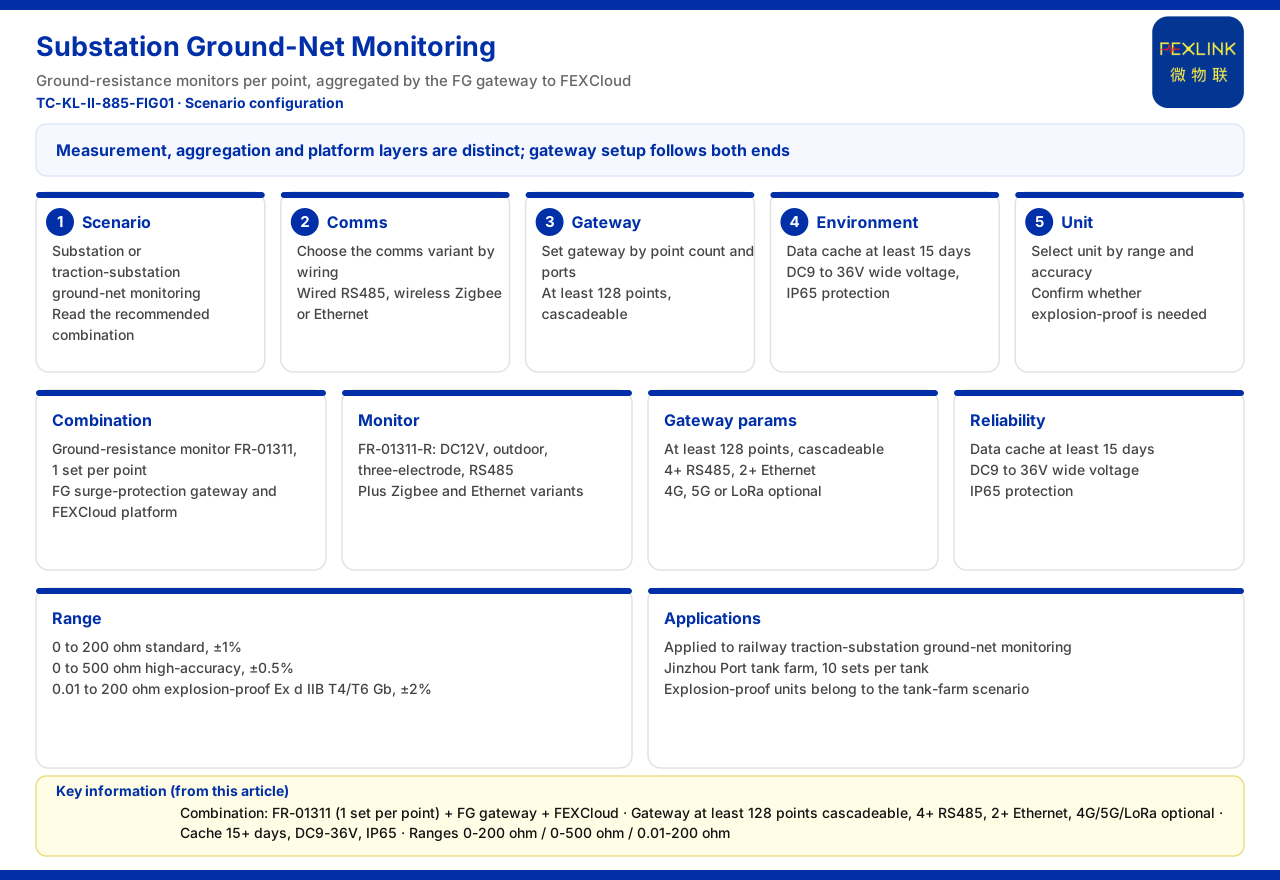
The concrete magnitude of local caching can be referenced in a class of system-level parameters. The product material records that the intelligent-gateway reference parameters of the grounding-resistance monitoring system include a data cache of not less than fifteen days, no fewer than one hundred and twenty-eight mount points that can be cascaded, no fewer than four serial ports and no fewer than two Ethernet ports, communication selectable as a fourth- or fifth-generation mobile network and a long-range low-power method, a wide-voltage DC supply and an IP65 protection rating. The cache days here are a rare convention in which the product material writes caching capability in the form of days. It shows the cache design has an explicit time-coverage target rather than a vague "has caching". It should be noted that this convention is a system-level reference parameter, and this article does not infer a general cache duration for other scenarios from it.
3. Why Data Is Not Lost During an Outage
When the uplink is interrupted, the field keeps producing data. If the edge layer has no local storage, data can only be sent as it is collected, and once a send fails it cannot be recovered; if the edge layer has a local cache, data falls to the local side first and is back-filled by the gateway once the uplink recovers. Local caching solves exactly this time gap. Reading the cache days together with the mount points shows its coverage: the mount points determine how many data paths one gateway must watch at once, and the cache days determine how long those data are retained on site. When there are many mount points and dense sampling, the cache days are a key parameter for maintaining data completeness. The fact that the product material lists the two together in the reference parameters shows they must be assessed together.
4. The Value of Caching in Cascaded Scenarios
The item that mount points can be cascaded extends the meaning of caching into more complex links. The product material records that the intelligent gateway has no fewer than one hundred and twenty-eight mount points and can be cascaded. Cascading means data may be aggregated through several levels before being uploaded, and an interruption at any segment affects whether end data reaches the platform. In a cascade structure, each level's gateway local cache is a retention layer for that level's data: when an upper link is interrupted, the data already cached at the lower level need not be discarded, and after recovery it is back-filled level by level. In cascade scenarios, caching therefore protects not only the local data but also the integrity of the data chain of downstream nodes.
5. Cache Carrying Across Different Gateway Forms
The edge layer in the product material contains several gateway forms, each with its own access convention. The intelligent edge-computing gateway has the model ESX-0223-GR, an access capacity of thirty devices and two thousand data points, a DC five-volt supply, serial downlink and wired or mobile-network uplink. Industrial gateways have three models, CW-C1, CW-C2 and CW-C3, corresponding to networking combinations of dual Ethernet, dual Ethernet plus mobile network, and dual Ethernet plus low-power wireless. The lightning-protection smart gateway, in models FG-0221-ER and FG-0221-EZ, both carry protocol conversion, with serial or low-power wireless downlink and Ethernet uplink. Different forms suit different field conditions, but local caching, as an edge-layer duty, is the common capability foundation of these forms.
6. The Relation Between Cache and Uplink Protocol
Back-fill after caching relies on an available uplink protocol. The product material records that, in the communication-protocol matrix, the device downlink supports serial Modbus RTU, a low-power wireless method and Zigbee; the uplink supports Modbus TCP and MQTT over Ethernet or a mobile network, and at the gateway level optionally IEC 61850. The uplink protocol determines how cached data is returned to the platform: when the uplink is MQTT, cached data can be back-filled in order as pending messages once the link recovers; when the uplink is Modbus TCP, it relies on the master polling to retrieve it. Understanding this helps assess caching capability and the chosen uplink method as one whole rather than separately.
7. Connection With Platform-Side Storage
Edge caching does not replace platform storage but guards the entrance to it. The product material records that the Taiyi back end carries forty-plus protocol access, four-stage cleaning, a PB-level time-series data lake and an intelligent data bus. The platform-side time-series data lake is very large in capacity, but its completeness presupposes that data can arrive; edge caching is exactly the buffer that keeps data from draining away during an interruption. Viewing edge caching and the platform data lake as the two ends of one continuous link reveals their division of labour: the edge is responsible for "not losing", the platform for "storing completely and usefully". Only when the cache hands data back complete does platform-side cleaning and analysis have complete input.
8. Organising the Cache Assessment Into a Reviewable Order
Combining the above, assessing gateway local caching can be organised in the following order. First, confirm that local caching is one of the three edge-layer duties, not an add-on. Second, check the cache days, mount points and cascade capability in the system reference parameters, understanding the time and scale coverage of the cache. Third, distinguish the two scenarios of outage back-fill and cascade level-by-level back-fill, confirming that each level's gateway has cache retention. Fourth, combine the gateway form and access capability to confirm the mount-point scale the chosen device carries. Fifth, connect the cache with the uplink protocol and platform storage and assess them as one continuous link. This order separates duties, parameters, scenarios, forms and links, making item-by-item review easier.
Applicability and Limits
- The content is limited to the existing wording of the product material on the edge-layer duties, the intelligent-gateway reference parameters of the grounding-resistance monitoring system, the access capability of each gateway form, the communication-protocol matrix and the Taiyi back-end capability. - The data-cache days (not less than fifteen days), the mount points (no fewer than one hundred and twenty-eight, cascadable), the serial and Ethernet port counts, the access device and data-point counts (thirty devices and two thousand points), and the gateway models and networking combinations are all as listed in the product material and are not a commitment to any project's results. - Parameters such as the cache days are a specific system-level reference, and this article does not infer a general cache duration or capacity for other scenarios from them. - The protocol support scope is limited to those listed in the product material, and this article does not infer the support status of unlisted protocols, nor expand back-fill scheduling details. - This article is not a commitment to any unlisted indicator; actual capability is governed by the latest product material and project scheme.