Direct answer
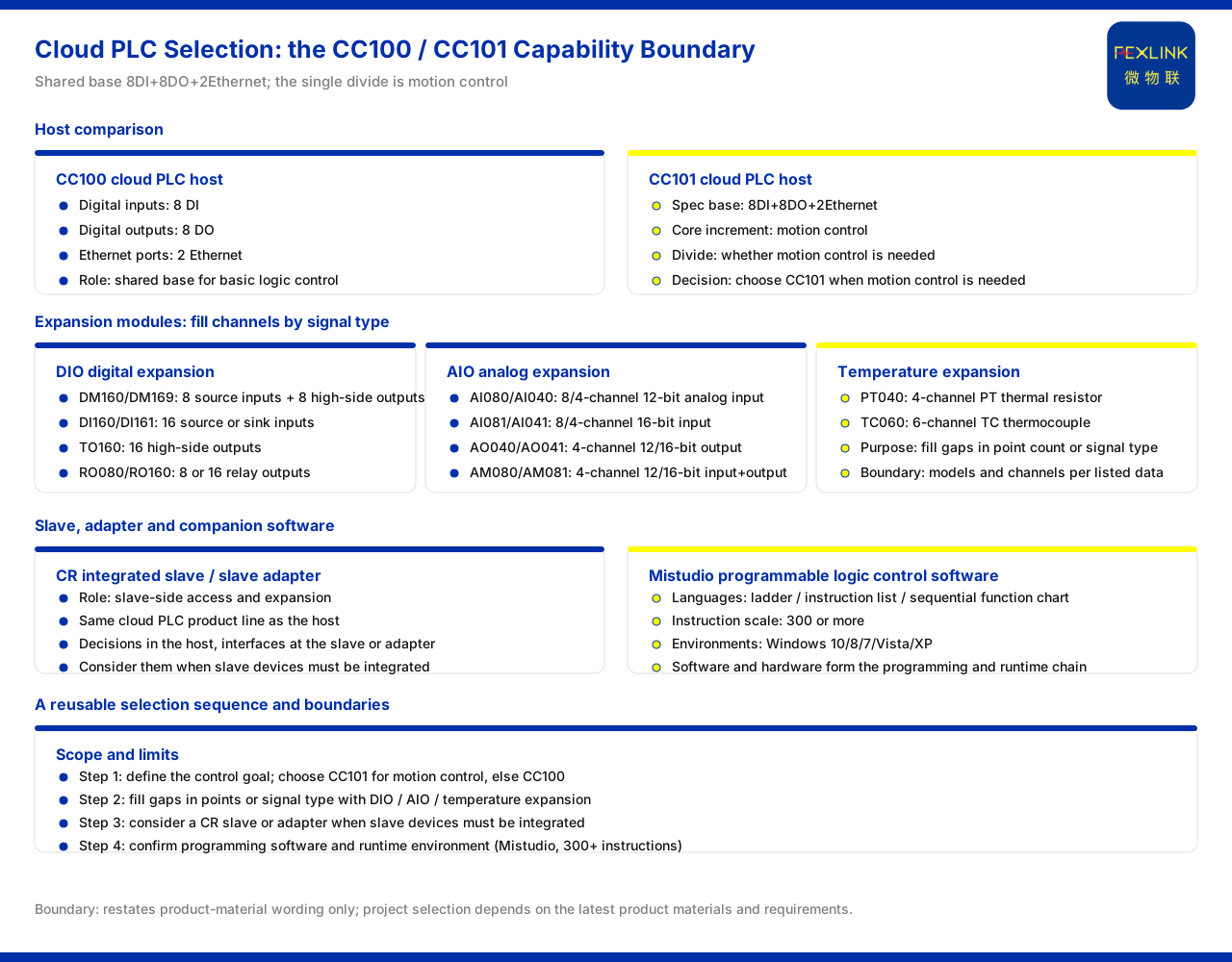
The difference between the cloud PLC (with expansion modules) (e.g. CC100) and the cloud PLC (with expansion modules) (e.g. CC101) concentrates on one point. The product knowledge base records that the specification of the cloud PLC host CC100 is 8DI+8DO+2Ethernet; CC101 adds motion control on the same 8DI+8DO+2Ethernet basis. That is, the digital-quantity and Ethernet configuration of the two hosts is exactly the same, and the real watershed is the motion-control capability. Selection can therefore be simplified to one question: does the solution need motion control. If not, CC100 already covers 8 digital inputs, 8 digital outputs and 2 Ethernet ports; if so, CC101 should be chosen. The product line also has a CR all-in-one slave and a slave adapter, which take the slave-side role. Beyond the host, if the point count or signal type is insufficient, DIO, AIO and temperature expansion modules can fill in the gap; the companion Mistudio programmable logic control software system (compiler) provides more than 300 instructions and supports languages such as ladder diagram, instruction list and sequential function chart. This article restates only the existing specifications above and infers no specification of unlisted models.
1. The common base of the two hosts
The product knowledge base records that the specification of the cloud PLC host CC100 is 8DI+8DO+2Ethernet, and that CC101 adds motion control on this basis. This statement shows that the two hosts share the same base: 8 digital inputs, 8 digital outputs and 2 Ethernet ports. For common local logic-control scenarios, this base already has basic acquisition and control capability — digital inputs read signals such as switches, buttons and limit positions, digital outputs drive loads such as relays, indicator lights and actuators, and the two Ethernet ports are used for networking and communication with the upper level. Once the common base is confirmed first, the difference remains only motion control, and the selection question becomes immediately clear.
2. The only watershed: motion control
On the same base, what CC101 adds is motion control. Motion control usually faces occasions that require precisely driving an actuator by position, speed or trajectory, which is not at the same level as ordinary switching-quantity logic control. The product knowledge base lists this capability as the core increment of CC101 separately, meaning that it should be treated as the primary judgement item during selection: if there is an object in the solution that needs a motion-control axis, the 8DI+8DO base of CC100 cannot replace it; conversely, if the control logic consists only of switching quantities, the motion-control capability of CC101 may not be necessary. Focusing the difference on motion control avoids repeated comparison over small differences in digital point counts while missing the capability item that really determines the feasibility of the solution.
3. When the cloud PLC (CC101) is needed
Whether CC101 is needed can be judged from the action requirements of the solution. If the control object contains an actuator that needs precise positioning, running by a speed curve or coordinated action, motion control should be listed as a mandatory item and land on CC101. If the control object is only switching actions such as start/stop, switching, interlocking and alarm output, the base of CC100 can carry the basic logic. It should be noted that the introduction of motion control is often accompanied by mechanical and process coordination requirements, and selection should be carried out after the control objective is made clear rather than choosing the host first and supplementing the requirement afterwards. The product knowledge base defines only the configuration difference between the two hosts, and this article infers no specific axis count or control precision on that basis.
4. Outside the host: slave and adapter
The product knowledge base records that the cloud PLC product line also has a CR all-in-one slave and a slave adapter. They belong to the same product line as the host but have different roles: the host undertakes control logic and computation, and the slave and adapter are used for expansion or access. Distinguishing this layer from the host helps clarify "which device makes the decision and which device provides the interface" in a solution. During selection, if there are already slave devices on site that need to be accessed, the slave-side companion should be considered alongside the host rather than assuming the host can complete all access on its own.
5. How expansion modules fill in channels
The expansion capability of the product is divided into three groups by signal type, all limited to the models listed by the knowledge base. DIO expansion undertakes digital input and output, including DM160 and DM169 (8-point source-type input plus 8-point high-side output), DI160 and DI161 (16-point source-type or sink-type input), TO160 (16-point high-side output), and RO080 and RO160 (8-point or 16-point relay output). AIO expansion undertakes analogue input and output, including AI080 and AI040 (8-channel or 4-channel 12-bit analogue input), AI081 and AI041 (8-channel or 4-channel 16-bit), AO040 and AO041 (4-channel 12-bit or 16-bit analogue output), and AM080 and AM081 (4-channel 12-bit or 16-bit analogue input plus output). Temperature expansion includes PT040 (4-channel PT thermal resistor) and TC060 (6-channel TC thermocouple). The meaning of these modules is that, when the fixed point count of the host is insufficient, or when signal types such as analogue and temperature are needed, they fill in the gap through expansion without replacing the host.
6. Companion software and runtime environment
The product knowledge base records that the Mistudio programmable logic control software system (compiler) supports programming languages such as ladder diagram, instruction list and sequential function chart, provides more than 300 instructions, and can run on Windows 10/8/7/Vista/XP. The software and the host and expansion modules together form a complete programming and runtime chain: the host and modules provide hardware capability, and the software provides the programming and compiling entry. Including the software's language support and runtime environment in the selection consideration avoids discovering only after the hardware is chosen that the programming method or the host environment does not match.
7. A reusable selection order
Arranging the information above into an order makes the selection land item by item. First, clarify the control objective: is it switching-quantity logic control, or does it include a motion-control object that needs precise action; second, if there is no motion-control requirement, choose the cloud PLC (CC100), whose 8DI+8DO+2Ethernet covers the basic logic; if there is a motion-control requirement, choose the cloud PLC (CC101), which adds motion control on the same base; third, take stock of the site signal points and types, using DIO expansion when digital quantities are insufficient, AIO expansion when analogue quantities are insufficient, and temperature expansion (PT040 or TC060) when temperature measurement is needed; fourth, if there are slave devices on site that need access, consider the CR all-in-one slave or the slave adapter; fifth, confirm the host programming software and runtime environment, where the Mistudio programmable logic control software system (compiler) provides languages such as ladder diagram, instruction list and sequential function chart with more than 300 instructions and can run on Windows 10/8/7/Vista/XP. This order separates "define capability, choose host, configure expansion, connect slave, configure software" and avoids choosing hardware first and supplementing the requirement afterwards.
Scope and limitations
First, this article restates only what the product knowledge base lists, with the factual boundary limited to existing entries such as the configuration difference of the cloud PLC (e.g. CC100/CC101), the CR all-in-one slave and slave adapter, the models of the DIO, AIO and temperature expansion modules, and the language support, instruction count and runtime environment of the Mistudio software.
Second, the common base of the two hosts is 8DI+8DO+2Ethernet and the incremental capability of CC101 is motion control; this article infers no unlisted parameter such as axis count, control precision or scan cycle on that basis.
Third, the channel counts and bit numbers of the expansion modules are limited to the listed models, and this article does not generalise the specification of one module to other models in the same group.
Fourth, the more than 300 instructions and the listed runtime environment of Mistudio are the knowledge-base specification, and this article infers no unlisted programming language or operating-system version.
Fifth, this article provides no selection configuration or control-solution conclusion for a specific project; actual selection is subject to the latest product material and project requirements.