Direct answer
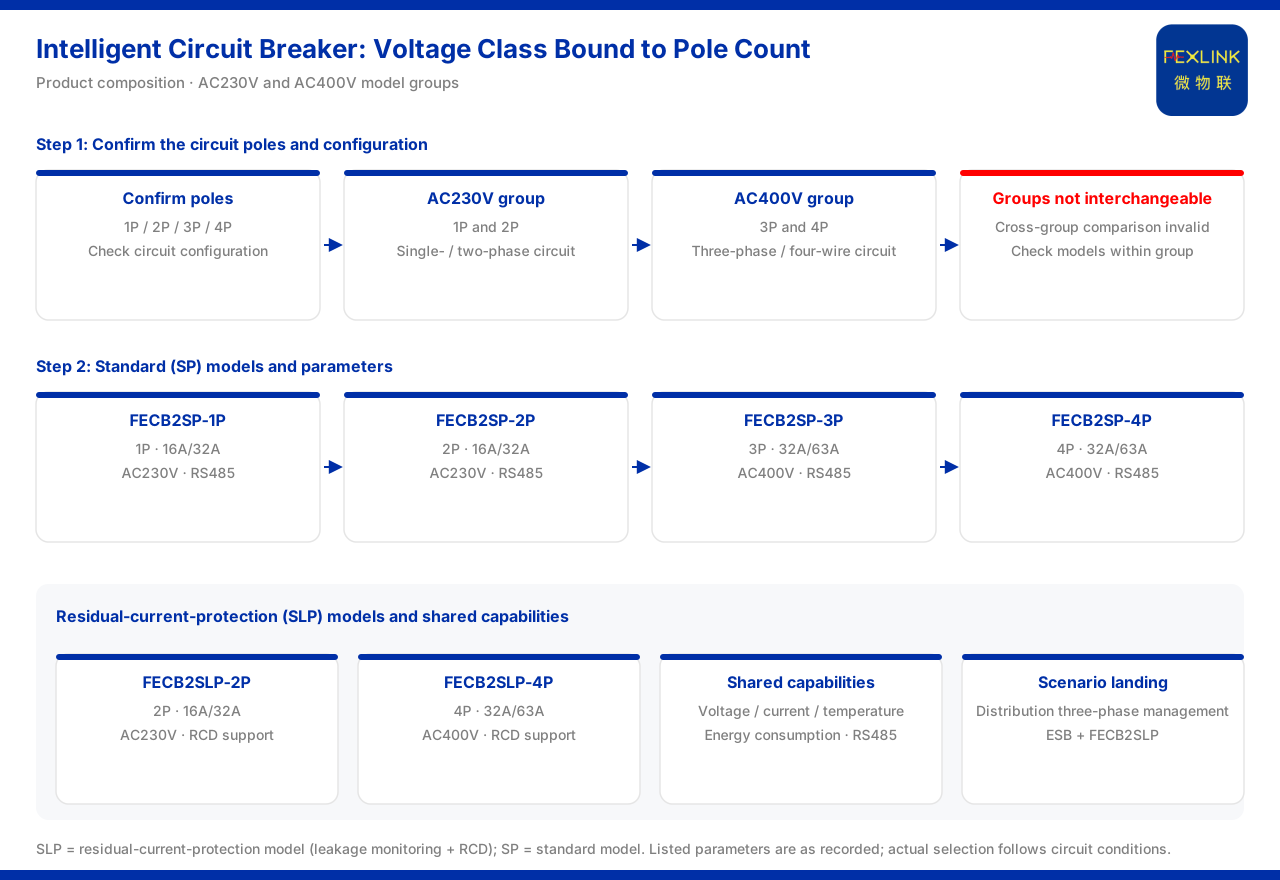
According to the knowledge base's intelligent circuit breaker table, voltage class and circuit configuration appear bound together: the intelligent circuit breaker (standard model) (FECB2SP) is AC230V in the 1P and 2P ratings and AC400V in the 3P and 4P ratings; the intelligent circuit breaker (with residual-current protection) (FECB2SLP) follows the same grouping, with 2P at AC230V and 4P at AC400V. That is, single-phase / two-phase circuits correspond to AC230V, and three-phase / three-phase four-wire circuits correspond to AC400V. Choosing a voltage class is in essence first confirming the pole count and configuration of the circuit, then checking the model within the corresponding group.
1. Voltage class is not an independent option
Many selection exercises treat AC230V and AC400V as a freely selectable scale, fixing the voltage first and then matching the pole count. The knowledge base is not arranged that way: it gives rated voltage together with pole count and rated current on the same row. 1P and 2P fall into the AC230V group, 3P and 4P into the AC400V group; the two groups are not interchangeable, and cross-group comparison does not hold either. The first step in confirming the voltage class is therefore not to ask "230V or 400V," but to ask "how many poles is this circuit, and what is its configuration."
2. The AC230V group: 1P and 2P
In the AC230V group, the standard model lists two models:
| Model | Poles | Rated current | Rated voltage | Communication | | --- | --- | --- | --- | --- | | FECB2SP-1P | 1P | 16A/32A | AC230V | RS485 | | FECB2SP-2P | 2P | 16A/32A | AC230V | RS485 |
This group corresponds to single-phase and two-phase circuits, with rated currents of 16A/32A and RS485 communication.
3. The AC400V group: 3P and 4P
In the AC400V group, the standard model likewise lists two models:
| Model | Poles | Rated current | Rated voltage | Communication | | --- | --- | --- | --- | --- | | FECB2SP-3P | 3P | 32A/63A | AC400V | RS485 | | FECB2SP-4P | 4P | 32A/63A | AC400V | RS485 |
This group corresponds to three-phase and three-phase four-wire circuits, with rated currents of 32A/63A and RS485 communication. Comparing the two groups shows that pole count, voltage, and current appear as a set: 16A/32A belongs to the AC230V group, and 32A/63A belongs to the AC400V group.
4. The residual-current-protection model follows the same grouping
The note beneath the knowledge base table states: SLP = the residual-current-protection model (leakage monitoring + residual-current protection), SP = the standard model. Under the same grouping, the residual-current-protection model lists two models, 2P (FECB2SLP-2P, AC230V, 16A/32A) and 4P (FECB2SLP-4P, AC400V, 32A/63A), both supporting residual-current protection. Its voltage grouping is thus the same as the standard model's; the difference lies in whether leakage monitoring and residual-current protection are carried. It should be noted that the residual-current-protection model lists only 2P and 4P; if the circuit is 1P or 3P, one should return to the corresponding tier of the standard model to check. The grouping logic is unchanged across the two product forms, so the pole count, not the presence of residual-current protection, remains the entry point for locating the correct tier.
5. What else to verify after the voltage is confirmed
Voltage is only the first check. The knowledge base's intelligent circuit breaker table lists that all standard-model and residual-current-protection models support voltage / current / temperature monitoring and energy consumption, with RS485 communication in all cases. These three monitored quantities and the RS485 communication do not change with pole count or voltage; they are capabilities common to the four standard models and the two residual-current-protection models. Once pole count and voltage are fixed, they can simply be checked as baseline conditions, without re-judging them because the voltage grouping differs. Keeping the variable and the constant apart matters for selection: pole count and voltage are variables that decide which group applies, whereas the three monitored quantities and RS485 are constants across all six models. The product-line overview places the intelligent circuit breaker (standard model / residual-current-protection model) in the circuit-breaker product line, indicating that its positioning belongs to breaker-class products on the distribution side.
6. Scenario landing point: the AC400V tier for three-phase management
The knowledge base lists the recommended combination for "distribution-automation three-phase management" as the three-phase imbalance monitor (ESB) together with the intelligent circuit breaker (with residual-current protection) (FECB2SLP). This combination lands in a three-phase scenario, which corresponds to the AC400V tier in terms of voltage grouping; combined with the pole-count range, the landing point should be 3P/4P or the 4P residual-current-protection model. The scenario gives a combination clue; which tier is actually taken must still be checked against the circuit's pole count and voltage. Conversely, if the circuit is single-phase or two-phase, its voltage class itself falls in the AC230V group, and it should not enter a model in the AC400V tier. This correspondence between voltage and circuit configuration is precisely why pole count is taken as the first item to confirm.
Scope and limitations
First, this article explains only the correspondence between the voltage class of the intelligent circuit breaker and its pole count and configuration in the knowledge base; the factual boundary is limited to the product knowledge base and introduces no standard clause, parameter, certification, or case that is not listed.
Second, the correspondences among AC230V, AC400V, 1P/2P/3P/4P, 16A/32A, and 32A/63A, as well as the RS485 communication, are all parameters listed in the knowledge base; this article does not extend them to other models.
Third, SLP = residual-current-protection model and SP = standard model, as well as the "distribution-automation three-phase management" recommended combination, are existing records in the knowledge base; this article draws no unlisted functional or performance conclusion from them, nor does it infer parameters such as the tripping curve that the knowledge base does not list.
Fourth, this article does not provide a selection calculation method based on voltage or load; actual selection should be determined in conjunction with on-site circuit conditions and engineering design.