Direct answer
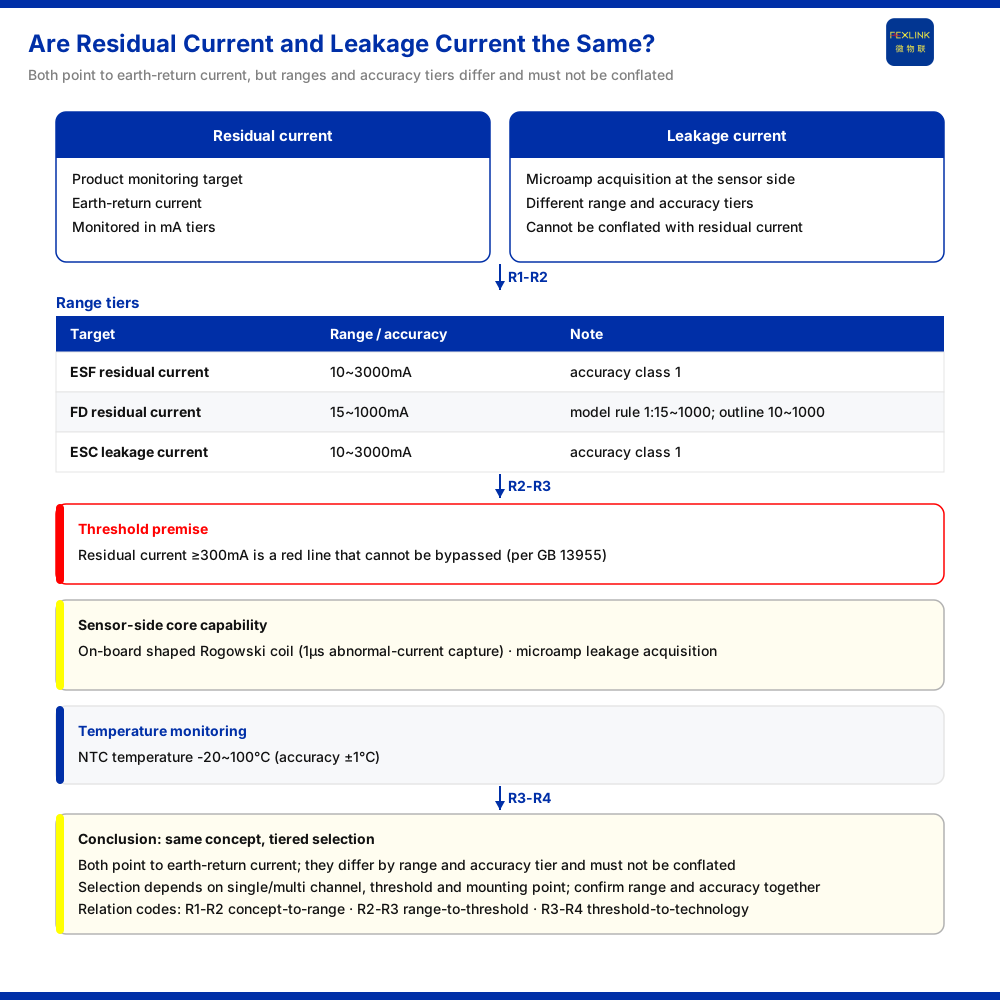
In an engineering context residual current and leakage current cannot simply be equated. The knowledge base places them under the specifications of different products: those that take residual current as the monitored object are the electrical fire monitoring controller and the mains monitoring module, the former covering 10~3000 mA (class 1 accuracy) and the latter 15 mA~1000 mA; the one that takes leakage as the monitored object is the multi-channel leakage monitoring controller, covering 10~3000 mA (class 1 accuracy). Both point to current flowing from a circuit to earth, but the ranges and accuracy tiers differ, and so do the product forms. In addition, the knowledge base records microampere-level leakage current acquisition on the sensor side, belonging to another, fainter class of signal acquisition. Unclear terminology readily leads to a range and accuracy mismatch at selection.
The two terms land in different places in the knowledge base
The knowledge base does not use residual current and leakage current as one and the same term. Residual current appears in the key parameters of the electrical fire monitoring controller and in the product name of the mains monitoring module; leakage appears in the key parameters of the multi-channel leakage monitoring controller. The same knowledge base names different products and monitored objects with two words — a clue in itself that they each have their own place in engineering usage.
In everyday speech the two are often treated as synonyms, but once they land on specific products and ranges the difference shows. Checking the two words separately is the first step in avoiding a configuration mismatch.
Residual current: two ranges
The key parameters the knowledge base gives for the electrical fire monitoring controller are: residual current 10~3000 mA, class 1 accuracy; NTC temperature measurement -20~100 °C, ±1 °C. This set places residual current and temperature monitoring on one device, showing that residual current monitoring often appears together with temperature measurement.
The mains (residual current) monitoring module provides another range. The knowledge base lists FD-01011-R as 1 residual current channel covering 15 mA~1000 mA; the current-acquisition range code 1 in its model rule corresponds to 15 mA~1000 mA, while the product outline positions it at 10 mA~1000 mA. The same product showing two lower limits, 15 mA and 10 mA, under different descriptions means that when reading a parameter one must see clearly whether the figure comes from the model rule or the product outline, and must not conflate the two.
The point of listing the two ranges side by side is to cover different scenarios: where a wider upper limit is needed, the 10~3000 mA tier applies; where a smaller current interval is the target, the 15 mA~1000 mA tier applies. Beyond range, the accuracy tier is also a condition that must be confirmed at the same time during selection.
Leakage current: the range of the multi-channel controller
The key parameter the knowledge base gives for the multi-channel leakage monitoring controller is leakage 10~3000 mA, class 1 accuracy. Compared with the residual current products, this tier has the same upper range limit; the difference is the product positioning as multi-channel monitoring, aimed at situations requiring several circuits to be monitored at once. When a project needs to cover several circuits at one measurement point, the landing point is therefore the leakage controller, not a single-channel product named for residual current.
Class 1 accuracy is the specification common to both residual current products and the leakage controller, showing that this accuracy tier covers a fairly wide current range. At selection, range determines how wide the measurement can go and accuracy determines how comparable the readings are; neither can be considered alone.
Microampere-level leakage current acquisition sits on the sensor side
Besides the milliampere-level residual current and leakage, the knowledge base also records a capability for fainter signals: the core technology is a board-mounted shaped Rogowski coil with 1 μs-class abnormal current capture, and it includes microampere-level leakage current acquisition. This item belongs to sensor technology and is not on the same order of magnitude as the milliampere product parameters above.
It matters to treat this item separately: microampere-level leakage current acquisition describes the acquisition capability of the front-end sensor, not the range parameter of a monitoring controller. It cannot be applied directly as the range of a residual current product, nor used to infer the measurement range of a model.
The red-line premise: residual current ≥ 300 mA
The knowledge base lists "residual current ≥ 300 mA" as a non-bypassable red line, on the basis of GB 13955. A red-line designation means this threshold is a criterion that may not be relaxed at will. Understanding this helps set the direction of range configuration: since there is a threshold that must be intercepted, the range of the selected product should be able to cover the reading interval around that threshold, otherwise the criterion will lack a usable data basis.
The check order at selection
Taken together, distinguishing the two terms comes down to one check order: first confirm whether the monitored object is residual current or leakage current, then determine the range tier according to the on-site current interval, then confirm the required accuracy class, and finally judge whether the form is single-channel or multi-channel. The knowledge base separates the two object classes by different product names and range parameters precisely to remind the reader to check each item in turn at selection.
Applicability and limits
First, this article only explains the difference in scope between residual current and leakage current in the knowledge base; its factual boundary is limited to the product knowledge base, and it introduces no standard clauses, parameters, certifications or cases the knowledge base does not list.
Second, the electrical fire monitoring controller's residual current 10~3000 mA (class 1 accuracy) and NTC temperature measurement -20~100 °C (±1 °C), the mains monitoring module's 15 mA~1000 mA, and the multi-channel leakage monitoring controller's leakage 10~3000 mA (class 1 accuracy) are all parameters listed in the knowledge base; this article does not extend them to other models.
Third, 10 mA~1000 mA is the positioning description in the knowledge base's product outline and 15 mA~1000 mA is its model-rule description; this article lists them as they are, without merging them and without inferring which is authoritative.
Fourth, this article does not equate the board-mounted shaped Rogowski coil's 1 μs-class capture capability and microampere-level leakage current acquisition with the range parameter of any controller; the reference to GB 13955 is limited to the residual-current red-line criteria recorded in the knowledge base, does not set out specific clauses, and makes no compliance determination.