Direct answer
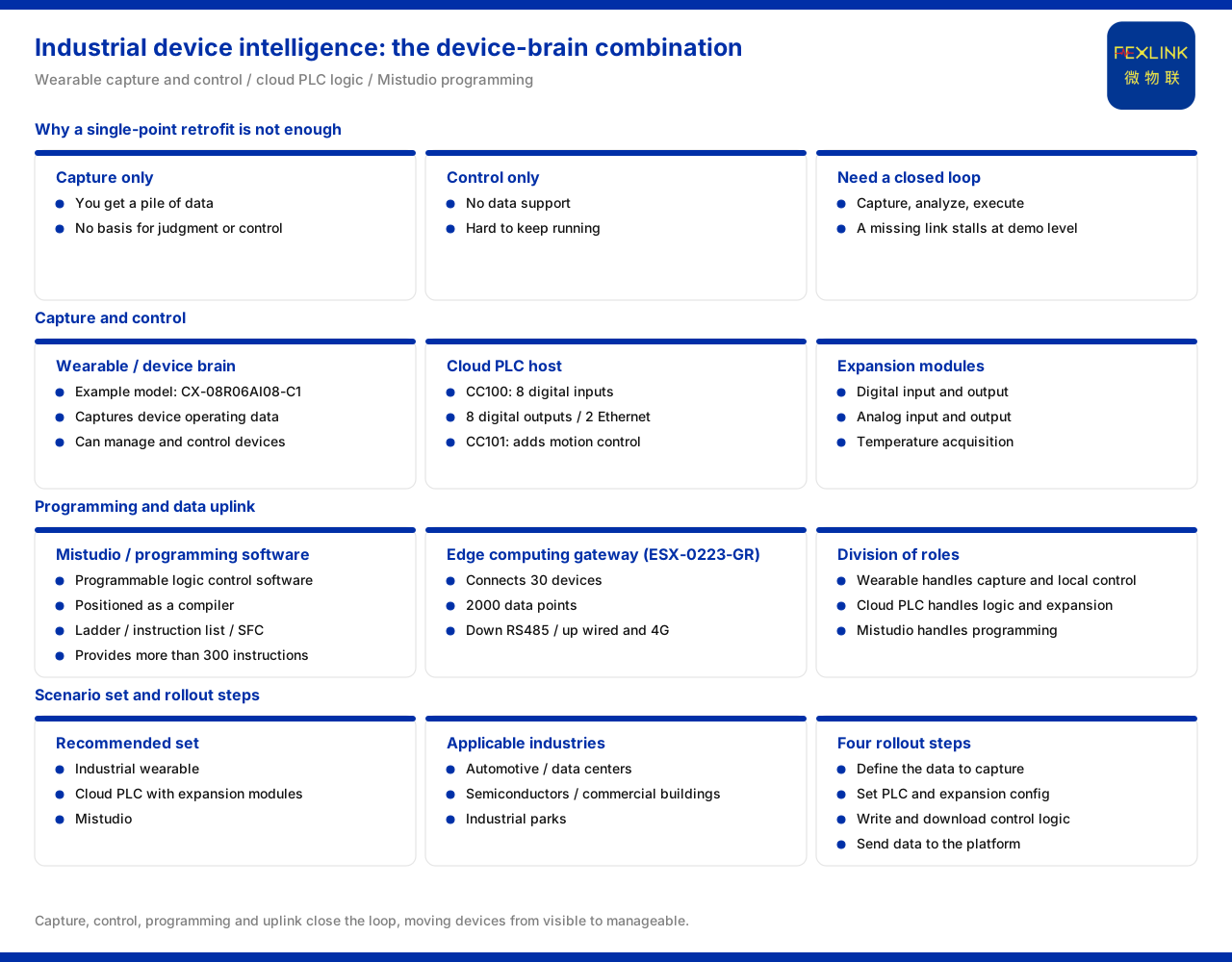
The core of intelligent retrofit for industrial equipment is not to add a display screen to the device but to make the device collectable, understandable, and manageable and controllable when necessary. The product material summarises this direction as the "device brain": the industrial wearable acquires equipment operating data and can manage and control the equipment, the cloud PLC handles logic control, and the programmable logic control software completes program writing and downloading. Combined, the three form a complete capability from acquisition to control and then to programming. This article explains this combination logic according to the material and does not derive additional field criteria.
Why single-point retrofit is not enough
If equipment intelligence solves only acquisition, the result is a pile of data; if it solves only control, it lacks a basis for judgement. A genuinely usable retrofit needs to connect acquisition, analysis and execution into a closed loop: after equipment operating data is acquired, it must be able to enter the control logic; the control logic must be writable, modifiable and maintainable; and the execution result must be observable back on the data side. Without any link, the retrofit stops at the demonstration level and is hard to run continuously.
The combination given by the material is organised around this closed loop, not as three mutually independent tools.
Acquisition and control: the positioning of the industrial wearable
The positioning of the industrial wearable is summarised as putting a "smart watch" on the equipment: it acquires equipment operating data and can also manage and control the equipment, which is why it is called the "device brain". The model example given by the material is the industrial wearable (CX-08R06AI08-C1). This positioning shows that it is not merely a passive recorder but also takes a control role over the equipment, a link in the closed loop connecting acquisition and execution.
Logic control: the cloud PLC and its models
On the control side, the cloud PLC host contains two basic models: one provides 8 digital inputs, 8 digital outputs and 2 Ethernet interfaces, corresponding to the cloud PLC host (CC100); the other adds motion-control functionality on that basis, corresponding to the cloud PLC host (CC101). The Ethernet interfaces provide a channel for programming and networking, and the motion-control model faces equipment needing position or speed control.
The cloud PLC also supports expansion modules, covering three categories: digital input and output, analogue input and output, and temperature acquisition. The digital direction includes different forms such as relays and transistors, the analogue direction covers current and voltage input and output, and the temperature direction provides two types, thermal resistance and thermocouple. Through expansion modules, the channel count of the cloud PLC can be increased or decreased according to the number of field devices and signal types, without having to equip a separate controller for each type of device.
The programming side: the role of Mistudio
Mistudio is a proprietary programmable logic control software system, positioned as a compiler; it supports programming languages such as ladder diagram, instruction list and sequential function chart, and provides more than 300 instructions. Its role is to write the control logic into a program and compile and download it to the cloud PLC. For field engineers, whether the programming languages are complete and whether the instructions are sufficient directly determine whether the retrofit can cover complex control requirements. The multi-language support and instruction scale provided by Mistudio are prepared for this need.
Data uplink: the edge-computing gateway
The data of the retrofitted equipment needs to be aggregated upward. The intelligent edge-computing gateway (ESX-0223-GR) provides access capability for 30 devices and 2000 data points, uses RS485 downward and supports wired and 4G upward. It is responsible for aggregating the downstream equipment data and sending it to the platform, so that the acquisition-side data does not stay local but can enter higher-level analysis. In this way the judgement of the device brain is supported by more complete data.
Scenario combination and industry landing points
According to the typical application scenarios in the material, the recommended combination for the industrial-equipment intelligent-retrofit direction is the industrial wearable, the cloud PLC (including expansion modules) and Mistudio. That is, acquisition and control are carried by the wearable and the cloud PLC, programming by Mistudio, and data uplink connected by the edge-computing gateway. At the industry level, the applicable industries of the Taiyi intelligent control hub system include automotive manufacturing, data centres, semiconductors, commercial buildings and industrial parks, which can serve as a reference for the industries where equipment intelligent retrofit lands.
From standalone to closed loop
Connecting the parts above, the retrofit proceeds as follows: first clarify which operating data is to be acquired, then determine the configuration of the cloud PLC and expansion modules according to signal types, then use Mistudio to write and download the control logic, and finally send the data to the platform through the edge-computing gateway. The four steps form a closed loop, and the equipment moves from "can be seen" to "can be managed".
Why programming capability is also brought into the retrofit
Industrial-equipment intelligent retrofit often needs to implement interlocking, sequencing and conditional control on site, and these logics cannot be exhausted by fixed firmware. If the controller cannot be programmed, the retrofit can only cover a small number of pre-designed functions; once the process changes, the equipment must be replaced again. Bringing programmable capability into the combination means the control logic can be rewritten as the process is adjusted, and the applicable scope of the retrofit is thereby expanded. This is also why the material includes software and hardware together in the recommended combination.
The division of labour among acquisition, control and programming
In this combination, the industrial wearable leans towards acquisition and local control, the cloud PLC towards logic control and channel expansion, Mistudio towards program writing and compiling and downloading, and the edge-computing gateway is responsible for data uplink. The four have different duties but point to the same goal: to make the equipment state obtainable, the control logic adjustable and the operating result reviewable. Understanding the division of labour clearly prevents confusing data acquisition with control retrofit during field implementation.
The flexibility brought by expansion
The expansion modules of the cloud PLC cover the three categories of digital, analogue and temperature, so that the channel count can be increased or decreased according to the number of devices and signal types. For a retrofit project, this flexibility means there is no need to configure the same set of controllers for each device; instead, expansion can be combined according to the field signal distribution. Flexibility brings finer configuration, but it also requires the signal list to be clarified at the design stage, otherwise the expansion modules may be idle or insufficient.
Several boundaries that need explanation
- The models and interface configurations are based on the formulations listed in the material; the specific selection should be determined together with the field signal list. - The programming languages and instruction count describe the capability range of the software and do not constitute a promise of control effect. - The scenario combination gives a direction of capability matching and does not replace scheme design for specific equipment and processes.
Scope and limitations
- The content of this article is limited to the existing statements in the product material regarding the industrial wearable, the cloud PLC and its expansion modules, the Mistudio programmable logic control software, the intelligent edge-computing gateway and the applicable industries of the Taiyi intelligent control hub system. - The model examples, input and output configuration, programming languages and instruction count, gateway access capability and interfaces, typical scenario combination and applicable industries are all formulations listed in the material. - This article explains the capability combination and the way to advance an intelligent retrofit of industrial equipment; it gives no specific retrofit scheme, control program or benefit promise, and actual implementation should be determined together with field equipment, process requirements and the project scheme. - Other field conditions, installation methods and maintenance cycles not listed in the material are not inferred or promised here.