Direct answer
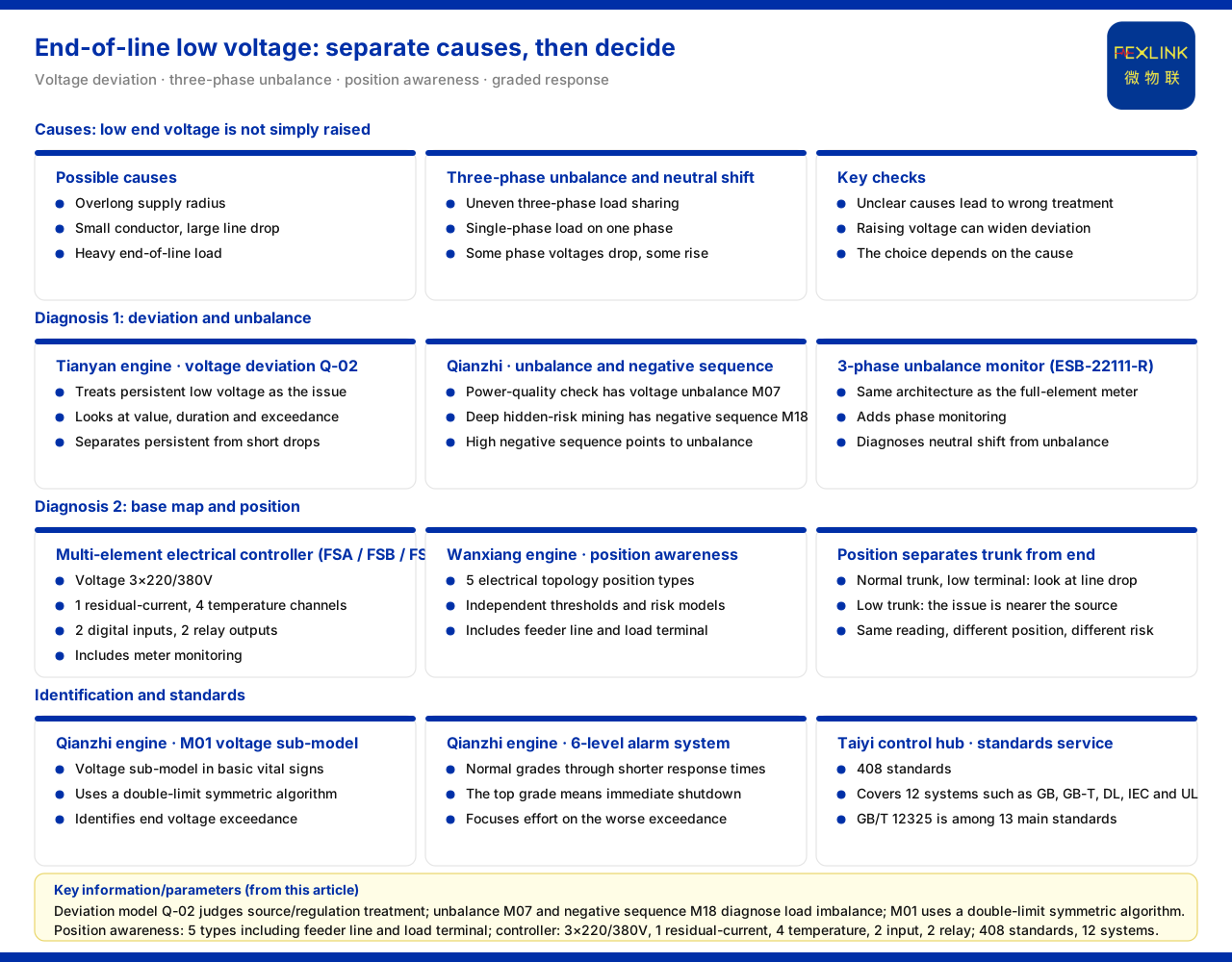
When the voltage at the end of a line stays low for a long time, the most direct reaction is often to install a voltage stabiliser or regulating device to raise it. But low voltage is only a result; the cause may be an excessively long supply radius, an undersized conductor, a neutral-point shift caused by three-phase imbalance, or a heavy load at the end. Raising the voltage without distinguishing among these, at best treats the symptom and not the cause, and at worst conceals a real hazard. The path given by the product material is: first use the voltage-deviation model to judge whether this is a problem that needs to be handled from the source or the regulating side, then use voltage imbalance and negative-sequence components to diagnose whether it comes from load imbalance, and combine position to distinguish the trunk, the branch and the end, and finally decide the response according to the voltage sub-model and alarm grading. This article explains this path according to the product material and does not derive additional field criteria.
Why end-of-line low voltage cannot be solved by "raising it whenever it is low"
Low voltage at the end is a common phenomenon in a distribution network, but its causes differ and so do the ways of handling it. If the three-phase load is unevenly distributed, or a large number of single-phase loads are concentrated on one phase, the imbalance current superposes on the neutral line and causes a neutral-point potential shift, lowering some phase voltages and raising others. What is really needed then is to balance the load or adjust the operating mode; simply raising the voltage pushes some phases even higher and instead widens the deviation. If the cause is an excessively long supply radius or an undersized conductor, the line voltage drop itself is large, and this is closer to a problem that needs to be considered from the supply and regulating side. Without distinguishing the causes, the direction of mitigation will be wrong.
Step one: judge whether this is a voltage-deviation problem
The power-quality section of the Tianyan engine includes a voltage-deviation model. The role of voltage-deviation analysis is to examine a long-term low voltage at the end as a problem that needs to be handled from the supply or regulating side, rather than concluding merely by "raising it whenever it is low". Through the magnitude, duration and degree of over-limit of the voltage deviation, the problem can first be classified: whether it is a persistent deviation or a short-time drop that varies with the load period. The former is more likely related to the supply conditions, and the latter more likely to the load characteristics. Once the classification is clear, the subsequent investigation has a direction.
Step two: investigate three-phase imbalance and neutral-point shift
Beyond voltage deviation, it is also necessary to see whether the three phases are imbalanced. The power-quality examination of the Qianzhi engine includes a voltage-imbalance sub-model; the deep-hazard-mining part includes negative-sequence component analysis. These two correspond to voltage problems caused by three-phase or load imbalance. If the voltage of one phase at the end is clearly lower than that of the others and the negative-sequence component is high, imbalance is an important suspect. On site, the ESB three-phase imbalance monitor (for example ESB-22111-R) can be used to obtain phase data: it shares the architecture of the all-parameter smart meter and adds phase-monitoring functionality on that basis, and is used to diagnose the neutral-point shift caused by three-phase imbalance. With phase data, it becomes possible to separate "the voltage is low as a whole" from "one phase is pulled down".
Step three: build the end base map from basic electrical quantities
To land the judgement on a specific circuit, basic electrical quantities are needed as support. The common functions of the multi-parameter electrical intelligent controller series (FSA, FSB, FSE) include voltage 3 × 220/380 V, 1 residual-current path, 4 temperature paths, 2 digital inputs, 2 relay outputs, and meter monitoring. These basic quantities form the base map of end monitoring: voltage reflects the deviation of each phase, residual current and temperature reflect the safety state, and the digital inputs and relay provide linkage interfaces. Only by superimposing phase and imbalance analysis on this base can it be judged whether the low voltage is a general phenomenon or a local one.
Step four: position decides "trunk or end"
The same voltage reading, appearing at different electrical positions, does not receive the same risk judgement. The Wanxiang engine maintains independent thresholds and risk models for 5 types of electrical topology positions, including the feeder line and the load terminal. Position information can be used to distinguish whether the problem occurs at the trunk, a branch or the end: if the trunk voltage is normal while the load terminal is low, the voltage drop is mainly produced on the line, and the supply radius or conductor size deserves attention; if the trunk is already low, the problem is closer to the supply side. Position awareness turns these judgements from a feeling into a comparable distribution difference.
The voltage sub-model and alarm grading
In the identification link, the basic vital signs of the Qianzhi engine include the M01 voltage sub-model, which uses a double-limit symmetric algorithm; the system has a 6-level alarm system, from the normal tier to tiers requiring a shorter handling time, with the highest tier corresponding to immediate shutdown. An end-of-line voltage over-limit can be identified and responded to by tier. The meaning of grading is to direct the limited operation and maintenance effort first to the more serious over-limits, rather than handling every low value in the same way. Combining the voltage sub-model, phase data and position information turns end-of-line low voltage from "a number" into "a clue with position and grade".
The decision: raise the voltage or investigate the load
Returning to the original question, whether to raise the voltage or investigate the load depends on the cause. If voltage imbalance and negative-sequence components show that the problem comes from three-phase imbalance or concentrated single-phase loads, the load should be investigated and balanced first rather than raising the voltage in a hurry; if position and voltage distribution show that the problem comes from the line voltage drop from the trunk to the end, it is closer to the direction of considering the supply and regulating side. Looking at the three clues of voltage deviation, imbalance and position together is what avoids the repetition of "a stabiliser is installed but the voltage is still low". It should be explained that this article describes a diagnostic path, and the specific voltage-regulation or load-adjustment scheme should be determined together with the field conditions.
Standard formulation
At the standard level, the standard service of the Taiyi intelligent control hub system contains 408 standards and covers 12 systems such as GB, GB-T, DL, IEC and UL; among them, GB/T 12325 belongs to the 13 main standards already covered by the Qianzhi engine. Only when the judgement of end-of-line voltage deviation returns to a unified standard formulation is the conclusion more comparable and easier to keep consistent across projects in different regions.
From a single investigation to continuous monitoring
End-of-line low voltage often changes with the season, the time period and the load, and a single measurement easily gives a one-sided impression. Only by continuously accumulating monitoring data can it be seen whether the voltage is low over the long term or drops only during heavy-load periods, and whether the imbalance exists over the long term or appears only during a certain period. The two situations are handled differently: the former relies more on improving the supply conditions, and the latter more on adjusting the operating mode and load distribution. The value of monitoring is precisely to present this distinction with data, rather than investigating temporarily after each complaint. The planning of end-of-line treatment should therefore treat acquisition, analysis and response as a whole, rather than purchasing only voltage-regulating devices.
Scope and limitations
- The content of this article is limited to the existing statements in the product material regarding the voltage-deviation model of the Tianyan engine, the voltage imbalance and negative-sequence components, the voltage sub-model and alarm system, the three-phase imbalance monitor, the common functions of the multi-parameter electrical intelligent controller, and the position awareness and standard service of the Wanxiang engine. - The voltage specification, channel and interface configuration, number of position types, alarm grading, and standard-library count and number of systems are all formulations listed in the material. - This article explains the cause diagnosis and decision path for end-of-line low voltage; it gives no specific voltage-regulation parameter or load-adjustment scheme, and actual handling should be determined together with field conditions, equipment specifications and the project scheme. - Other field conditions, installation methods and maintenance cycles not listed in the material are not inferred or promised here.