Direct answer
The power-quality problem of a hospital distribution system ultimately comes down to the judgement "does it affect diagnosis and treatment and the safety of life". Power-quality management in a hospital scenario therefore cannot follow the logic of general industry or commercial buildings, which looks only at efficiency and cost; safety must be given a heavier place. The capability combination given by the product material is: the power-quality monitor acquires harmonics and other electrical quantities, the voltage-sag sub-model of the Qianzhi engine assesses sensitive equipment according to tolerance curves, the four-dimensional impact assessment of the Wanxiang engine adjusts the weights for the hospital scenario, and the Taiyi intelligent control hub system handles unified access and analysis. This article explains the logic of this combination according to the material and does not derive additional field criteria.
Why the hospital scenario is special
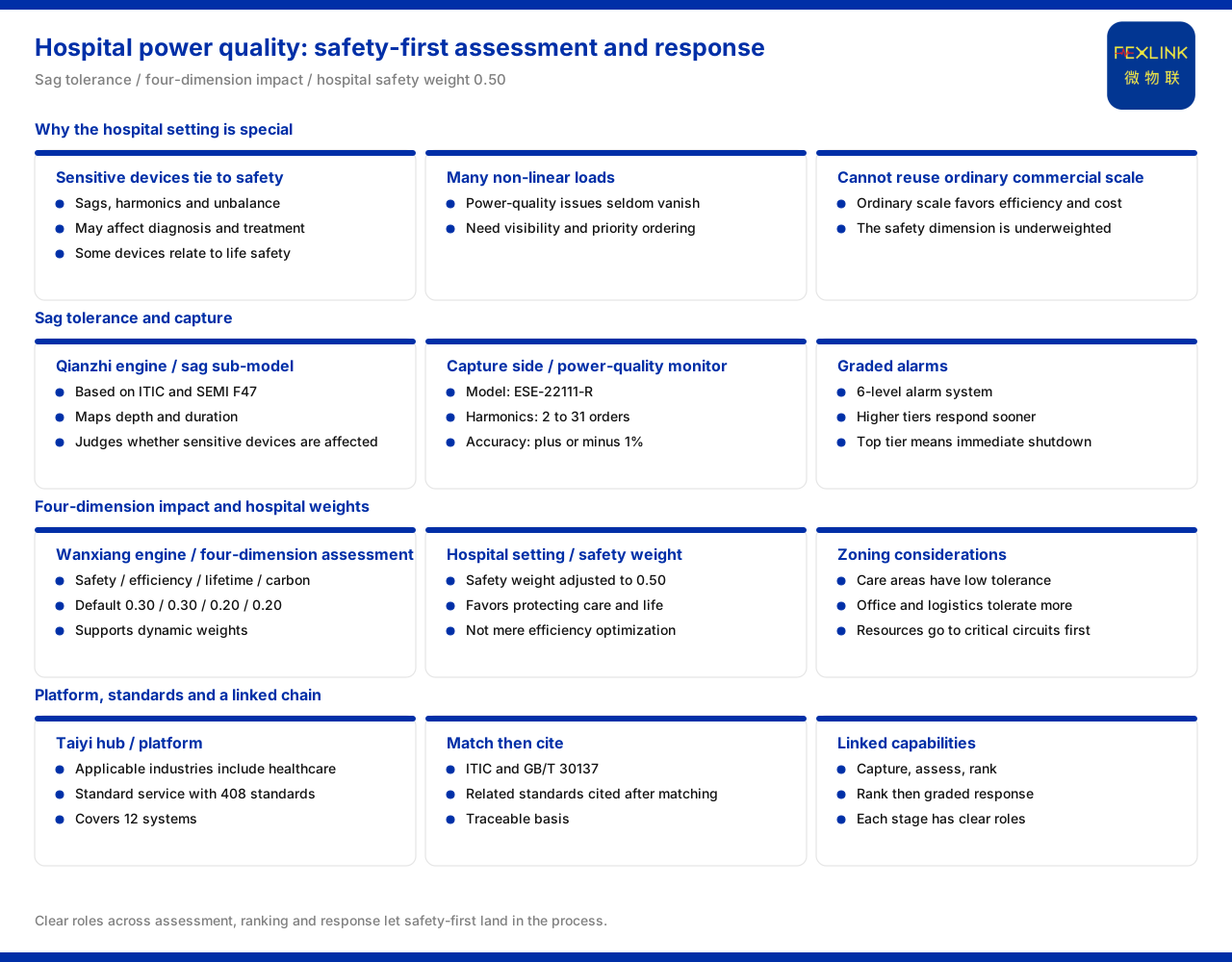
A hospital contains a large number of devices sensitive to power quality, and voltage sags, harmonics and imbalance can all affect their normal operation, while some of those devices are directly related to the treatment process and the safety of life. At the same time, a hospital also has many non-linear loads, so power-quality problems do not disappear naturally. The two together mean the hospital needs both "visible" monitoring and an assessment method that can prioritise safety.
If a hospital is managed like an ordinary commercial building, the assessment scale easily leans towards efficiency and cost, and the safety dimension carries insufficient weight. This is precisely why the material gives the hospital scenario a dynamic weight.
Tolerance assessment: how voltage sag is viewed
In the power-quality physical examination of the Qianzhi engine, voltage sag is carried by a dedicated sub-model based on the ITIC and SEMI F47 curves. The curves correspond sag depth and duration with equipment tolerance capability, to judge whether sensitive equipment may be affected. For a hospital, this assessment helps link an occasional sag event with a specific sensitive load rather than looking only at how much the voltage dropped.
The acquisition side: how harmonics and electrical quantities are taken
On the acquisition side, the ESE power-quality monitor (for example ESE-22111-R) provides harmonic monitoring, with a harmonic order range of 2 to 31 and an accuracy of ±1%. Harmonics are one of the problems requiring long-term attention in hospital distribution, and continuous monitoring data provides input for subsequent assessment. Acquisition is the starting point of the whole capability chain; if the data is not continuous, later assessment lacks a basis.
Impact assessment: four dimensions and the hospital weight
The four-dimensional impact assessment of the Wanxiang engine proceeds from the four dimensions of safety, efficiency, life and carbon, with default weights of safety 0.30, efficiency 0.30, life 0.20 and carbon 0.20. The assessment supports dynamic weights, in which the safety weight for the hospital scenario is adjusted to 0.50. That is, for the same power-quality problem, safety is given a higher share in the hospital scenario, and the assessment result leans more towards protecting treatment and the safety of life than towards a pure optimum of efficiency or cost.
Alarm grading: response by impact
The Qianzhi engine has a 6-level alarm system, in which the higher tiers require a shorter handling time and the highest tier corresponds to immediate shutdown. For hospital power supply and distribution, this graded response leaves room to handle areas of different importance differently: circuits related to the safety of life respond at stricter tiers, while general areas are handled at conventional tiers. In this way the handling order of alarms matches the actual risk rather than being uniform.
Platform and standard formulation
The applicable industries of the Taiyi intelligent control hub system include medical institutions, which can serve as the basis for a hospital-scenario landing point. At the standard level, its standard service contains 408 standards and covers 12 systems such as GB, GB-T, DL, IEC and UL; standards related to voltage sag, such as ITIC and GB/T 30137, must be matched in the standard library before citation. Matching before citing means the standard basis is traceable rather than applied by experience.
How the capabilities are strung together
Stringing the above capabilities by data flow gives a path: the power-quality monitor continuously acquires harmonics and other electrical quantities, the sag sub-model of the Qianzhi engine assesses sensitive equipment according to tolerance curves, the four-dimensional impact assessment of the Wanxiang engine ranks the problems by hospital safety weight, and the Taiyi intelligent control hub system handles access and analysis and drives graded alarms. With acquisition, assessment, ranking and response each performing its own duty clearly, safety priority in a hospital scenario can be implemented in the process.
Why the hospital scenario needs zoning
Different areas of a hospital have different requirements for supply continuity and power quality. Areas directly related to treatment and the safety of life have a low tolerance for sags and interruptions, while general office and logistics areas have a relatively high tolerance. The four-dimensional impact assessment supports dynamic weights, which is precisely the room left for this difference: the same class of power-quality problem can be ranked differently in different areas. Zoning is not about adding complexity but about directing limited handling resources to the more critical circuits first.
What the safety weight of 0.50 means
Under the default weights, safety, efficiency, life and carbon carry relatively balanced shares. After the hospital scenario adjusts the safety weight to 0.50, the assessment result leans more clearly towards the safety dimension. Put plainly, for the same harmonic or sag, the judgement of its priority considers the impact on treatment and the safety of life more, rather than prioritising energy saving or equipment life. This adjustment reflects the scenario's choice of value orientation, not a rejection of any one indicator.
Connection between acquisition and response
The acquisition side provides continuous electrical-quantity data, the assessment side provides tolerance and impact judgement, and the alarm side provides graded response. Only when the three connect well can a hospital both see the problems and know which to handle first. If acquisition is not continuous, an occasional sag may be missed; if assessment carries no scenario weight, a critical circuit may be ranked behind; if alarms are not graded, handling tends to be uniform. The construction of a hospital scenario should therefore consider the three parts as a whole.
From assessment to daily management
Power-quality management in a hospital is not a one-off action. Only by keeping monitoring data, assessment conclusions and alarm records continuously can it be seen which circuits repeatedly have problems and which periods carry higher risk. Based on this accumulation, daily inspection and maintenance plans can be more targeted rather than applying the same effort on a fixed cycle.
Boundary between standards and project requirements
The standard service provides a traceable standard basis, while specific limits and handling requirements should still be determined together with the current standard version and the hospital's own procedures. The weights and grading described here explain an assessment method and do not replace the institutional requirements of the site.
Scope and limitations
- The content of this article is limited to the existing statements in the product material regarding the voltage-sag sub-model and alarm system of the Qianzhi engine, the four-dimensional impact assessment and dynamic weights of the Wanxiang engine, the applicable industries and standard service of the Taiyi intelligent control hub system, and the power-quality monitor. - The four-dimensional default weights and hospital safety weight, the harmonic order and accuracy, the alarm grading, the standard-library count and number of systems, and the related standard names are all formulations listed in the material. - This article explains the assessment and response capability combination for power-quality management in hospital distribution; it gives no specific mitigation threshold or rectification scheme, and actual handling should be determined together with field conditions, equipment specifications and the project scheme. - Other field conditions, installation methods and maintenance cycles not listed in the material are not inferred or promised here.