Direct answer
An electric arc furnace is a typical impact load, and its smelting process periodically draws a large amount of power from the grid, causing voltage sags and voltage fluctuations that affect both its own equipment and possibly neighbouring users. To answer "whether a sag comes from the grid or from ourselves", the path given by the product material is: acquire synchronously at the point of common coupling and at the sensitive-load point, first check against the ITIC and SEMI F47 curves whether the sag depth and duration exceed the tolerance of sensitive equipment, then combine the voltage fluctuation and flicker features and the time sequence of the impact load to locate the sag source to a specific position, and finally use the responsibility-allocation model to quantify the contributions of both sides. The judgement depends on the combination of event features, position and responsibility quantification, not on a single peak value. This article explains this path according to the product material and does not derive additional field criteria.
Why an electric arc furnace produces voltage sags
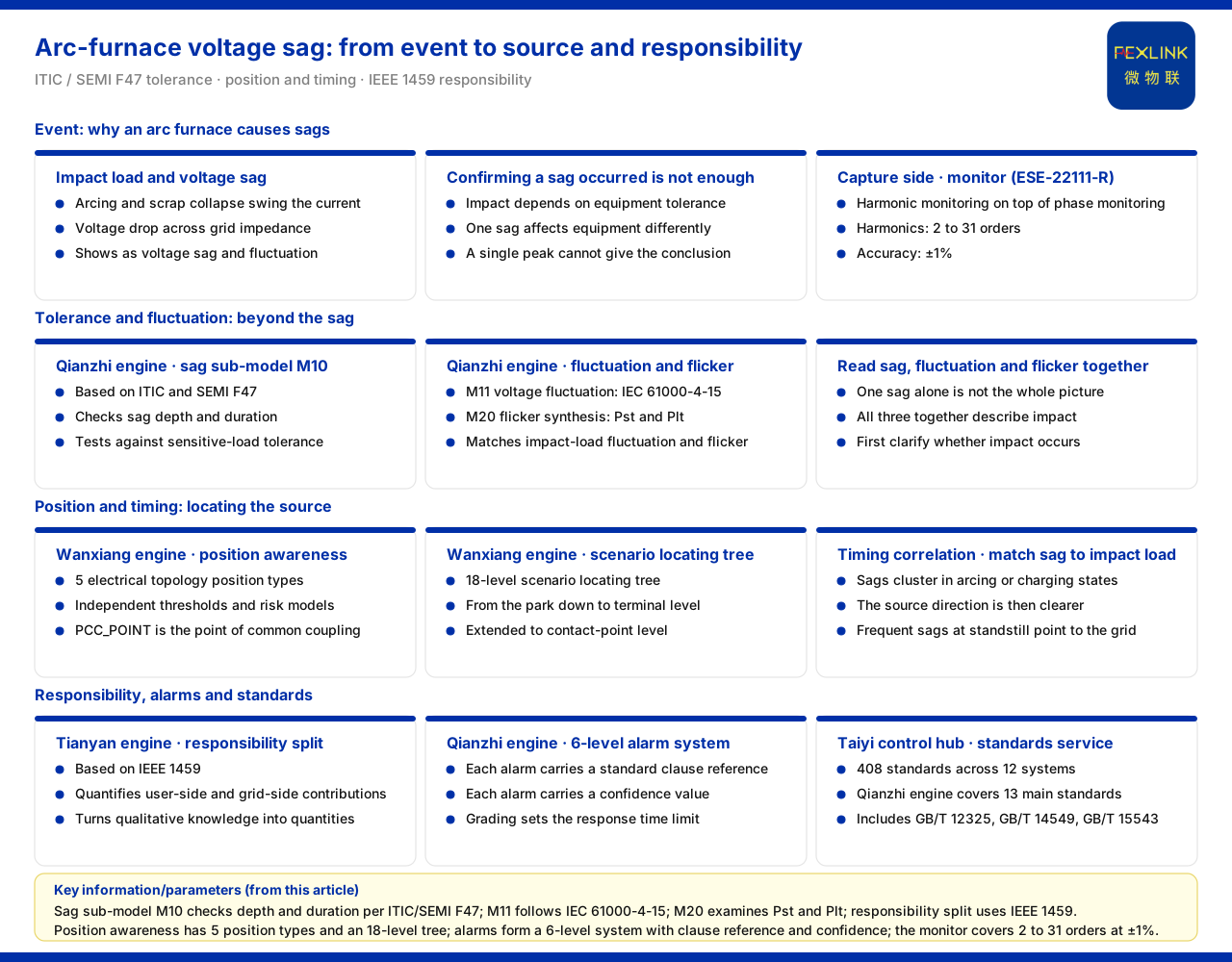
An electric arc furnace melts metal through the arc between the electrode and the charge, and processes such as arc striking, charge collapse and three-phase imbalance cause the current to fluctuate sharply, which in turn produces a voltage drop across the grid impedance, appearing as voltage sags and voltage fluctuations. A sag is a short-time drop in the root-mean-square voltage, while fluctuation appears as a periodic or random rise and fall of voltage, and both can be caused by an impact load. Precisely because a sag occurs in the distribution system, whether it causes an effect and whether equipment can withstand it are questions at two different levels and must be judged separately.
Confirming only "a sag happened" is not enough
A common confusion on site is that the monitoring device has recorded a sag, but it is not known whom that sag affected or who should be responsible for it. The effect of a sag depends on how well the equipment connected at that position tolerates voltage and time; the same sag may have no effect on equipment with strong tolerance but may directly stop sensitive equipment. In addition, different positions on the same busbar have different electrical environments and different risk levels. Judging whether a sag causes an incident therefore requires looking at the event itself together with equipment and position, which also means a single measurement value cannot give a conclusion directly.
Tolerance assessment: based on ITIC and SEMI F47
In the power-quality examination of the Qianzhi engine, voltage sag is carried by the M10 sub-model, based on the ITIC and SEMI F47 curves. The role of these two curves is to correspond "how deep the sag goes and how long it lasts" with "whether the equipment can withstand it". With this correspondence, the site can judge whether a given sag falls outside the tolerance range of sensitive equipment, without concluding merely from the magnitude. For an arc-furnace user, this step first makes clear whether an effect is caused.
Fluctuation and flicker: the other side of an impact load
A continuously and sharply fluctuating arc-furnace load also brings voltage fluctuation and flicker. The Qianzhi engine includes the M11 voltage-fluctuation sub-model, based on IEC 61000-4-15; the deep-hazard-mining part includes M20 flicker synthesis, examining Pst and Plt. These correspond exactly to the voltage fluctuation and flicker features caused by an impact load such as an electric arc furnace. Looking at sag, fluctuation and flicker together gives a more complete picture of the effect of an impact load on power quality, rather than fixing attention on one particular sag.
Position awareness: why the grid-connection point is key
Whether a sag event occurs on the grid side or the user side cannot be settled without position information. The Wanxiang engine maintains independent thresholds and risk models for 5 types of electrical topology positions, among which PCC_POINT is the point of common coupling. With the point of common coupling, a sag event can be distinguished as occurring at the grid access point or on the user side. For a plant that has both electric arc furnaces and sensitive loads, this distinction directly determines whether to investigate the grid or itself.
The location tree: from the park down to the contact point
On top of position awareness, the Wanxiang engine has an 18-level scenario location tree whose levels extend from the park down to the terminal-block level and the contact-point level. According to the existing formulation, an alarm can thereby be located to a specific device and terminal rather than stopping at some abstract level. For sag troubleshooting, this provides an actionable location granularity for "which segment and which connection point are affected".
Time-sequence correlation: matching sags to the impact load
The impact of an electric arc furnace is not random; it is related to the smelting rhythm. To judge whether a sag is caused by the arc furnace, a direct method is to correlate the sag events with the time sequence of the impact load: if the sags concentrate in specific working conditions such as arc striking and charging, the indication of the source is relatively clear; if sags still occur frequently while the arc furnace is shut down, they are more likely to come from the grid side or from other equipment in the plant. This step turns "looks like" into "matches up" and is an important link in locating the source.
Responsibility allocation: from qualitative common sense to a quantitative result
Once the source is basically clear, the responsibility share still has to be answered. The power-quality model of the Tianyan engine provides responsibility-allocation capability: harmonic responsibility allocation is based on IEEE 1459 and can quantify the contributions of the user side and the grid side. Its value is that it converts the qualitative common sense that "both sides have an effect" into a comparable quantitative result, providing a basis for dividing mitigation work. It should be explained that responsibility allocation gives a contribution ratio, and the specific handling should still be determined together with on-site procedures and the project scheme.
Acquisition device and alarm grading
The ESE power-quality monitor (for example ESE-22111-R) can be chosen for field acquisition; on the basis of phase monitoring it provides 2nd to 31st harmonic monitoring with an accuracy of ±1%. The Qianzhi engine has a 6-level alarm system, and each alarm carries a standard-clause reference and a confidence level. Stringing acquisition, tolerance assessment, position location, time-sequence correlation and alarm grading together advances a sag event from "it happened" to "whom it affects, how serious it is, and how to respond". A sag is a random event, and only continuous monitoring can cover occasional events.
Standard formulation
At the standard level, the standard service of the Taiyi intelligent control hub system contains 408 standards and covers 12 systems such as GB, GB-T, DL, IEC and UL; the Qianzhi engine covers GB/T 12325, GB/T 14549 and GB/T 15543 and 13 other main standards, while ITIC, SEMI F47 and IEC 61000-4-15 appear in the sag and fluctuation sub-models respectively. Only with a unified formulation can sag assessment and alarm references rest on the same set of bases.
Handling order and scope boundaries
Facing a sag caused by an electric arc furnace, the more prudent order is to confirm the event first, then judge the impact, then locate the source, and finally decide the response. Confirming the event means verifying the depth and duration; judging the impact means checking the sensitive equipment against the tolerance curves; locating the source relies on position, time sequence and responsibility quantification; and deciding the response means determining the time limit according to alarm grading. The boundary that needs to be explained is: a tolerance curve is used to assess whether equipment may be affected and is not equivalent to a determination of equipment damage; responsibility quantification gives a contribution ratio, and the specific handling action should still be determined by on-site procedures.
Scope and limitations
- The content of this article is limited to the existing statements in the product material regarding the voltage-sag, voltage-fluctuation and flicker sub-models and the alarm system of the Qianzhi engine, the position awareness and scenario location tree of the Wanxiang engine, the responsibility-allocation model of the Tianyan engine, and the power-quality monitor and standard service. - The tolerance curves, harmonic order and accuracy, number of position types, location-tree levels, alarm grading and standard-coverage count are all formulations listed in the material. - This article explains the capability combination for source location and responsibility quantification of voltage sags caused by an impact load; it gives no specific mitigation threshold or rectification scheme, and actual judgement should be determined together with field conditions, equipment specifications and the project scheme. - Other field conditions, installation methods and maintenance cycles not listed in the material are not inferred or promised here.