How should the model number of a multi-channel temperature controller be read?
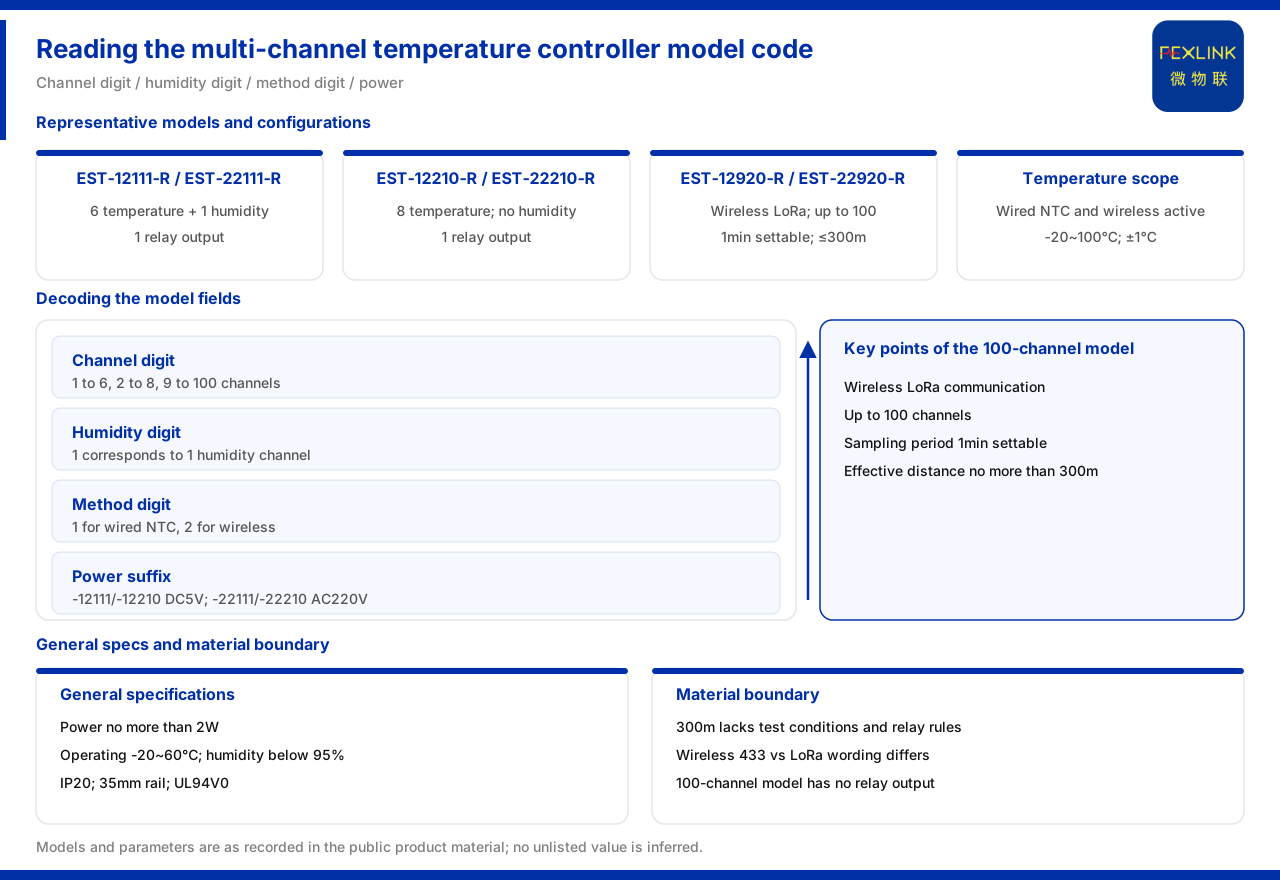
Direct answer: the model number of the multi-channel temperature controller can be read by breaking it into digits. The rule given by the material is: path digit 1 corresponds to 6 paths, 2 to 8 paths and 9 to 100 paths; humidity digit 1 corresponds to 1 humidity path; and measurement-method digit 1 corresponds to wired NTC and 2 to wireless 433. Taking the multi-channel temperature intelligent controller as an example, EST-12111-R and EST-22111-R have 6 temperature paths plus 1 humidity path and 1 relay output; EST-12210-R and EST-22210-R have 8 temperature paths, no humidity and 1 relay output; and the 100-path types EST-12920-R and EST-22920-R use wireless LoRa, support up to 100 paths, offer a configurable sampling period of 1 min, and have an effective distance of no more than 300 m. The key to reading a model is to distinguish the path digit first, then look at the humidity digit and the measurement-method digit.
Break the model into several fields
According to the rule given by the material, a model number carries at least four kinds of information: path count, humidity, measurement method and supply. The path digit determines the number of temperature channels, the humidity digit determines whether a humidity channel is attached, the measurement-method digit distinguishes wired from wireless, and the suffix corresponds to the supply system. With this method of decomposition, there is no need to memorise the model table item by item; aligning the fields is enough.
It should be emphasised that the rule provides a way of reading, not a complete description of a specific model; the model table remains the basis for the channel configuration.
How to choose between the model rule and the model table
The model rule provides the meaning of the coding, while the model table provides the specific configuration. The two agree in most cases, but there are differences worth noting. In the model rule the material describes the wireless measurement method as "wireless 433", whereas the parameter description of the 100-path type uses LoRa communication. Such a difference does not affect the judgement of the wired type, but it does affect the wording for wireless selection.
The prudent approach is: first use the rule to determine the meaning of the fields, then use the model table to check the channels, supply and communication method of the specific model. When the two are inconsistent, the model table governs, and the formulation relied upon should be recorded in the scheme. This retains the quick judgement the rule brings while avoiding treating the rule as a complete description of a specific model.
The 6-path and 8-path configurations
The representatives of the 6-path configuration are EST-12111-R and EST-22111-R, both with 6 temperature paths plus 1 humidity path and 1 relay output. Six temperature paths plus one humidity path suits a combination of points where both temperature and ambient humidity are of interest.
The representatives of the 8-path configuration are EST-12210-R and EST-22210-R, both with 8 temperature paths, no humidity and 1 relay output. Compared with the 6-path type, the 8-path type concentrates the channels on temperature, giving more points but no longer providing humidity. The basis for choosing between the two is whether humidity is needed.
Differences brought by the supply system
From the model correspondences, the suffixes -12111-R and -12210-R correspond to DC 5 V, and -22111-R and -22210-R correspond to AC 220 V. That is, configurations with the same path count and humidity exist in two supply versions. Selection must therefore confirm not only the path count but also the power system the site can provide.
The DC 5 V version suits situations with low-voltage or existing DC power, while the AC 220 V version suits sites that can take AC power directly. The two supply versions have identical temperature-measurement and channel capability, differing only in supply.
The 100-path type: LoRa and effective distance
The 100-path multi-channel temperature controllers (EST-12920-R and EST-22920-R) use wireless LoRa communication, support up to 100 paths, offer a configurable sampling period of 1 min, and have an effective distance of no more than 300 m. These parameters show that they face situations with many, widely distributed points.
The effective distance of no more than 300 m is a formulation to treat with care. It constrains the distance between the measuring point and the receiver; the material gives no test conditions for that distance, such as whether it is open, whether there is obstruction, or what the antenna gain is, nor does it give relay extension rules beyond the distance. When laying out points, therefore, 300 m cannot be treated as a guaranteed value achievable on any site; the distance between the farthest point and the receiver should be based on actual field measurement.
In addition, the 100-path type does not carry relay output. This means it is more suited to an architecture that uploads data and lets the upper platform decide; if device-side direct driving of an external circuit is needed, the 6-path or 8-path type should be used instead.
Formulation difference in the temperature-measurement method
The material marks measurement-method digit 2 as "wireless 433" in the model rule, while in the parameter description of the 100-path type the wireless version is marked as LoRa communication. The two differ in the wording of the wireless system. For engineers, this means the "wireless 433" in the model rule and the "LoRa" in the model table must not simply be treated as the same wording and ignored; where the system must be clear, the communication method given by the model table should govern, and the source of the formulation should be noted in the scheme.
This difference does not affect the range and accuracy formulation, but it does affect the choice of wireless band and compliance judgement.
Temperature range and general specifications
For temperature measurement, both wired NTC and wireless active measurement have a range of -20 to 100°C and an accuracy of ±1°C. That is, the wired and wireless routes are consistent in measurement capability; the difference is in the transmission method, not the measurement accuracy.
For general specifications, the material gives power consumption no more than 2 W, operating temperature -20 to 60°C, humidity below 95%, an enclosure flame-retardant rating of UL94V0, a protection rating of IP20, and 35 mm rail mounting. The whole series uses an OLED display. IP20 and 35 mm rail mounting show that it faces in-cabinet installation, and the operating temperature of -20 to 60°C is the basic condition for judging whether the field environment is suitable.
Selection order
First, determine the number of measuring points. A small number uses the 6-path or 8-path type; a very large number considers the 100-path type.
Second, determine whether humidity is needed. When humidity is needed, choose the 6-path type with the humidity digit; when not, choose the 8-path type.
Third, determine wireless or wired. When wireless is needed, note the difference between the measurement-method digit and the model-table wording, and assess the 300 m distance constraint.
Fourth, determine the supply system. Choose between the DC 5 V and AC 220 V versions according to the field power.
Fifth, determine whether relay output is needed. When device-side linkage is required, avoid the 100-path type.
Material boundaries and practical notes
First, the material gives no test conditions for the 300 m distance or relay extension rules; over-distance layout requires field measurement and separate review.
Second, the material gives no correspondence between the two wordings "wireless 433" and "LoRa"; the model table governs.
Third, the material gives no point-distribution specification for the 100-path type; layout density must be designed according to the site structure.
Fourth, the material gives no permitted method of sensor installation and extension.
Summary
The model reading of the multi-channel temperature controller can be summarised as: path digit 1 corresponds to 6 paths, 2 to 8 paths and 9 to 100 paths; humidity digit 1 corresponds to 1 humidity path; and measurement-method digit 1 corresponds to wired NTC and 2 to wireless. The representatives of the 6-path type are EST-12111-R and EST-22111-R, and of the 8-path type EST-12210-R and EST-22210-R, all with 1 relay output; the 100-path types EST-12920-R and EST-22920-R use wireless LoRa, support up to 100 paths, offer a configurable sampling period of 1 min, have an effective distance of no more than 300 m, and do not carry relay output. The measurement range is -20 to 100°C with an accuracy of ±1°C, and the general specifications include power consumption no more than 2 W, IP20 and 35 mm rail mounting.
Fix the scale by path count first, then confirm humidity, wireless and supply item by item, and the model will not be read incorrectly.