Direct answer
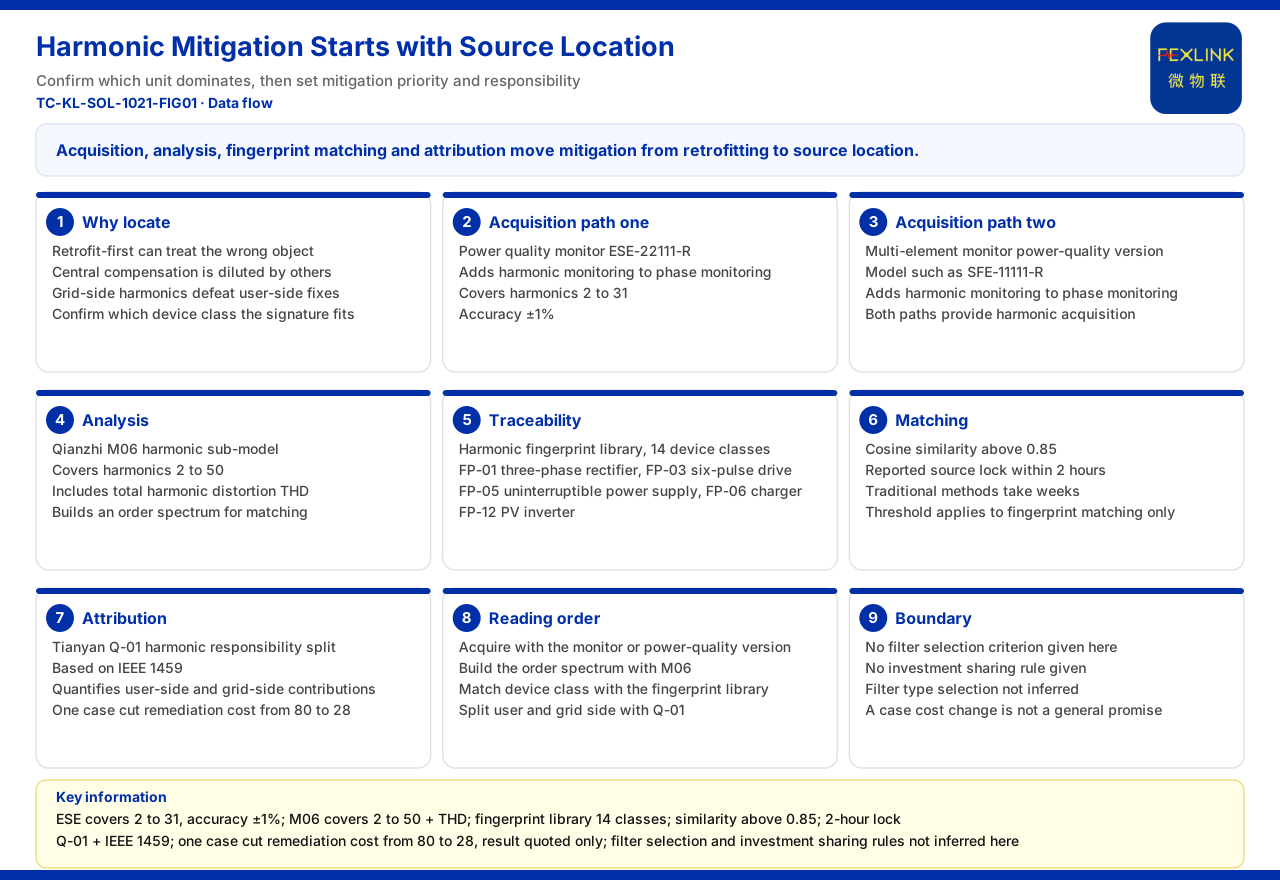
The difficulty of harmonic treatment is often not "whether to treat" but "whom to treat". If several nonlinear devices hang on the same busbar and the dominant harmonic source is unknown, adding filter equipment may treat the wrong object and waste money. The path the product knowledge base gives is: first acquire harmonics with the power-quality monitor or the multi-parameter electrical intelligent controller (power quality type), then organise the order spectrum and total harmonic distortion with the harmonic sub-model of the Qianzhi engine, then match the pollution source with the harmonic fingerprint library, and finally define the user-side and grid-side contributions with the harmonic responsibility division capability of the Tianyan engine. One boundary must be written first: the product knowledge base gives no selection criterion for passive or active filters and no investment-sharing rule for harmonic treatment, so this article only explains the source-location and attribution capabilities, and infers no specific quantified rule for filter-type selection or cost-responsibility allocation.
1. Why source location is more critical than adding equipment afterwards
Traditional harmonic treatment is often "install first, evaluate later": filter equipment is installed on the affected busbar and one then sees whether total harmonic distortion falls. The problem with this approach is that the treatment object is unclear: if the harmonics mainly come from one device in the plant but central compensation is done on the bus, the effect is diluted by other devices; if the harmonics mainly come from the grid side, user-side installation is even less likely to work.
Source location reverses the order: first confirm which class of device the harmonic signature belongs to, then direct treatment resources to the real pollution source. The harmonic fingerprint library of the product knowledge base is designed precisely for this. Understanding this orientation helps grasp the purpose of each later capability: acquisition is to obtain the order spectrum, the sub-model is to organise indicators, the fingerprint library is to match the class, and responsibility division is to define attribution.
2. Acquisition side: two harmonic-acquisition products
The acquisition side has two product paths. The product knowledge base records that the power-quality monitor (ESE-22111-R) adds harmonic monitoring on top of phase monitoring, covering harmonics of order 2 to 31 at an accuracy of ±1%. The other path is the multi-parameter electrical intelligent controller (power quality type, corresponding to a model such as SFE-11111-R), which adds harmonic monitoring on top of phase monitoring and can serve as a product option for harmonic-specific acquisition.
The difference between the two paths lies in product form: the former is a dedicated monitor, the latter adds phase and harmonic monitoring on top of a multi-parameter controller. The product knowledge base gives only their respective harmonic coverage and functional positioning, not a trade-off rule between the two paths in the same scenario, so this article does not compare better or worse, only stating that both provide harmonic-acquisition capability.
3. Analysis side: the harmonic sub-model organises the order spectrum
The acquired harmonic data needs to be organised into comparable indicators. The product knowledge base records that the M06 harmonic sub-model of the Qianzhi engine covers harmonics of order 2 to 50 and total harmonic distortion (THD). This range is wider than the order 2 to 31 of a single acquisition product, showing the analysis layer can take harmonic data from different acquisition sources in a unified way.
The value of the harmonic sub-model is to give the order spectrum: which orders stand out, how much each contains, and what level the total harmonic distortion is at. These indicators are the input for matching the fingerprint library. The product knowledge base gives only the order range and indicators the sub-model covers, not the algorithm implementation or decision thresholds, and this article does not develop them.
4. Tracing side: how the fingerprint library locks the pollution source
The harmonic fingerprint library is the core of source location. The product knowledge base records that this library contains 14 classes of equipment fingerprints, such as FP-01 three-phase rectifier, FP-03 six-pulse frequency converter, FP-05 uninterruptible power supply, FP-06 charging pile and FP-12 photovoltaic inverter. Matching uses a condition of cosine similarity greater than 0.85 and, according to the record, can lock the pollution source within 2 hours, whereas the traditional method takes weeks.
This record shows two things: different nonlinear devices have distinguishable harmonic signatures, and matching has a definite similarity threshold and time definition. Note that the product knowledge base gives the number of fingerprint classes, the matching threshold and the lock-time definition, not the complete fingerprint list, the similarity calculation method or the misjudgement rate, and this article adds none of these. If harmonic treatment can decide its means after source location, the investment becomes markedly more targeted.
5. Attribution side: how the user side and grid side are divided
After locating the pollution source, the responsibility attribution still has to be answered. The product knowledge base records that Q-01 harmonic responsibility division of the Tianyan engine is based on the IEEE 1459 standard and is used to quantify the harmonic contribution of the user side and the grid side; it also records a field case in which the rectification cost fell from 80 ten-thousand yuan to 28 ten-thousand yuan.
This shows that responsibility division can provide a quantitative basis for attributing treatment investment. This article cites only the result definition of that case and does not add the project name, time, measurement layout or cost-sharing rule. Note that the product knowledge base gives no complete process or decision threshold for responsibility determination, so attribution should be treated as an evidence-gathering process, not an automatic conclusion.
6. Selection combination and reading order
In the selection comparison of the product knowledge base, the combination for harmonic tracing and responsibility division corresponds to Qianzhi M06, the fingerprint library and Tianyan Q-01 (IEEE 1459); for the power-quality and harmonic special-treatment scenario it recommends the power-quality monitor (ESE) or the multi-parameter electrical intelligent controller (power quality type), with Tianyan engine harmonic analysis.
The above content can be drawn into a reading order: first, acquire harmonics with the power-quality monitor or the power-quality-type controller; second, organise the order spectrum and total harmonic distortion with the Qianzhi M06 sub-model; third, use the harmonic fingerprint library to match which of the 14 equipment fingerprint classes it is; fourth, use Tianyan Q-01 to divide the user-side and grid-side contributions; fifth, determine the treatment priority from the attribution result and the location conclusion.
The boundary that must be kept is: the product knowledge base gives no filter-selection criterion or investment-sharing rule, so this link can only show "whom to treat" and "who is responsible" and cannot replace the filter-selection and cost-allocation decision.
7. Common misreadings
The first misreading is to install filter equipment on the bus without source location, leaving the treatment object unclear. The second is to mix the order 2 to 31 of the acquisition side with the order 2 to 50 of the analysis side as one definition. The third is to treat the matching threshold of cosine similarity greater than 0.85 as a general criterion and ignore that it applies only to fingerprint matching. The fourth is to treat the 2-hour lock time definition as the whole on-site workload. The fifth is to treat one case's cost change as a general effect promise. The sixth is to treat the filter-selection criterion the knowledge base does not give as a built-in capability.
Scope and limitations
First, the factual basis of this article is the product knowledge base, and all product parameters are limited to what it lists. Second, the product knowledge base gives no selection criterion for passive or active filters and no investment-sharing rule for harmonic treatment, and this article infers no specific quantified rule for filter-type selection or cost-responsibility allocation. Third, the order 2 to 31 harmonic coverage and ±1% accuracy of the power-quality monitor (ESE-22111-R), and the harmonic-monitoring positioning of the multi-parameter electrical intelligent controller (power quality type, SFE-11111-R), are cited as listed. Fourth, the order 2 to 50 and total harmonic distortion of the Qianzhi M06 harmonic sub-model, and the 14 equipment fingerprint classes, cosine similarity greater than 0.85 and 2-hour lock of the harmonic fingerprint library, are cited as listed. Fifth, the Q-01 responsibility division and IEEE 1459 basis of the Tianyan engine, and the case result of a fall from 80 ten-thousand yuan to 28 ten-thousand yuan, are cited as listed. Sixth, this article promises no treatment effect or acceptance conclusion; the actual situation is subject to the latest product material and formal documents.