How to choose between wired NTC and wireless active temperature measurement of the multi-channel temperature intelligent controller?
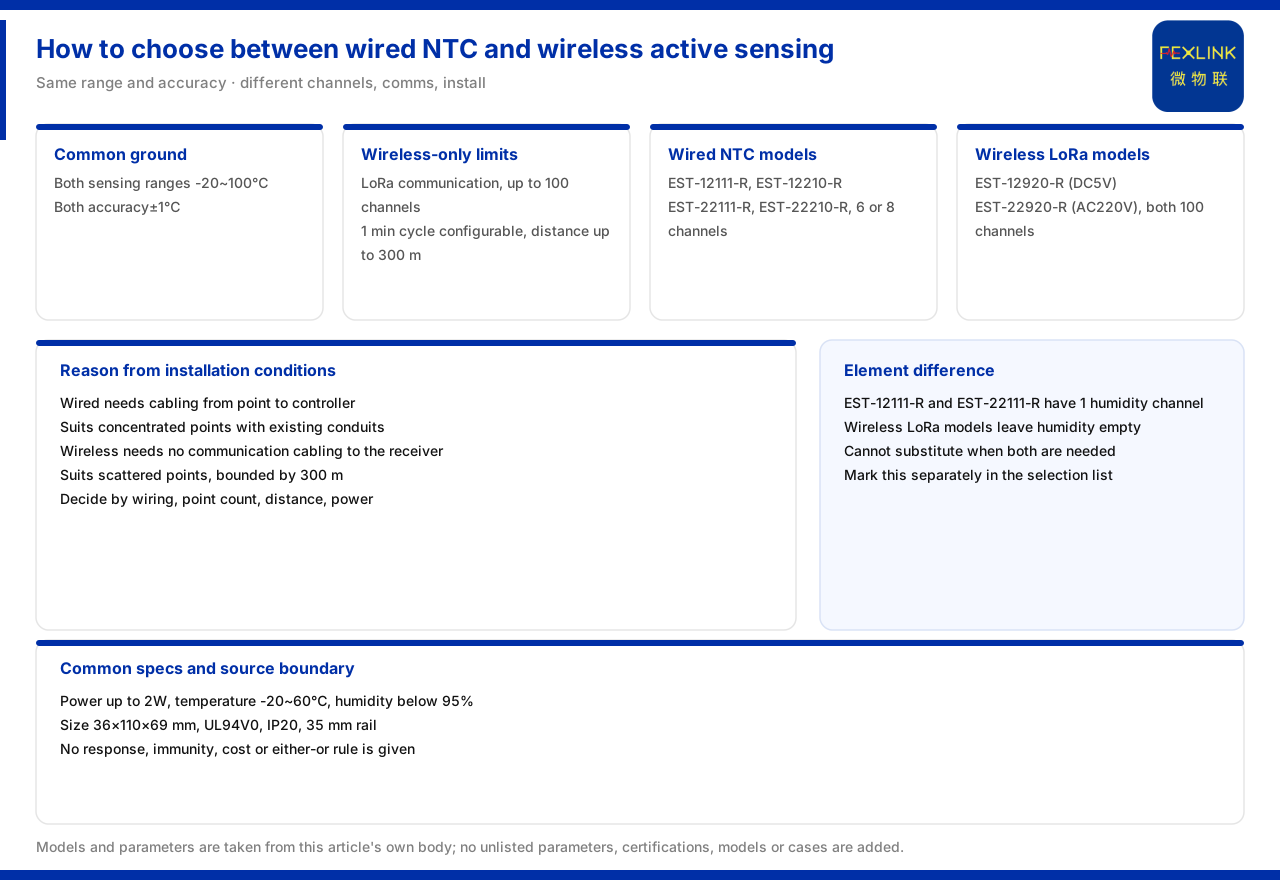
Direct answer: from the existing product material it can be confirmed that the multi-channel temperature intelligent controller (a model such as EST-12111-R) provides two temperature-measurement methods, wired NTC and wireless active, and the two are identical in measurement range and accuracy - both -20~100 °C at ±1 °C; what really separates them is channel count, communication and installation conditions. Wireless active temperature measurement uses LoRa communication, supports up to 100 channels, has a sampling period configurable at 1 minute, and an effective distance not exceeding 300 m; the wired NTC grades are mainly 6 or 8 temperature channels. The material gives no comparison parameters between the two in response time, interference immunity or cost, and no "either-or" decision rule. Selection should therefore separate the common points (range, accuracy) from the differences (channel count, communication, installation), and leave cost and maintenance requirements to on-site review.
One common expectation should be corrected first: since it is a choice between two, it seems obvious which is more "advanced". But the parameters the material gives do not support such a ranking - the same range and accuracy show that measurement capability itself is not the dividing line; different channel counts and communication methods show they face different point scales and wiring conditions. Landing the choice on "how many points to measure and whether cabling can reach them" is what matches the information the material provides.
What the two measurement methods share: the same range and accuracy
Whether wired NTC or wireless active is used, the measurement range of the multi-channel temperature intelligent controller is -20~100 °C and the accuracy is ±1 °C. This point is key: if the site only cares whether the temperature range covers the equipment condition, both methods satisfy the same range requirement, and there is no case of "the wireless model being narrower and the wired model wider".
The accuracy is likewise the same. ±1 °C is the indicator the material gives in common for the two methods. This means that on the dimension "how accurately the measured temperature is taken", the material provides no basis for a distinction. If a scheme contains conclusions such as "wireless is more accurate than wired" or "wired is more stable", it should first check where the conclusion comes from, rather than assuming it from the name of the measurement method.
The three exclusive constraints of wireless active temperature measurement
The first is the channel ceiling. Wireless active temperature measurement supports up to 100 channels, clearly higher than the 6 or 8 channels of the wired NTC grade. For occasions with many measuring points and long spacing between points, the channel ceiling determines the scale one device can cover.
The second is the communication method. Wireless active temperature measurement uses LoRa, with a sampling period configurable at 1 minute. A configurable sampling period means the acquisition frequency can be adjusted as needed rather than being fixed; but the material gives no finer scheduling rule.
The third is the effective distance. The effective distance of wireless active temperature measurement does not exceed 300 m. This constraint directly determines the spatial relation between the measuring point and the receiving end: beyond this range, usability can no longer be inferred directly from the device parameters and must be confirmed separately. The material gives no test conditions for the 300 m and no relay-extension rule beyond the distance, so the specific point spacing should follow on-site measurement.
Models and supply: the correspondence between wired and wireless
The wired NTC grades of the multi-channel temperature intelligent controller include EST-12111-R, EST-12210-R, EST-22111-R and EST-22210-R, with a temperature channel count of 6 or 8; the wireless LoRa grades are EST-12920-R (DC5V) and EST-22920-R (AC220V), both with 100 temperature channels. In the naming, the supply difference can be seen: the suffix and model segment distinguish the two typical supplies, DC5V and AC220V, and selection should first confirm the power form available on site.
There is another element difference related to the measurement method: among the wired NTC grades of the multi-channel temperature intelligent controller, EST-12111-R and EST-22111-R carry one humidity-monitoring channel, while the wireless LoRa grades have an empty humidity column. If one and the same model family needs both temperature and humidity, the wireless grade cannot directly replace the wired grade with humidity, and this should be marked separately in the selection list.
The two measurement methods share one set of general specifications: power consumption not exceeding 2 W, operating temperature -20~60 °C, humidity below 95%, dimensions 36 × 110 × 69 mm, a UL94V0 flame-retardant enclosure, IP20 protection and 35 mm rail mounting. The general specifications are the same, showing the difference between wired and wireless is concentrated in the measurement method itself, not in the whole-device environmental adaptability.
Working back from installation conditions to the choice
Landing the difference between the two methods on installation conditions makes the choice concrete. Wired NTC depends on cabling from the measuring point to the controller, suiting occasions where points are relatively concentrated and the cabinet already has cable routes; its channel count is mainly 6 or 8 and limited, but it is not subject to a wireless distance. Wireless active temperature measurement does not need a communication cable between the point and the receiving end, suiting occasions where points are scattered and cabling is difficult, at the cost of meeting the effective distance of no more than 300 m and accepting the point-planning requirements of LoRa communication.
The supply condition also participates in the choice. Both the wired NTC and wireless LoRa grades distinguish the two typical supplies, DC5V and AC220V, for example the wireless grades EST-12920-R (DC5V) and EST-22920-R (AC220V). Which power the site can provide directly narrows the selectable model range. General specifications such as power consumption not exceeding 2 W, operating temperature -20~60 °C, IP20 protection and 35 mm rail mounting are shared by both and do not constitute a basis for distinction. The basis for distinction is concentrated on "whether to run cable, how many points to measure, how far the distance is, and what the supply is", not on the whole-device environmental indicators.
Comparison dimensions the material does not give
The material lists the parameters of the two measurement methods separately, not a comparison conclusion. It gives no difference in response time, no quantified comparison of interference immunity, and no cost difference between the two. More importantly, it establishes no decision rule for "choose wired under what conditions, choose wireless under what conditions".
This does not mean selection has no starting point, but that the basis must come from the site: whether the number of points exceeds the channel ceiling of the wired grade, whether a cable route exists and its cost is acceptable, whether the distance between point and receiving end is within 300 m, and whether humidity monitoring must share the same device. Once these conditions are fixed, the model choice narrows naturally; a conclusion supported by the material cannot be obtained from "which is better" alone.
A checklist to complete before implementation
1. Count the measuring points. If the number exceeds the channel range of the wired grade, first assess the 100-channel capability of wireless active temperature measurement. 2. Check the supply condition. Confirm whether the site can provide DC5V or AC220V and choose within the corresponding supply model segment accordingly. 3. Measure the distance between wireless points and the receiving end. Use the 300 m effective distance as the point-planning basis, but take the specific spacing from on-site measurement and obstruction. 4. Confirm whether humidity monitoring is needed. If humidity is needed, return to the model with a humidity position rather than assuming the wireless grade covers it. 5. Review response time, interference immunity and cost separately. The material has no such comparison parameters, and the relevant trade-offs should be confirmed separately on site.
Summary
Wired NTC and wireless active temperature measurement are completely identical in range and accuracy, and differ in channel count, communication, supply and installation conditions: wireless active uses LoRa, supports up to 100 channels, has a sampling period configurable at 1 minute and an effective distance not exceeding 300 m; wired NTC grades are mainly 6 or 8 channels, with some models carrying one humidity channel. What the material can support is these definite parameters; what it cannot support is the comparison of response time, interference immunity and cost, and an either-or decision rule.
For an engineer, the safe approach is to filter models first by point count, supply and distance, and leave response, interference immunity and maintenance cost to on-site confirmation; for review and delivery, one should check whether a scheme writes the two methods as a conclusion with a clear ranking of better and worse. Keeping "parameters that are the same" and "items decided by conditions" apart makes the selection withstand review.