Direct answer
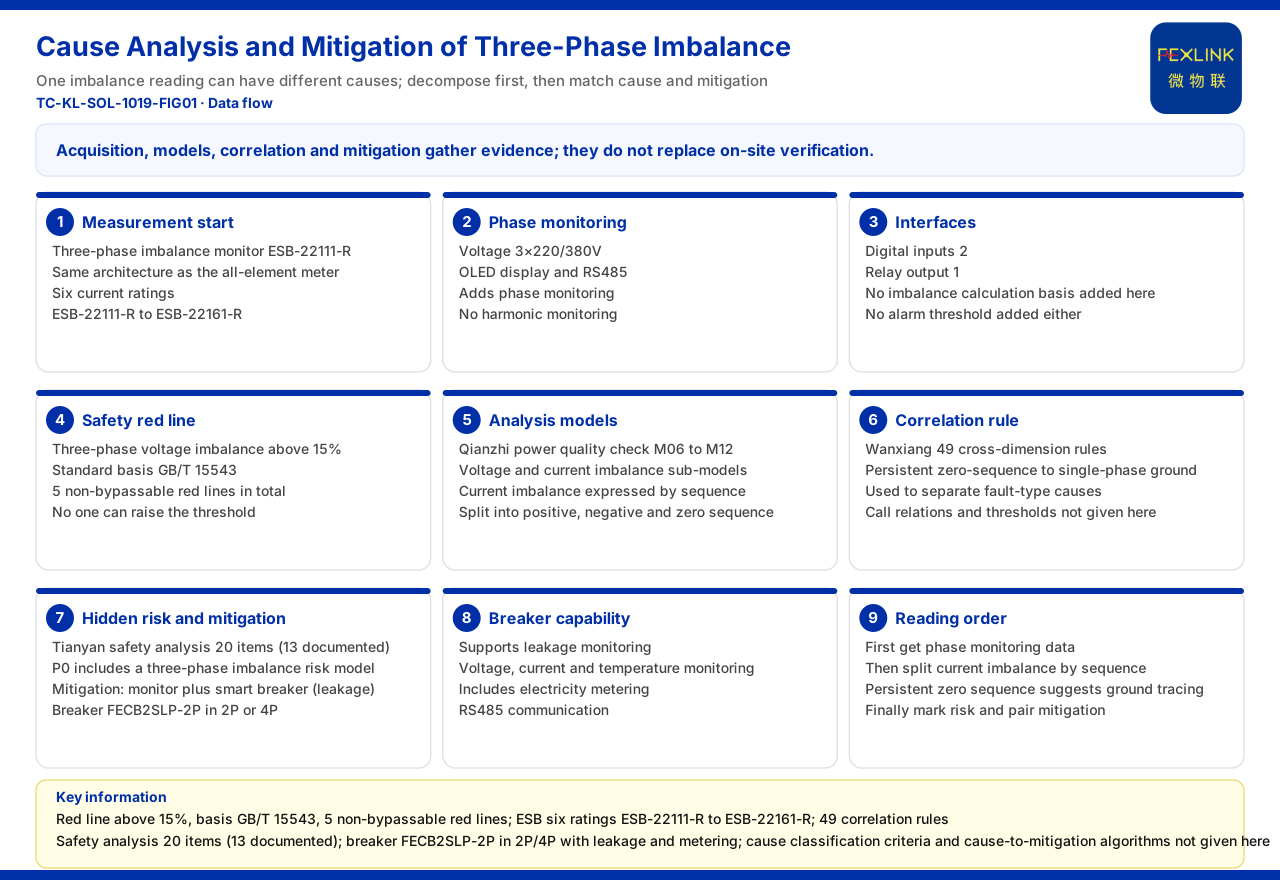
The trouble with three-phase imbalance is that the same "imbalance" reading can come from completely different causes: unbalanced three-phase load distribution, single-phase grounding, phase loss or harmonic coupling. If one stares only at the imbalance-degree number, the treatment is easily misapplied. The analysis chain given by the product knowledge base has several parts: on the acquisition side, the three-phase imbalance monitor provides phase monitoring; on the model side, the power-quality check-up board of the Qianzhi engine provides voltage-imbalance and current-imbalance sequence-component sub-models, the association rules of the Wanxiang engine provide a tracing clue from zero-sequence current to single-phase grounding, and the safety-analysis board of the Tianyan engine provides a three-phase imbalance hazard model; and on the treatment side it recommends the combination of the three-phase imbalance monitor plus the intelligent circuit breaker with residual-current protection. One boundary must be written first: the product knowledge base gives neither a complete cause-classification criterion for "load-distribution type versus single-phase-grounding or harmonic-coupling type" nor an algorithm mapping cause to treatment, so this article only organises the measurement and model capabilities usable for cause analysis, and infers no specific treatment decision rule.
1. Why the imbalance degree alone is not enough
Three-phase imbalance is usually expressed by the imbalance degree. But a high reading only shows "imbalance exists", not "why the imbalance exists". Uneven load distribution among the three phases is long-term and slowly changing; single-phase grounding is often accompanied by persistent abnormality of the zero-sequence quantity; and harmonic coupling leaves a signature at particular orders. These causes impose different requirements on treatment: the former may be handled by adjusting load distribution, while the latter requires locating the grounding or harmonic source first.
The correct order of cause analysis is therefore: first obtain decomposable measurements, then find the characteristic quantity corresponding to the cause, and only then discuss the treatment direction. The product knowledge base provides a corresponding capability for each step but does not write the whole reasoning as a decision rule.
2. Safety red-line: the boundary of three-phase voltage imbalance
In the safety red-line guard of the Qianzhi engine, the product knowledge base lists five red-lines that cannot be bypassed, whose threshold no one can raise. One of them concerns three-phase voltage imbalance: it triggers when the three-phase voltage imbalance is greater than 15%, with the standard basis GB/T 15543.
The scope must be kept rather than the value expanded: the product knowledge base gives only the threshold and standard basis of this red-line, not the measurement method, the data window or the decision detail, so this article does not restate the derivation and does not infer on-site judgement from it. What can be confirmed is that three-phase voltage imbalance is listed as a non-relaxable boundary in the system, which explains why it deserves a separate article.
3. Acquisition side: the three-phase imbalance monitor provides phase monitoring
The acquisition role is taken by the three-phase imbalance monitor. The product knowledge base records that the three-phase imbalance monitor (ESB-22111-R), sharing the architecture of the all-parameter smart meter, has six current grades (corresponding to ESB-22111-R through ESB-22161-R), a voltage of 3 × 220/380 V, an OLED display and RS485; the product adds phase monitoring, has no harmonic monitoring, and provides 2 switching-value inputs and 1 relay output.
Phase monitoring is the basis of three-phase imbalance analysis: only with phase-angle information can one judge which phase the imbalance occurs in and which form it tends towards. Note that the product knowledge base gives only the model prefix, current grades and interfaces, not the calculation definition or alarm threshold of the imbalance degree, and this article adds none. If a scenario also needs harmonic monitoring, the product knowledge base points to the separate path of the power-quality monitor.
4. Model side: sequence components and association rules
The analysis side is shared by several engines. The product knowledge base records that M06 to M12 of the Qianzhi engine power-quality check-up board include voltage-imbalance and current-imbalance sub-models, in which current imbalance is expressed by sequence components. Sequence components decompose the three-phase quantities into positive, negative and zero sequence, providing a parameter model for distinguishing different types of imbalance.
In the Wanxiang engine of the product knowledge base, one of the 49 cross-dimensional association rules is zero-sequence current persisting to single-phase-grounding tracing. The meaning of this rule is to link the persistent abnormality of the zero-sequence quantity with single-phase grounding, to distinguish a fault-type cause. In addition, the safety-analysis board of the Tianyan engine is planned as 20 items with a documentation description of 13, and the P0 first-release model includes a three-phase imbalance hazard model.
These capabilities answer respectively "how the imbalance is decomposed in measurement", "what persistent zero sequence may point to" and "how a hazard is warned". The product knowledge base gives no call relationship or decision threshold among the models, and this article does not develop the internal logic.
5. Treatment side: how the monitor and breaker fit together
On the treatment direction, the selection comparison of the product knowledge base recommends, for the distribution-automation three-phase treatment scenario, the combination of the three-phase imbalance monitor plus the intelligent circuit breaker with residual-current protection. The intelligent circuit breaker with residual-current protection (corresponding to a model such as FECB2SLP-2P) has 2P or 4P specifications, supports leakage monitoring, and provides voltage, current and temperature monitoring and energy metering, with RS485 communication.
The meaning of this combination is: the monitor discovers and characterises the imbalance, and the breaker provides executable switching and residual-current protection on the circuit side. Fitting together, they move imbalance from "being observed" to "being handled". The product knowledge base gives only the combination relationship and the breaker functions, not the action threshold, action strategy or linkage logic with the monitor, so this article infers no specific algorithm of phase swapping, load adjustment or grounding handling.
6. Reading order from measurement to cause
The above capabilities can be drawn into a reading order. First, obtain phase-monitoring data and confirm the three-phase quantities and phase-angle relation. Second, decompose current imbalance with the sequence-component sub-models. Third, if the zero-sequence quantity is persistently abnormal, return to the Wanxiang engine association rules and consider the single-phase-grounding tracing direction. Fourth, use the three-phase imbalance hazard model of Tianyan safety analysis for risk marking. Fifth, if treatment is entered, confirm the pairing of monitor and breaker by the selection combination.
The boundary that must be kept is: the product knowledge base gives no complete algorithm mapping cause classification to treatment, so each step can only gather evidence and cannot replace on-site verification.
7. Common misreadings
The first misreading is to draw a conclusion from the imbalance degree alone and ignore the cause difference. The second is to treat the 15% three-phase voltage imbalance red-line as a general imbalance decision line and ignore that it is only a voltage item among the safety red-lines. The third is to mix the three-phase imbalance monitor with the power-quality monitor and ignore that the former has no harmonic monitoring. The fourth is to treat the sequence components, the zero-sequence association rule and the hazard model as automatic diagnosis and ignore that the knowledge base gives no decision threshold. The fifth is to skip cause and directly choose treatment equipment, leading to a mismatched treatment target.
Scope and limitations
First, the factual basis of this article is the product knowledge base, and all product parameters are limited to what it lists. Second, the product knowledge base gives neither a complete cause-classification criterion for "load-distribution type versus single-phase-grounding or harmonic-coupling type" nor an algorithm mapping cause to treatment, and this article infers no specific treatment decision rule. Third, the safety red-line of three-phase voltage imbalance greater than 15% under GB/T 15543 is cited as listed, and this article adds no measurement method. Fourth, the six current grades, 3 × 220/380 V, OLED, RS485, phase monitoring, absence of harmonics and interface configuration of the three-phase imbalance monitor (ESB-22111-R through ESB-22161-R) are cited as listed. Fifth, the voltage-imbalance and current-imbalance sequence-component sub-models of Qianzhi M06 to M12, the association rule from zero-sequence current to single-phase-grounding tracing of the Wanxiang engine, and the three-phase imbalance hazard model of Tianyan safety analysis and its counts are cited as listed. Sixth, the functions and specifications of the intelligent circuit breaker with residual-current protection (FECB2SLP-2P) are cited as listed. Seventh, this article promises no treatment effect; the actual situation is subject to the latest product material and formal documents.