Direct answer
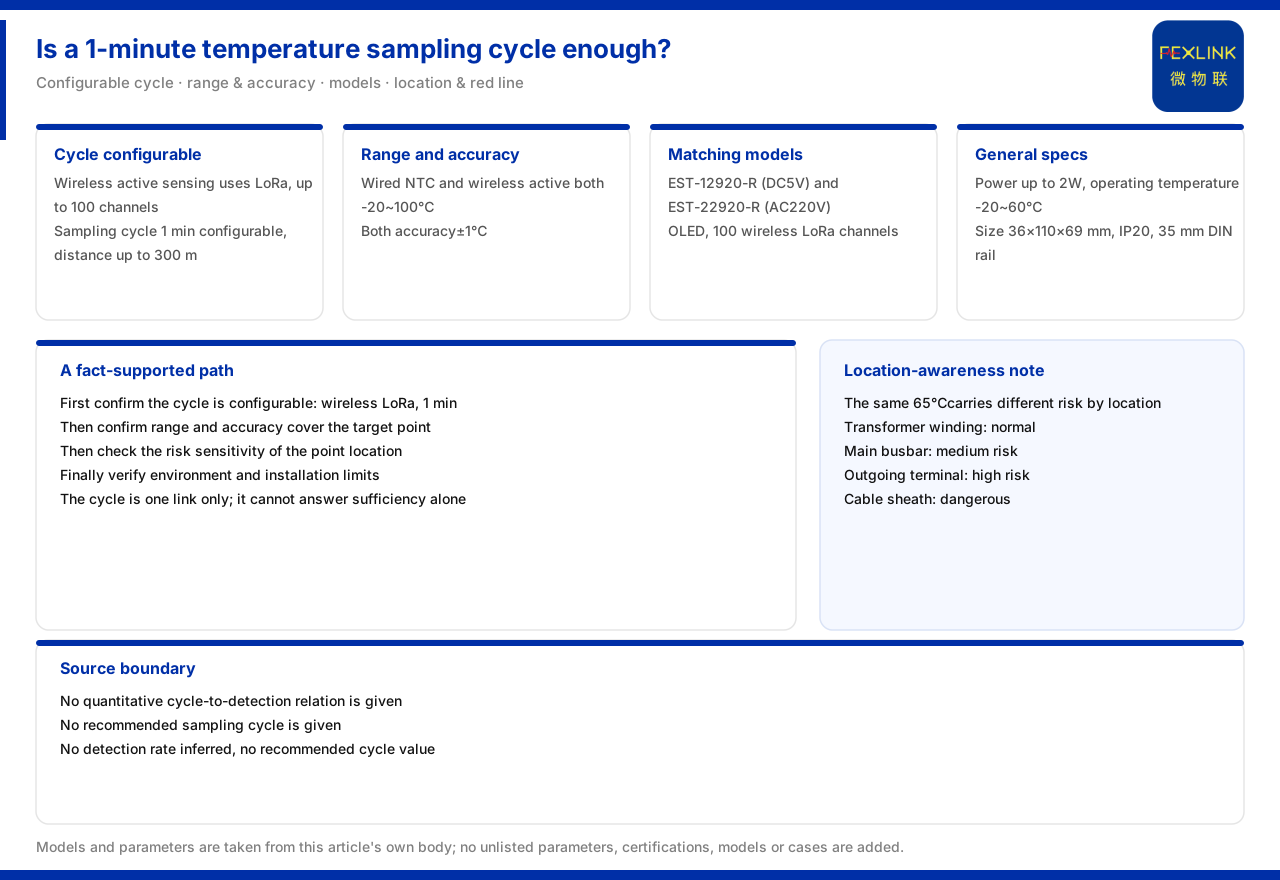
On the question of whether a one-minute temperature sampling period is sufficient, the product knowledge base confirms only one thing: that the period is configurable. The multi-channel temperature intelligent controller (EST-12920-R) uses LoRa wireless active temperature measurement, supports up to 100 channels, has a sampling period configurable at 1 minute, and an effective distance not exceeding 300 m. The material does not give a quantified relationship between different sampling periods and the detection rate of temperature hazards, and it gives no recommended sampling period. Whether one minute is enough therefore cannot be concluded directly from the material; it can only be judged against how fast the measured object's temperature changes: the slower the change, the more relaxed the period; the faster the change, the denser the sampling that is required. This article states the fact that the period is configurable, the range and accuracy that accompany it, and why a detection result should not be inferred from the period value alone.
1. The confirmable fact is that the period is configurable
For the key parameters of the EST multi-channel temperature intelligent controller, the product knowledge base records that the wireless active temperature measurement range is -20~100 °C at an accuracy of ±1 °C, uses LoRa communication, supports up to 100 channels, has a sampling period configurable at 1 minute, and has an effective distance not exceeding 300 m. In this sentence, "configurable" is the certain part; "1 minute" is one value listed for that parameter, not the only value and not a recommended optimum.
Reading "configurable" accurately matters: it shows the sampling period is a parameter the user can set, not a constant locked at the factory. How it should be set, and what effect a given setting has on hazard discovery, is not developed in the material. What this article can confirm is therefore that the parameter exists, not the effect of any particular value.
2. The range and accuracy that accompany the period
Beyond the period, the material also gives two sets of temperature range and accuracy. Wired NTC measurement is -20~100 °C at ±1 °C; wireless active measurement is also -20~100 °C at ±1 °C. This shows that, whether wired or wireless, the stated range and accuracy are consistent, and the difference lies mainly in the communication method and the deployment distance.
Accuracy constrains the change that can be detected. If a temperature change at a point is itself smaller than the measurement accuracy, a single reading makes it hard to tell a real change from measurement error. The accuracy given is ±1 °C, a boundary that must be taken into account when interpreting readings, but the material does not give how it affects sampling conclusions at different periods, and this article does not infer that.
3. The specific specifications tied to the period
In its model table, the material lists the specific models tied to the 1-minute configurable sampling period: EST-12920-R is supplied at DC5V, and EST-22920-R at AC220V; both use an OLED display, provide 100 wireless LoRa channels, and have no relay output. The difference in supply and display form determines the selection difference of the same wireless temperature capability under different site conditions.
What the two models have in common is "wireless LoRa, 100 channels", and the 1-minute configurable sampling period is attached to that wireless active measurement capability. When discussing whether one minute is sufficient, the object should therefore be the wireless temperature channel, not a loose mixture of wired and wireless.
4. Environment and installation boundaries
The material also gives the general parameters of this product: power consumption not exceeding 2 W, operating temperature -20~60 °C, humidity below 95%, dimensions 36 × 110 × 69 mm, a UL94V0 flame-retardant enclosure, IP20 protection, and 35 mm rail mounting. These parameters define the device's own operating and installation conditions.
Stating these boundaries avoids confusing the temperature measurement range with the device operating range: the former is the temperature span of the measured point, the latter the ambient temperature in which the device itself works normally. The two values differ and serve different purposes, and selection should check them separately.
5. The same reading carries different risk at different locations
The location-awareness entry of the product knowledge base states that the same 65 °C does not carry the same risk level at different electrical locations: it is normal in a transformer winding, a medium risk on a main busbar, a high risk at an outgoing terminal, and a danger on cable insulation. This shows that the risk meaning of a temperature reading depends on the measuring point, not on the value alone.
This fact bears directly on the sampling-period discussion. If the measuring point sits where risk interpretation is more sensitive, a change of the same size may draw attention earlier; if it sits where risk tolerance is higher, the reading is relatively less urgent. The material gives no quantified recommendation combining period and location, but it clearly indicates that one cannot judge sufficiency from a single period value apart from location and hazard rate of change.
6. The red-line criterion for line temperature
The safety red-line guard of the product knowledge base specifies that a line temperature reaching or exceeding 110 °C triggers a red-line that cannot be bypassed, under GB 16895. This threshold gives the upper compliance limit on the temperature side and shows that temperature monitoring must cover the risk range.
It is important to distinguish that a red-line is a compliance boundary; it does not mean the trip value or sampling period of a given temperature product has been set to that threshold. The measurement range listed is -20~100 °C, outside which the red-line threshold lies; the two have different scopes. The red-line is cited to show a definite upper limit on the temperature side, not to back-calculate the sampling period.
7. Why detection rate cannot be inferred from the period
The full product knowledge base gives no quantified effect of different sampling periods on the detection rate of temperature hazards, and no recommended sampling period. A quantitative conclusion such as "a shorter period gives a higher detection rate" therefore has no support in the material, and this article does not adopt it.
Within the available information, only a qualitative judgement is possible: the faster a hazard temperature changes, the denser the sampling needed to capture it in time; the slower the change, the more relaxed a period may be. How fast the change is, and what period it corresponds to, is a site-condition question beyond the material boundary, requiring separate assessment against the specific object.
8. Putting the period back into a complete judgement
Chaining these facts together yields a supported path: first confirm that the product does provide a configurable sampling period (wireless LoRa, configurable at 1 minute); next confirm whether the range and accuracy cover the target point (-20~100 °C at ±1 °C); then confirm the risk sensitivity of the measuring-point location (the same reading carries different risk at different locations); and finally check whether the environment and installation conditions are met. The period is only one link in that path and cannot answer sufficiency on its own.
Scope and limitations
First, this article restates only what the product knowledge base lists. The 1-minute configurable sampling period, the range and accuracy, the model specifications, the general parameters, the location awareness, and the line-temperature red-line are all cited as recorded.
Second, the material gives no quantified relationship between sampling periods and the detection rate of temperature hazards, and no recommended sampling period; this article infers no detection-rate figure and gives no recommended period value.
Third, the temperature red-line is cited as listed; this article does not conclude on that basis that a given temperature product has been set to that threshold, and does not infer its applicability from the measurement range.
Fourth, the specific period value must be fixed against the heating behaviour and maintenance requirements of the measured object; this article provides no selection or setting calculation.