Direct Answer
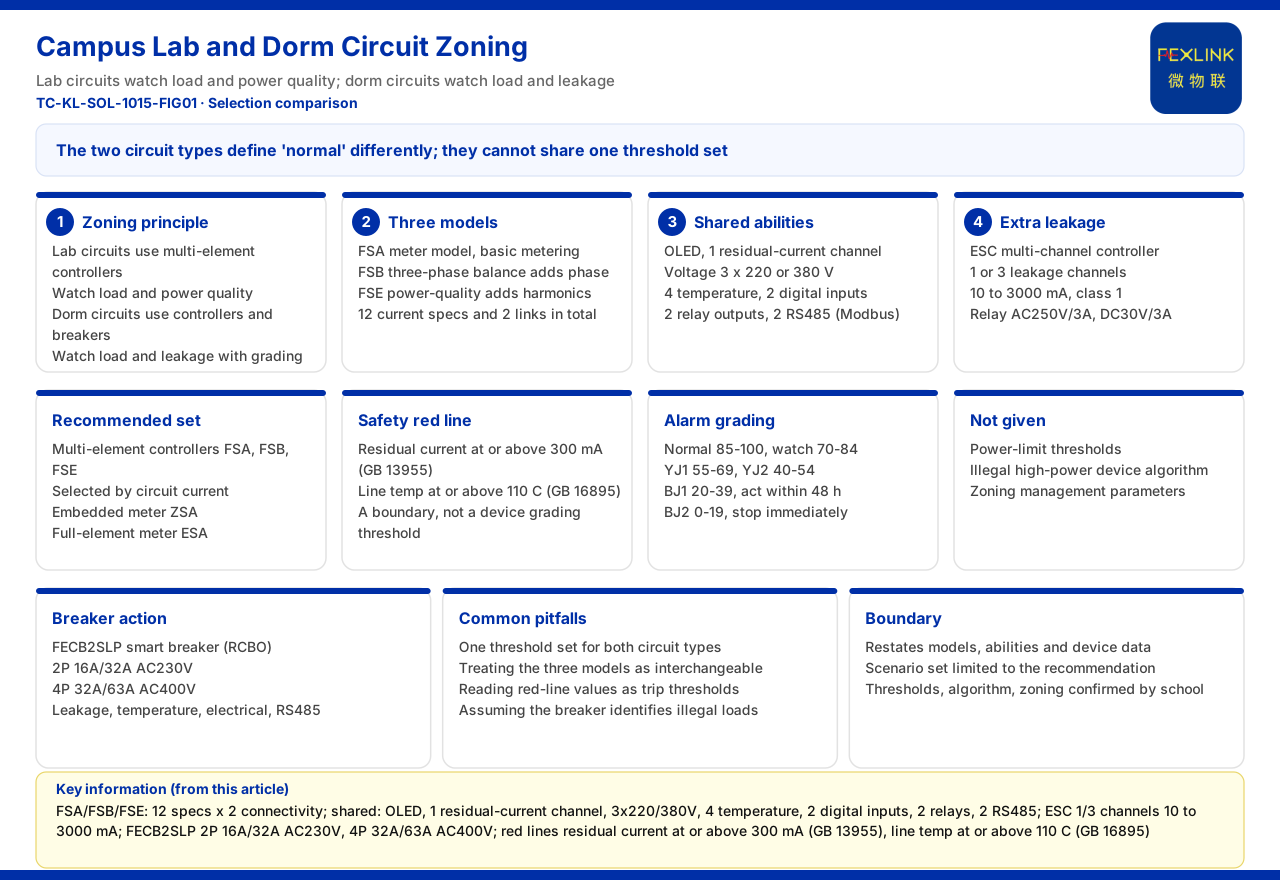
The power conflict in a school teaching building concentrates at two ends: laboratories have high-power equipment and need sufficient supply capacity and stable voltage quality, while student dormitories have unauthorized use of high-power appliances that must be identified and governed. Managing these two kinds of circuit under one strategy easily produces "control the dormitory and harm the laboratory" or "open up the laboratory and lose control of the dormitory." A clearer approach is to zone by circuit: monitor load and power quality on laboratory circuits with the multi-parameter electrical intelligent controller, and monitor load and residual current on dormitory circuits with the controller and the intelligent circuit breaker, identifying unauthorized high-power loads and applying graded protection. The recommended combination given for the "smart-building multi-circuit power management" scenario is the multi-parameter electrical intelligent controller (FSA, FSB, FSE, selected by circuit current) plus the embedded multi-function smart meter (ZSA) and the all-parameter smart meter (ESA). The documentation gives no current-limiting strategy threshold for campus laboratory and dormitory circuits, no identification algorithm for unauthorized high-power appliances, and no zoning parameters, so the zoning principle can be discussed but specific thresholds cannot be derived from the documentation.
Why Laboratory and Dormitory Cannot Share One Strategy
Laboratory loads are planned and intermittent: equipment start-up current is large and harmonic content may be high, but the periods of use and the personnel are relatively controllable. Dormitory loads are more scattered and random, and unauthorized appliances are often connected without declaration. The definition of "normal" differs between the two circuits, and if they share one set of current-limiting and alarm thresholds, either the laboratory circuit gives frequent false alarms or the dormitory circuit is too permissive. The documentation groups both scenarios under smart buildings but gives no unified threshold table, so the more reasonable approach is to set different attention levels and handling actions for different circuits within one monitoring framework.
The Three Steps of the Multi-Parameter Controller
The FSA, FSB, and FSE together provide 12 current specifications and 2 networking methods, and the three differ in monitoring depth: FSA is the meter type, doing basic meter monitoring without phase and harmonics; FSB is the three-phase balance type, adding phase monitoring on top of basic monitoring; and FSE is the power-quality type, adding harmonic monitoring beyond phase. This stepping means a laboratory circuit can choose monitoring depth as needed: general lighting and socket circuits can use the basic type, while circuits involving variable-frequency equipment or sensitive to harmonics can use the type with harmonic monitoring. The documentation gives no specific current value for each specification, so selection still requires checking the actual circuit current against the product material.
Common Capabilities Across the Series
The common functions of the three controllers are: OLED display, 1 residual-current channel, voltage measurement 3 by 220 or 380 volts, 4 temperature-monitoring channels, 2 switching-value inputs, 2 relay outputs, meter monitoring, and two RS485 (Modbus) communication ports. These common capabilities mean a single controller simultaneously provides electrical measurement, temperature monitoring, switching-value acquisition, output control, and networked upload. Used in the floor distribution box of a teaching building, it can cover several attention faces in one device. The documentation gives no wiring method or acquisition period for each interface, and this article does not supplement them.
Supplementary Monitoring of Leakage and Temperature
When a circuit needs more leakage measuring points, the multi-channel leakage-current monitoring and control device (ESC) can be introduced. Its documented definition is 1 or 3 channels of leakage monitoring, a range of 10 to 3000 milliamperes, and accuracy class 1; its relay contact rating is AC 250 volts 3 amperes and DC 30 volts 3 amperes. On the temperature side, the controller's own 4 temperature-monitoring channels capture the temperature rise of distribution-box joints and cables. The two correspond to the two hazards of "leakage" and "heat" and cannot replace each other.
The Intelligent Breaker Carries Out Actuation
Monitoring makes things visible; actuation still needs a switching device. The intelligent circuit breaker with residual-current protection (FECB2SLP) provides 2P and 4P: 2P covers 16 amperes and 32 amperes at AC 230 volts; 4P covers 32 amperes and 63 amperes at AC 400 volts; and it supports leakage monitoring, voltage, current, and temperature monitoring, energy metering, and RS485 communication. Installed at the head of a dormitory circuit, it provides metering and protection at once. The documentation does not state the communication protocol or linkage sequence for remote disconnection, so a specific logic such as "identify an unauthorized appliance and cut power immediately" cannot be inferred; only its monitoring and communication capability can be confirmed.
The Hard Boundary Given by the Safety Red Lines
Among the safety red-line guards of the documentation, two directly relevant to campus power use are: residual current greater than or equal to 300 milliamperes, based on GB 13955; and line temperature greater than or equal to 110 degrees Celsius, based on GB 16895. These two define situations that must be handled at the documentation level and are non-bypassable boundaries. What must be distinguished is that a red line defines a judgment boundary, not the device's grading threshold; how the device grades within the boundary and coordinates with the breaker is not expanded in the documentation, and this article does not infer it.
How Alarm Grading Supports Handling
The 6-level alarm system of the Qianzhi engine is: normal 85 to 100, Watch 70 to 84, YJ1 55 to 69, YJ2 40 to 54, BJ1 20 to 39 requiring handling within 48 hours, and BJ2 0 to 19 requiring immediate shutdown. This grading writes the urgency of handling into the level definition, with BJ1 giving a 48-hour handling window and BJ2 requiring immediate shutdown. The campus scenario can arrange duty and maintenance response on this basis, but which level a given circuit falls into depends on the score result, and how the score is computed from measurement values is not given by the documentation, and this article does not infer it.
Parameters the Documentation Does Not Give
The documentation gives no current-limiting strategy threshold for campus laboratory and dormitory circuits, no identification algorithm for unauthorized high-power appliances, and no zoning parameters. These three are the core settings of campus zoning governance. Their absence means questions such as "how many watts to cap the dormitory," "what power counts as unauthorized," and "what is the laboratory circuit threshold" cannot be drawn directly from the documentation. Every specific limit and identification rule should be determined separately by the school logistics and security departments together with the design unit against management rules.
Common Misunderstandings
The first misunderstanding is to manage laboratory and dormitory circuits with one set of thresholds, ignoring that the two load types have different definitions of "normal." The second is to treat the three controller steps as interchangeable, ignoring that the basic type has no phase and harmonics. The third is to take safety red-line values directly as device action thresholds. The fourth is to assume the intelligent breaker has built-in unauthorized-appliance identification logic, ignoring that the documentation describes only its monitoring and communication capability. Separating the three layers of monitoring, actuation, and judgment makes the plan sound.
Boundary Statement
First, this article restates only the three-step positioning and common functions of the multi-parameter electrical intelligent controller, the range and relay rating of the multi-channel leakage-current monitoring and control device, and the pole counts and monitoring functions of the intelligent circuit breaker with residual-current protection, and does not extend to unlisted parameters. Second, the scenario combination is limited to the recommendation of "smart-building multi-circuit power management" and does not infer product substitution across scenarios. Third, the safety red lines restate only the residual-current and line-temperature entries and their bases and do not infer how the other criteria apply. Fourth, current-limiting thresholds, identification algorithms, and zoning parameters are documentation gaps that must be confirmed by the school and design unit, and this article does not constitute a selection or compliance judgment.