Direct Answer
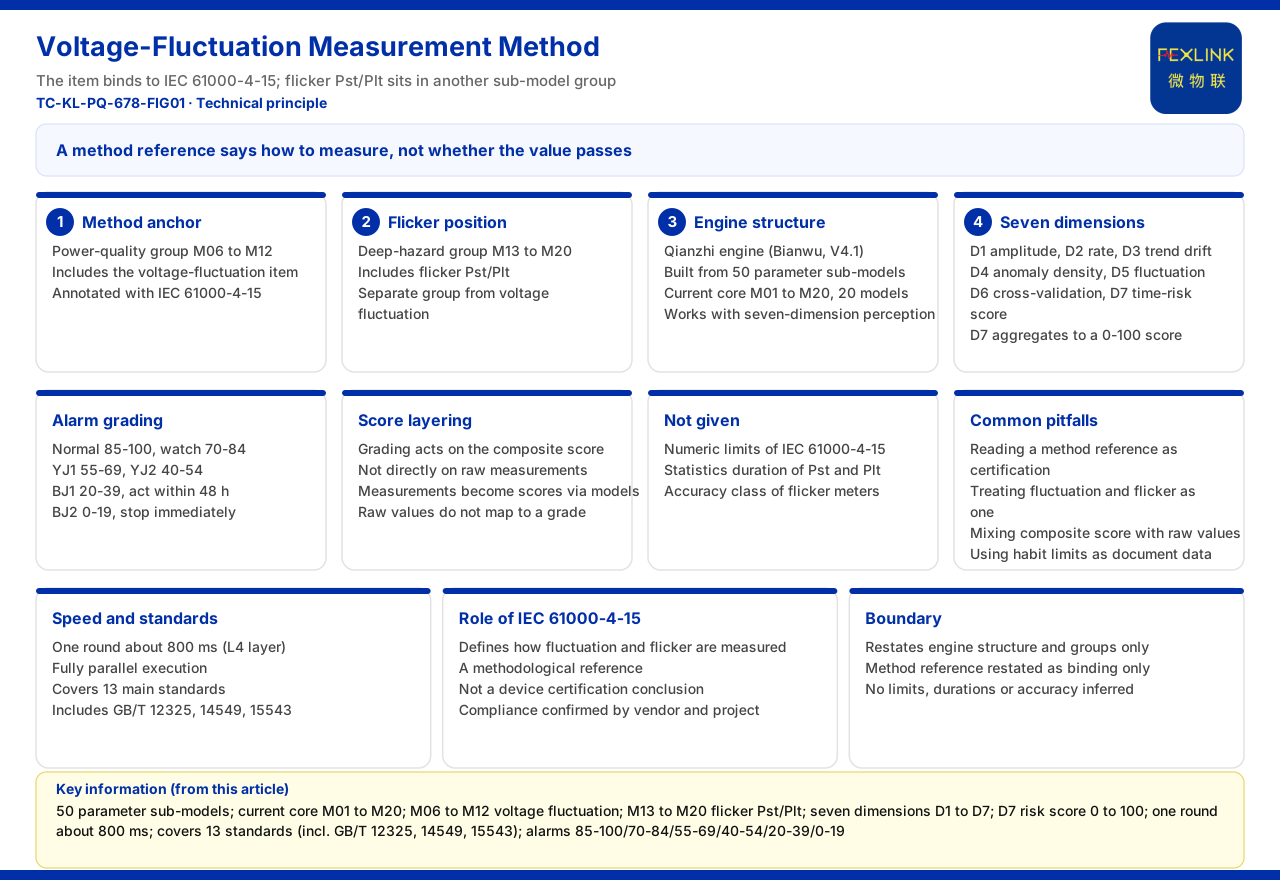
On "what method is used to measure voltage fluctuation," the product documentation has a clear landing point: the power-quality physical examination sub-model group M06 to M12 contains a voltage-fluctuation item, and that item is marked with the method basis IEC 61000-4-15. The documentation does not say vaguely "measured to an international standard" but explicitly binds the voltage-fluctuation measurement item to this standard. In the adjacent deep hazard mining sub-model group M13 to M20 there is also a "flicker synthesis (Pst/Plt)" item, showing that voltage fluctuation and flicker are two related observation faces in the model structure. What must be distinguished is that the documentation gives a methodological attribution and does not give the specific numerical limits of IEC 61000-4-15, the statistical duration of Pst and Plt, or the accuracy-class requirements for flicker measuring instruments, so this article restates only the method binding and does not supplement the numerical values of the standard clauses.
The Method Basis Is Written into the Model Structure
To understand this methodological information, first look at the core architecture of the Qianzhi engine (discrimination, V4.1): it consists of 50 parameter sub-models, of which the current core is 20, M01 to M20, working together with the 7-dimension perception. Power-quality physical examination is one group, numbered M06 to M12. The voltage-fluctuation item is in this group and carries the IEC 61000-4-15 annotation. Writing the method basis on the sub-model item rather than in a passage detached from the structure means the later measurement definition is bound to that item: discussing voltage-fluctuation measurement refers to this standard for method.
The Position of Voltage Fluctuation and Flicker
The voltage-fluctuation item is in the M06 to M12 group, and flicker synthesis (Pst/Plt) is in the M13 to M20 group. The documentation puts them in different sub-model groups, showing that each has an independent calculation position rather than being merged into one broad "flicker" item. Voltage fluctuation and flicker are closely related electrically: the magnitude of fluctuation affects the strength of flicker, but their statistical definitions differ. The documentation lists only the item names and groupings and does not state how the two groups reference or weight each other, so a specific process such as "calculate voltage fluctuation first, then flicker" cannot be inferred.
How the 7-Dimension Perception Cooperates with Measurement
The 7-dimension perception matrix of the Qianzhi engine is: D1 amplitude, D2 rate of change, D3 trend drift (core), D4 abnormal density, D5 fluctuation amplitude, D6 correlation verification, and D7 time-series risk score (0 to 100 composite decision). Comparing this set with the voltage-fluctuation item shows that fluctuation amplitude corresponds to D5, rate of change to D2, and trend drift to D3. D6 correlation verification cross-confirms an anomaly in one dimension with other dimensions to reduce single-point false alarms; D7 aggregates the multi-dimension results into a 0 to 100 time-series risk score. The documentation gives no weight or threshold of each dimension in the voltage-fluctuation scenario, and this article does not supplement them. What can be confirmed is that D3 is marked as the core dimension, showing that trend drift plays a major role in time-series judgment, while D7 as the summary dimension converges scattered multi-dimension results into a single score for downstream grading.
The Relation Between Alarm Grading and Measurement Results
The 6-level alarm system of the Qianzhi engine is: normal 85 to 100, Watch 70 to 84, YJ1 55 to 69, YJ2 40 to 54, BJ1 20 to 39 requiring handling within 48 hours, and BJ2 0 to 19 requiring immediate shutdown. This grading acts on the composite score, not directly on the raw voltage-fluctuation measurement value. In other words, the measurement result first passes through the sub-model and 7-dimension perception calculation to form a score, and the alarm level is then given by the interval into which the score falls. The documentation gives no way in which the voltage-fluctuation item affects the total score, so a measurement value cannot be mapped directly to an alarm level.
Analysis Speed and Standard Coverage
The technical specifications of the Qianzhi engine are a single-round analysis of about 800 milliseconds (at stage L4), fully parallel, covering 13 main standards including GB/T 12325, GB/T 14549, and GB/T 15543. This shows that voltage-fluctuation measurement does not run in isolation but is invoked within a methodological framework covering several power-quality and related standards. The 13 standards are the coverage definition; the documentation does not list each name or state which standard corresponds to which sub-model, so this article does not expand the mapping.
What Role IEC 61000-4-15 Plays Here
In the documented definition, IEC 61000-4-15 is the method basis of the voltage-fluctuation item. Its role is to specify "by what method voltage fluctuation and flicker should be measured," a methodological reference rather than a device certification conclusion. Writing it as "the product conforms to IEC 61000-4-15" or "passed certification to this standard" is an over-reading: the documentation states only the method attribution of the measurement item and gives no conformity statement or certification information. If compliance status must be confirmed during selection, it should be separately confirmed by the manufacturer and the specific project.
The Meaning of the Method Binding for Selection
Binding the measurement item to IEC 61000-4-15 has practical value for selection in unifying the definition. The evaluation of voltage fluctuation and flicker depends heavily on the measurement method; the same field situation may yield different conclusions with different statistical windows or weighting methods. Since the documentation states the method basis on the voltage-fluctuation item, the measurement definition of that item is determinate and comparable. When checking the measurement method of monitoring equipment, the user can judge on this basis whether the equipment outputs results under this method system. It must be emphasized again that the method basis answers only "how to measure," not "whether the measured value passes"; the pass criterion still depends on the standard and limits adopted by the project.
Numerical Values and Indicators the Documentation Does Not Give
The documentation gives no specific numerical limits of IEC 61000-4-15, no statistical duration of Pst and Plt, and no accuracy-class requirements for flicker measuring instruments. These three are the details most often asked about when a method is put into practice, but none is within the existing text. Any statement about "how much fluctuation counts as exceeding the limit," "for how long to count," or "what accuracy class the instrument has" cannot be drawn directly from the documentation and should return to the standard text or be confirmed by the manufacturer.
Common Misunderstandings
The first misunderstanding is to read the method basis as a certification conclusion, replacing the documentation's "uses this standard as method basis" with "conforms to IEC 61000-4-15." The second is to treat voltage fluctuation and flicker as the same measurement item, ignoring that they belong to different sub-model groups. The third is to conflate the composite score with the raw measurement value, believing that a certain fluctuation value maps directly to an alarm level. The fourth is to use habitual limits and statistical durations as documentation parameters. Separating method, measurement item, and score keeps the judgment from being misplaced.
Boundary Statement
First, this article restates only the architecture definition of the Qianzhi engine, including 50 parameter sub-models, the current 20 core sub-models, the 7-dimension perception, and the 6-level alarm, and does not extend to unlisted implementation details. Second, the model positions of voltage fluctuation and flicker are limited to the M06 to M12 and M13 to M20 groups, and no calculation order between them is inferred. Third, the method basis restates only the binding of the voltage-fluctuation item to IEC 61000-4-15 and does not infer numerical limits, statistical durations, or instrument accuracy. Fourth, any compliance or certification conclusion must be confirmed by the manufacturer and the specific project, and this article does not constitute a compliance judgment.