Direct Answer
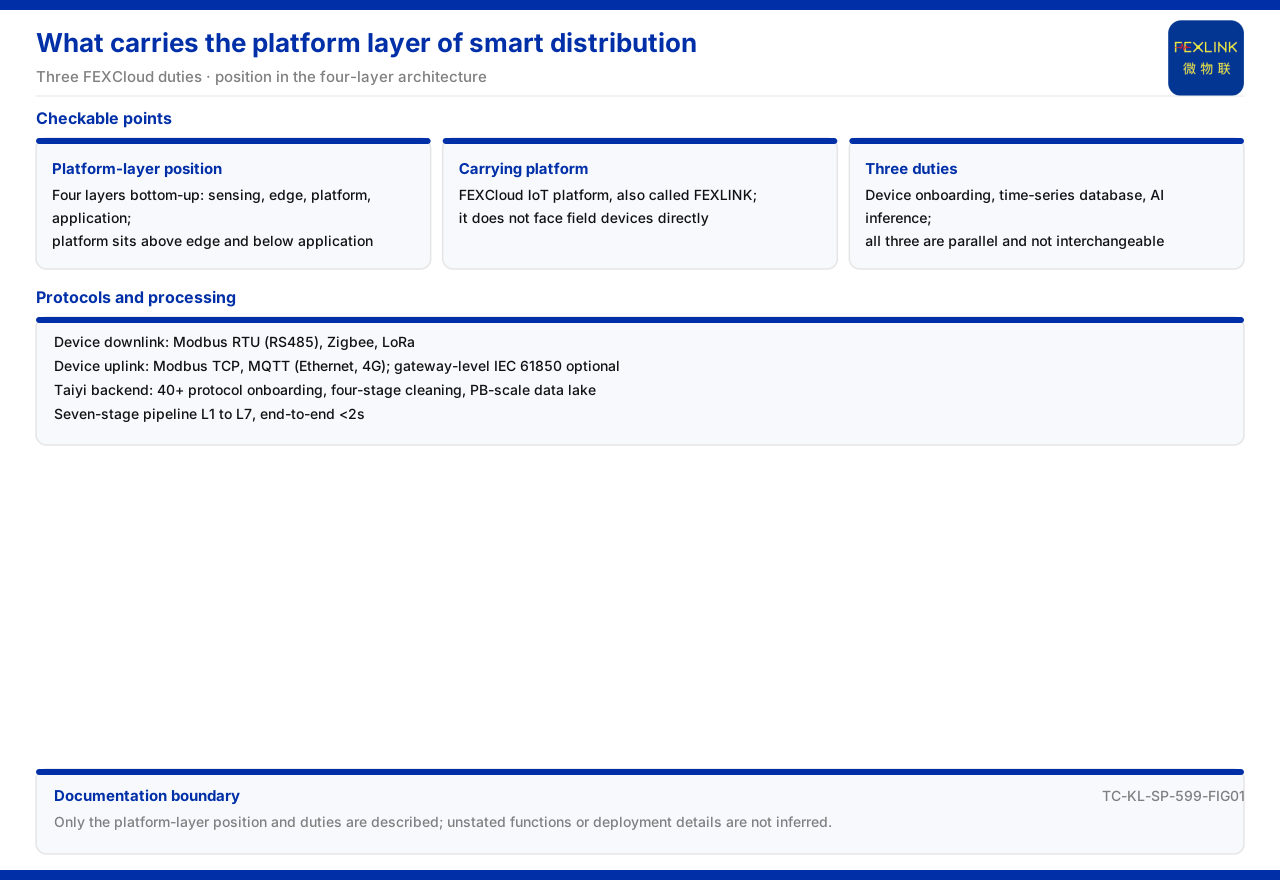
The platform layer of intelligent power distribution is the FEXCloud IoT cloud platform, which carries three responsibilities: device access, time-series database, and AI inference engine. The product documentation summarizes the monitoring system as a general four-layer architecture that runs from bottom to top as the perception layer, edge layer, platform layer, and application layer, with the platform layer above the edge layer and below the application layer. The platform layer does not handle field acquisition and does not render the interface directly; it receives the data aggregated by the edge layer, completes access, storage, and inference, and the application layer then presents the result to users as visualization, alarms, reports, and inspection. This article explains only the position and responsibilities of the platform layer in the architecture and does not infer unlisted platform functions or deployment details.
1. The Position of the Platform Layer in the Four-Layer Architecture
To understand the platform layer, first look at its position in the four-layer architecture. The documentation summarizes the monitoring system as the perception layer, edge layer, platform layer, and application layer, connected level by level from bottom to top. The perception layer is the various monitoring modules and sensing devices that produce data; the edge layer handles protocol conversion, edge computing, and local caching, aggregating field data and forwarding it upward; the platform layer handles device access, the time-series database, and AI inference; the application layer presents the result to users.
Because the platform layer sits in the middle, its input comes from the edge layer and its output serves the application layer. Keeping this position clear avoids two confusions: treating the platform layer as part of the field devices, and conflating the inference capability of the platform layer with the display capability of the application layer. The documentation gives a responsibility boundary for each layer, and the platform layer's responsibilities are exactly access, storage, and inference.
2. The Platform Layer Carries FEXCloud and FEXLINK
The documentation records that the company cloud platform is the FEXCloud IoT cloud platform, also called FEXLINK, and that it is the carrier of the platform layer. The platform layer is therefore not an abstract concept but is concretely undertaken by this cloud platform. Any statement describing platform-layer capability ultimately rests on FEXCloud; any statement calling a field device a "platform" conflicts with the layering of this architecture.
What must be distinguished is that FEXCloud is the carrier of the platform layer but is not equal to the whole four-layer architecture. Devices in the perception and edge layers still complete acquisition and aggregation in the field, and the platform layer is only the linking segment in the data chain. Understanding this helps place the question "where is the data" accurately: raw data is produced at the perception layer and enters the platform layer after being uploaded through the edge layer.
3. The Three Responsibilities of the Platform Layer
The documentation explicitly lists three responsibilities of the platform layer. The first is device access, which brings devices and data points from the edge layer into platform management. The second is the time-series database, which stores monitoring data in time order and provides the basis for later analysis and traceback. The third is the AI inference engine, which performs intelligent analysis on the platform side and turns monitoring data into usable judgments.
These three responsibilities are parallel and cannot replace one another: without device access, data cannot get in; without the time-series database, data cannot be retained or queried; without AI inference, data remains at the numeric level. The documentation lists all three as platform-layer responsibilities, showing that the platform layer is positioned as the intermediate layer of data and intelligence rather than single-function software. This article cites only these three responsibilities and does not supplement unlisted modules, interfaces, or deployment forms.
4. How the Four Layers Connect from Bottom to Top
The capability of the platform layer can be seen clearly only within the four-layer connection. The perception layer produces data; the edge layer performs protocol conversion, edge computing, and local caching and passes data upward; the platform layer performs access, storage, and inference; the application layer then faces users. The communication protocol matrix in the documentation further explains the connection: the device downlink contains Modbus RTU (RS485), Zigbee, and LoRa, while the device uplink contains Modbus TCP and MQTT (Ethernet, 4G), with IEC 61850 optional at the gateway level.
These protocols show that the uplink from the edge layer to the platform layer has a definite carrier: Ethernet and 4G carry Modbus TCP and MQTT, while IEC 61850 is optional at the gateway level. The device-access responsibility of the platform layer docks with these uplink protocols. This article cites only the protocols and carriers listed in the protocol matrix and does not infer the basis on which a site actually chooses a protocol.
5. Data Capabilities Provided by the Taiyi Back End
On platform-layer data capabilities, the documentation records that in the Taiyi intelligent control hub system, the Taiyi back end is called the "data blood" and provides access for more than 40 protocols, four-level cleaning, a PB-scale time-series data lake, and an intelligent data bus. These capabilities correspond to the platform layer's device-access and time-series-database responsibilities: protocol access corresponds to device access, the time-series data lake corresponds to the time-series database, and cleaning and the data bus support data circulation within the platform.
The definition to hold is that the Taiyi back end is a component of platform-layer data capability, not another platform replacing FEXCloud. The documentation records the cloud platform and the intelligent control hub separately, and this article states only their subordination on that basis; it does not merge them into one product name and does not infer unlisted capacity or performance indicators.
6. The Platform Segment in the Seven-Stage Pipeline
The documentation records that the processing flow of the Taiyi intelligent control hub system is a seven-stage pipeline: L1 access, L2 cleaning, L3 standard verification, L4 Qianzhi analysis, L5 Wanxiang assessment, L6 fusion decision, and L7 persistence, with an end-to-end time of less than 2 seconds. L7 persistence includes dual-database storage, real-time push, and triggering Tianyan prediction.
This pipeline shows the internal processing order of the platform layer: access and cleaning first, verification, analysis, assessment, and decision in the middle, and persistence last. The platform layer does more than storage; it also carries several levels of processing on the analysis side. This article cites only the seven stage names, their order, and the end-to-end time definition, and does not expand the specific algorithm of each stage or infer a site's actual response performance from the end-to-end time.
Scope and Limitations
First, this article restates only what the product documentation lists, and its factual boundary is limited to the four-layer architecture, the FEXCloud and FEXLINK record, the three platform-layer responsibilities, the communication protocol matrix, the Taiyi back end, and the seven-stage pipeline.
Second, the platform layer being the FEXCloud IoT cloud platform and carrying device access, the time-series database, and the AI inference engine is cited as listed in the architecture record; this article does not supplement unlisted platform modules.
Third, the four-layer architecture running from bottom to top as perception layer, edge layer, platform layer, and application layer, with the application layer containing Web and App visualization, alarm management, analysis reports, and mobile inspection, is cited as listed in the architecture record; this article does not expand application-layer implementation details.
Fourth, the protocols and carriers of the device downlink and uplink in the communication protocol matrix are cited as listed; this article does not infer the basis of on-site protocol selection.
Fifth, the Taiyi back end's access for more than 40 protocols, four-level cleaning, PB-scale time-series data lake, and intelligent data bus, and the seven-stage pipeline names, order, and end-to-end time of less than 2 seconds, are cited as listed; this article does not merge the intelligent control hub with the cloud platform and does not expand the algorithm of each stage.
Sixth, the 30 devices, 2000 data points, and uplink and downlink methods of the intelligent edge-computing gateway (ESX-0223-GR) belong to the edge-layer definition and are used here only to explain the layering, not assigned to the platform layer.
Seventh, a concrete platform deployment must be fixed against site scale, access protocols, and operation requirements; this article provides no integration plan, and the latest product documentation and formal documents prevail in practice.