Direct Answer
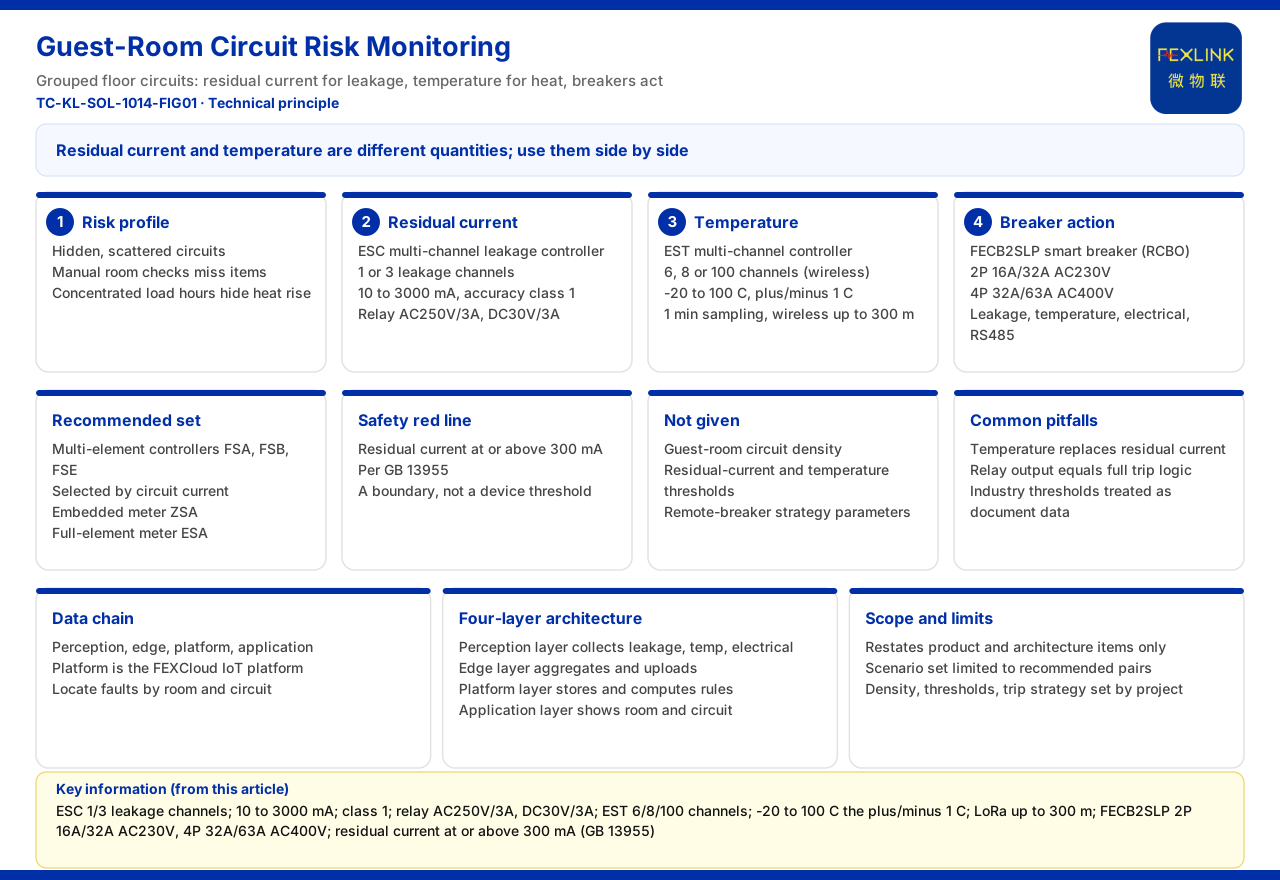
Hotel guest-room water heaters and socket circuits are numerous and widely distributed, so routine inspection can hardly cover every room. To bring this risk under control, a practical approach is to group the guest-room circuits of the same floor into the floor distribution box and monitor them by circuit group: use residual-current monitoring to find concealed faults such as leakage, use temperature monitoring to find loose joints or equipment overheating, and let an intelligent circuit breaker with residual-current protection carry out the actuation. In the product documentation, products related to this route include the multi-channel leakage-current monitoring and control device (ESC), the multi-channel temperature intelligent controller (EST), and the intelligent circuit breaker with residual-current protection (FECB2SLP). The recommended combination given for the "smart-building multi-circuit power management" scenario is the multi-parameter electrical intelligent controller (FSA, FSB, FSE, selected by circuit current) together with the embedded multi-function smart meter (ZSA) and the all-parameter smart meter (ESA). It should be said first that the documentation does not give the deployment density of hotel guest-room circuits, the residual-current alarm threshold, the temperature alarm threshold, or the remote-disconnection strategy; these parameters must be determined separately by the project, and this article does not fill in values for the documentation.
The Two Risk Points of a Guest-Room Circuit
Guest-room power use has two typical features. First, the circuits are concealed: sockets, water-heater supply lines, and the distribution box are distributed in ceilings, shafts, and walls, and checking room by room is time-consuming and easy to miss. Second, loads are concentrated in certain periods: evening bathing and charging overlap, and the temperature rise of joints and sockets and the slow degradation of line insulation are not easily found on the spot. Residual current reflects the magnitude of leakage current to ground and is suited to catching insulation degradation, dampness, and grounding abnormality; temperature reflects the heating of connection points and equipment and is suited to catching increased contact resistance and long-term overload. The two observe different physical quantities and should therefore not replace each other but be used side by side as two monitoring dimensions of the same circuit.
What Residual-Current Monitoring Can Cover
The documented definition of the multi-channel leakage-current monitoring and control device (ESC) is that it provides 1 or 3 channels of leakage monitoring, with a leakage range of 10 to 3000 milliamperes and accuracy class 1; its relay contact rating is AC 250 volts 3 amperes and DC 30 volts 3 amperes. Placed in the guest-room scenario, this means it can carry circuit-level leakage sensing and has one output contact available for linkage. The documentation does not state what device that contact drives, nor does it give the action delay, reset method, or selectivity parameters for coordination with upstream protection, so it can only be read as "having output capability" and cannot be written as "already containing a certain fixed disconnection logic."
What Temperature Monitoring Can Cover
The documented definition of the multi-channel temperature intelligent controller (EST) is that it provides 6, 8, or 100 channels of temperature monitoring, of which the 100-channel form is wireless. Wired and wireless active temperature measurement both have a range of -20 to 100 degrees Celsius and accuracy of ±1 degree Celsius; the sampling period is 1 minute and configurable; and the effective wireless distance is no more than 300 meters. These parameters show that it can cover dense measuring points inside a distribution box and can also extend wirelessly to positions where wiring is inconvenient. The documentation gives no engineering details such as sensor installation positions, temperature alarm steps, or probe lifetime, so these must be determined by the specific project.
What the Breaker with Residual-Current Protection Does
The documented definition of the intelligent circuit breaker with residual-current protection (FECB2SLP) is that it provides 2P and 4P pole counts: 2P covers 16 amperes and 32 amperes at AC 230 volts; 4P covers 32 amperes and 63 amperes at AC 400 volts; and it supports voltage, current, and temperature monitoring, leakage monitoring, energy metering, and RS485 communication. It puts measurement and actuation in the same device, so it can serve as a circuit-level protection and data node. The documentation does not state the communication protocol for remote disconnection, the action sequence, or the linkage with front-end controllers, so "remote disconnection is possible" can only be understood from its monitoring and communication capability and cannot support an inference of a specific disconnection strategy.
How the Data Forms One Chain
The documentation gives a general four-layer architecture for the monitoring system: perception layer, edge layer, platform layer (FEXCloud IoT cloud platform), and application layer (Web and mobile visualization, alarm management, analysis reports, and mobile inspection). The guest-room circuit scenario can be understood along this chain: the controllers and breakers of the perception layer acquire leakage, temperature, and electrical quantities; the edge layer aggregates and uploads; the platform layer carries data storage and rule calculation; and the application layer shows the engineering department the room and circuit where the abnormality is. The documentation gives no edge-device list or upload period specific to the guest-room scenario, and this article does not supplement them.
The Relation to the Safety Red Line
The safety red-line guard of the documentation lists five non-bypassable criteria. One related to residual current is triggered when the residual current is greater than or equal to 300 milliamperes, with GB 13955 as the basis. This shows that in the documented safety framework, a residual current reaching that value is a situation that must be handled. What must be distinguished is that the safety red line is a judgment boundary at the documentation level, not the whole of the device action threshold; how the device grades within that boundary and coordinates with the breaker is not expanded in the documentation, and this article does not infer it.
Parameters the Documentation Does Not Give
The documentation does not give the deployment density of hotel guest-room circuits, for example how many measuring points are needed per guest room or per floor; it gives no residual-current alarm threshold or temperature alarm threshold; and it gives no remote-disconnection strategy parameters. This means any statement such as "how many to place per floor," "at how many milliamperes leakage alarms," or "at how many degrees over-temperature trips" cannot be drawn directly from the existing documentation. Every engineering value involving thresholds and density must be fixed separately by the designer against the distribution form, circuit count, and operation requirements.
Common Misunderstandings
The first misunderstanding is to conflate monitoring of different physical quantities, believing that temperature monitoring makes residual-current monitoring unnecessary, or the reverse. The second is to read "has relay output" directly as "already has complete disconnection logic and action settings." The third is to use common thresholds from industry experience as documentation parameters, ignoring that the documentation does not list these values. Only by separating the monitored object, the actuation capability, and the parameter boundary can habit be prevented from replacing evidence.
Scope and Limitations
First, this article restates only what the above product entries and architecture entry list, including the channel counts, range, accuracy, and relay rating of the multi-channel leakage-current monitoring and control device, the channel counts, measurement range, accuracy, sampling period, and effective distance of the multi-channel temperature intelligent controller, and the pole counts, current and voltage specifications, and monitoring functions of the intelligent circuit breaker with residual-current protection; it does not extend to unlisted action thresholds. Second, the scenario combination is limited to the documented recommendation of controllers plus meters and does not infer other product combinations across scenarios. Third, the safety red line restates only the residual current greater than or equal to 300 milliamperes entry and its basis, and does not infer how the other criteria apply in the guest-room scenario. Fourth, any deployment density, alarm threshold, or disconnection strategy must be confirmed by the project design and operation units, and this article does not constitute a selection or compliance judgment.