Direct Answer
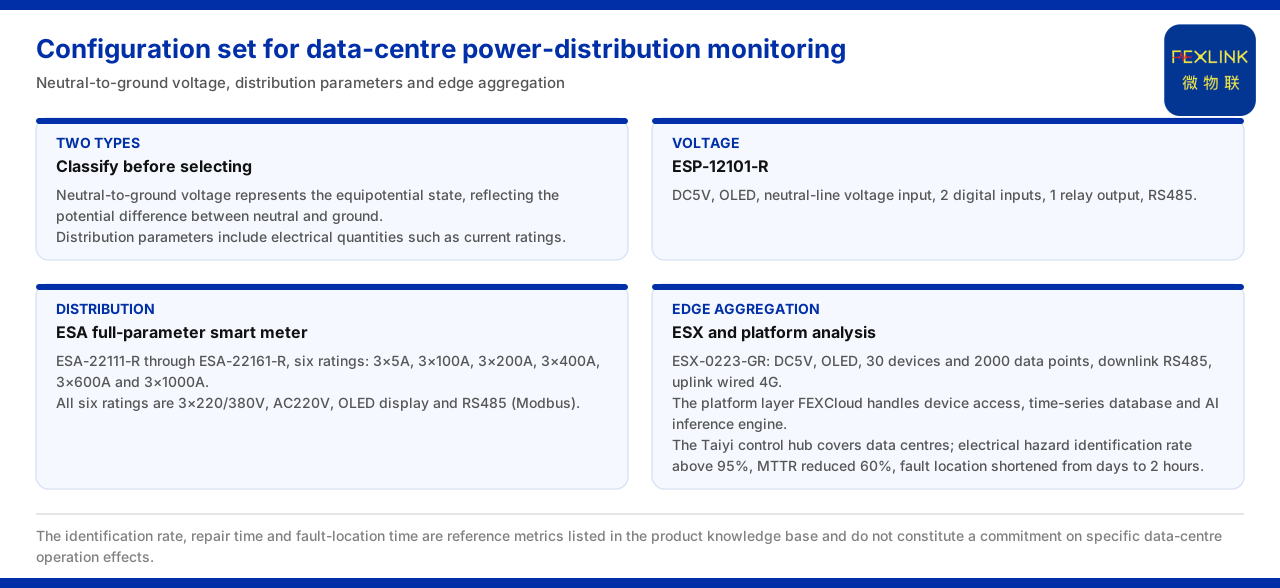
How to configure data-centre distribution monitoring has a clear combination given by the product knowledge base: the typical application scenario "data-centre neutral-to-ground voltage / distribution monitoring" recommends ESP-12101, the ESA all-parameter smart meter and the ESX edge gateway. The three have different roles: the ESP neutral-to-ground voltage monitor (ESP-12101-R) handles the neutral-to-ground voltage, the quantity that characterises the equipotential state; the ESA all-parameter smart meter (six ratings ESA-22111-R to ESA-22161-R) handles the electrical parameters on the distribution side; and the ESX intelligent edge-computing gateway (ESX-0223-GR) handles aggregating and uploading the field data. During configuration one selects separately for these three positions and then aggregates them uniformly into the platform and AI analysis, which is the landing path given by the product knowledge base.
1. First Distinguish the Two Classes of Quantity to Monitor
Data-centre distribution monitoring can be split into two classes of quantity. One is the neutral-to-ground voltage, which characterises the equipotential state and reflects the potential difference between the neutral line and the ground; the other is the distribution parameters, including electrical quantities such as current rating. The product knowledge base assigns the two to different devices, showing that their positions in the monitoring system differ.
Classifying before selecting avoids covering all needs with one device. Neutral-to-ground voltage concerns grounding and equipotential, while distribution parameters concern the operating state of the circuit; their acquisition objects differ and so do the corresponding device models. The product knowledge base lists both classes of device in the typical scenario precisely because data-centre distribution monitoring needs the two together.
2. Neutral-to-Ground Voltage: The ESP Neutral-to-Ground Voltage Monitor
On the neutral-to-ground voltage side, the product knowledge base records that the ESP neutral-to-ground voltage monitor has the model ESP-12101-R, with a five-volt DC supply, an OLED display, a "neutral-line input" voltage, two digital inputs, one relay output and RS485 communication, used for data-centre neutral-to-ground voltage monitoring. This configuration shows that it faces voltage monitoring between the neutral line and the ground.
When choosing this monitor, two points can be attended to: first, the voltage input method is "neutral-line input", corresponding to the acquisition of the neutral-to-ground voltage; second, it carries digital inputs and a relay output, so besides reading voltage it can accept status quantities and output control signals. For an occasion such as a data centre with high continuity requirements, monitoring the neutral-to-ground voltage separately helps detect an equipotential shift early.
3. Distribution Parameters: The ESA All-Parameter Smart Meter
On the distribution-parameter side, the product knowledge base records that the ESA all-parameter smart meter contains six current ratings from ESA-22111-R to ESA-22161-R, namely three-by-five amperes, three-by-100 amperes, three-by-200 amperes, three-by-400 amperes, three-by-600 amperes and three-by-1000 amperes; all six are three-by-220/380 volts, 220 volts AC, with an OLED display and RS485 (Modbus) communication.
The six current ratings mean that the main selection variable is the current level of the circuit. The current span of data-centre distribution circuits may be large, from small-current circuits to large-current mains, so the corresponding rating must be chosen by the actual circuit. The product knowledge base unifies the voltage and communication method across the six ratings as three-by-220/380 volts, 220 volts AC and RS485 (Modbus), showing that the difference concentrates on the current rating. During selection, determining the circuit current first and then matching one of the six ratings is a fairly direct approach.
4. Edge Aggregation: The ESX Intelligent Edge-Computing Gateway
The aggregation and uploading of the field-device data is handled by the edge gateway. The product knowledge base records that the ESX intelligent edge-computing gateway has the model ESX-0223-GR, with a five-volt DC supply and an OLED display, an access capability of 30 devices and 2000 data points, RS485 downlink and wired and 4G uplink. It aggregates the RS485 data of the neutral-to-ground voltage monitor and the smart meter and then sends it to the platform over the uplink.
Access capability is the selection basis of this step. The product knowledge base gives the convention of 30 devices and 2000 data points, showing that the access scale of one gateway has a clear boundary. If a data centre has many devices, the number of gateways to configure should be calculated accordingly, rather than assuming one unit can access unlimited devices. Treating access capability as a precondition avoids rework later caused by insufficient scale.
5. Platform and AI Analysis
After the data enters the platform, it is carried by the platform layer and the AI system. The product knowledge base records that the platform layer is the FEXCloud IoT cloud platform, handling device access, the time-series database and the AI inference engine. After the neutral-to-ground voltage and distribution parameters are stored centrally at the platform layer, trends can be observed as time series.
On the analysis side, the product knowledge base records that the applicable industries of the Taiyi intelligent control hub system include data centres. That is, this scenario can be brought into the unified AI hazard-analysis and decision system rather than building a separate analysis logic. The product knowledge base also gives quantified value indicators of the Taiyi intelligent control hub: an electrical-hazard identification rate of 95 percent or more, a reduction of mean time to repair (MTTR) of 60 percent, and a fault-location time shortened from several days to 2 hours. These indicators provide a comparison convention on the effect side for data-centre distribution monitoring.
Bringing the platform and AI analysis into the configuration consideration means that data-centre distribution monitoring does not end once the acquisition devices are installed. After the neutral-to-ground voltage and distribution parameters enter the platform, a unified judgement and decision mechanism is still needed to turn the data into operation and maintenance actions. The product knowledge base lists the Taiyi intelligent control hub as a system that can cover data centres precisely to show that this layer of capability can be used together with field devices.
6. Checking Against the Combination and the Value Indicators
Combining the above steps, the configuration of data-centre distribution monitoring can be reduced to one order: first use the ESP neutral-to-ground voltage monitor to monitor the neutral-to-ground voltage, use the ESA all-parameter smart meter to choose one of the six ratings by circuit current, then use the ESX intelligent edge-computing gateway to complete aggregation and uploading, and finally aggregate into FEXCloud and the Taiyi intelligent control hub for analysis. The typical combination given by the product knowledge base is precisely the pairing of these three devices.
During checking, one can first confirm whether all three classes of need are covered: whether the equipotential side has neutral-to-ground voltage monitoring, whether the distribution side has chosen the corresponding rating by current specification, and whether the aggregation side meets the device and data-point scale. If one item is missing, the configuration is not yet complete. The quantified value indicators of the product knowledge base can serve as a reference on the effect side, but whether the configuration is suitable still follows the site circuits, the number of devices and the product knowledge base conventions.
Applicability and Limits
First, this article states only the configuration approach of data-centre distribution monitoring, and its factual boundary is the product knowledge base; it introduces no standard clause, parameter, certification or case not listed in the product knowledge base.
Second, the model and interface configuration of the ESP neutral-to-ground voltage monitor, the six current ratings and unified voltage and communication parameters of the ESA all-parameter smart meter, the model and access capability of the ESX intelligent edge-computing gateway, the composition of the platform layer FEXCloud, and the applicable industries and quantified value indicators of the Taiyi intelligent control hub are all contents listed in the product knowledge base.
Third, the identification rate, repair time and fault-location time referred to in this article are reference indicators listed in the product knowledge base and do not constitute a promise about the operating effect of a specific data centre; the configuration scheme follows the site conditions and the product knowledge base conventions.