Direct Answer
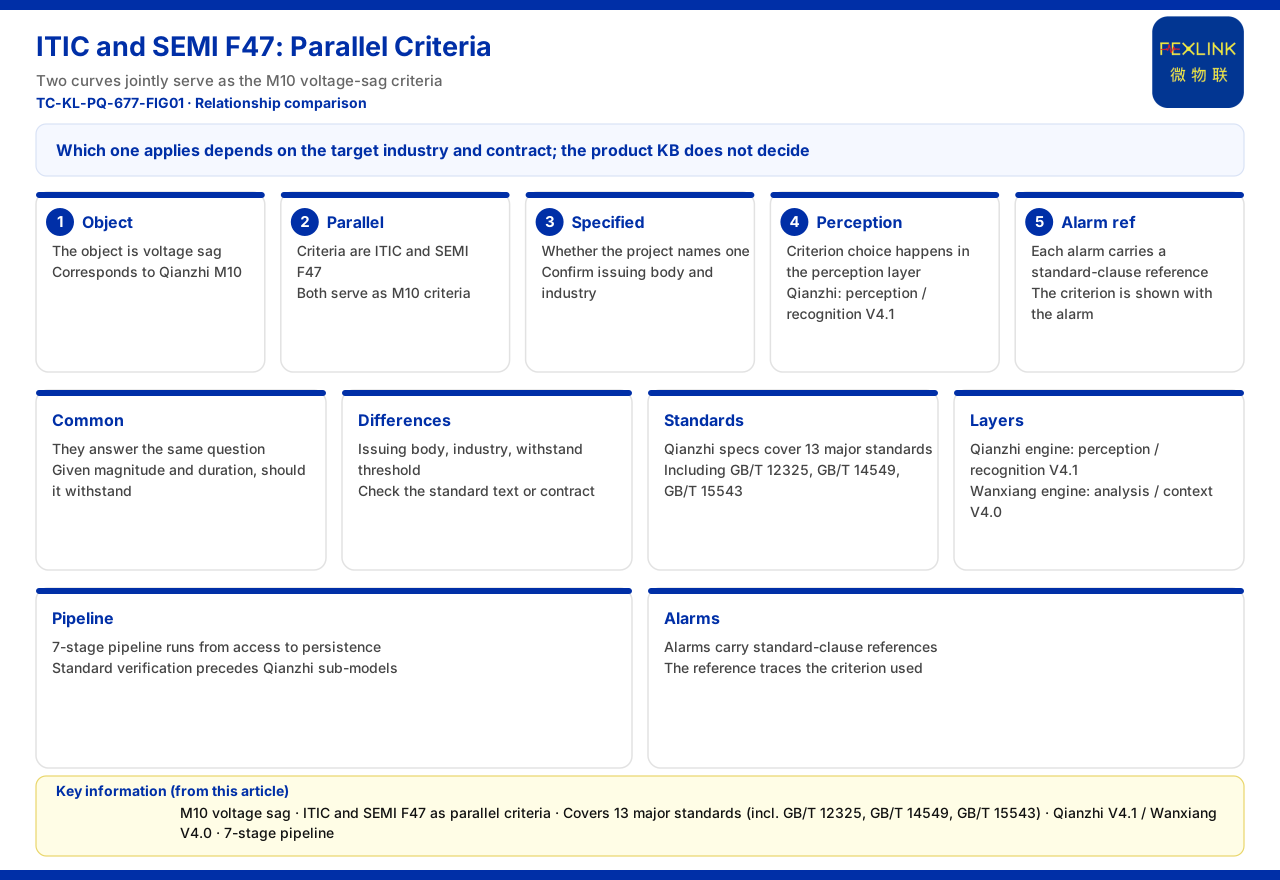
ITIC and SEMI F47 are two curves for judging voltage-sag tolerance, and the product knowledge base adopts them in parallel as the criterion for M10 voltage sag of the Qianzhi engine. Together they answer the same question: given a residual amplitude and a duration, whether the equipment should tolerate the sag. The reason the two need to be parallel rather than an either-or choice is that they correspond to different industry backgrounds and acceptance practices, and which one is chosen depends on the target industry and the project agreement. The product knowledge base does not distinguish the source organisations, applicable industries or tolerance-threshold differences of the two curves and gives no curve values. This article therefore states only the parallel relation, the difference dimensions to confirm during selection, and the position of the criterion in the system link, without writing difference values or inferring that an industry corresponds to a curve.
1. Common Point: The Two Curves Jointly Carry the M10 Criterion
In the product knowledge base, the power-quality physical-examination group M06-M12 of the Qianzhi engine is, in order, harmonics, voltage imbalance, current imbalance, power factor, voltage sag, voltage fluctuation and interharmonics. For the voltage-sag item, the criterion adopts ITIC and SEMI F47 in parallel. That is, sag does not correspond to only one curve but keeps two available tolerance curves at the same time. This shows at least two things: the sag judgement belongs to the single speciality M10 and is not repeated in other sub-models; and both curves are recognised as available criteria, with the choice decided by the specific scenario and acceptance requirements. Only thus can one understand why the differences need discussion.
2. Locating the Differences: Three Dimensions to Confirm
Since the product knowledge base adopts the two curves in parallel, users need to answer, during selection and acceptance, where exactly the two differ. The text of the product knowledge base does not give a description of the differences between the two in source organisation, applicable industry and tolerance threshold. What can be confirmed is only the fact that they are adopted in parallel. From this one can derive a cautious reading: when project materials or a contract specify one curve, that curve should be followed; when the specification is unclear, the source organisation, applicable industry and threshold convention should be listed as three dimensions to verify against the standard or contract, and cannot be inferred from the product knowledge base alone. The product knowledge base does not draw a conclusion for the two curves, and this article does not draw one for it either, which is the boundary proper to traceable citation.
3. Relation to the Standard Coverage
The product knowledge base records that the technical specification of the Qianzhi engine covers 13 major standards including GB/T 12325, GB/T 14549 and GB/T 15543, of which ITIC and SEMI F47 are the parallel sag criteria. That is, the sag criterion is part of this standard coverage set and exists in parallel with the standard bases of specialities such as harmonics, voltage deviation and three-phase voltage imbalance. Thus, when discussing the differences between ITIC and SEMI F47, one should not detach them from the whole standard set and magnify them in isolation; at the project level the sag criterion often enters acceptance conditions together with harmonic limits and voltage deviation. The product knowledge base does not give the application order or priority of the standards, so this article states only the parallel relation and does not infer which standard has priority.
4. The Division of Labour Between the Perception Layer and the Judgement Layer
The family overview of the product knowledge base positions the Qianzhi engine as the perception layer and object-recognition role, with the version recorded as V4.1; the Wanxiang engine is positioned as the judgement layer and scenario-recognition role, with the version recorded as V4.0. The choice of the sag criterion occurs in M10 of the perception layer. This division means that M10 is responsible for judging, at the perception stage, whether the sag crosses the line according to the chosen curve, while higher-level judgement and fusion occur after that. Placing the criterion choice at the perception layer fixes the judgement standard earlier in the analysis link, and later steps refer to the same convention, reducing repeated interpretation of the same data at different steps. Understanding this division helps locate, in use, whether a problem lies in the criterion choice or in the later judgement.
5. Standard Verification Comes Before Sub-Model Computation
The Taiyi intelligent control hub system of the product knowledge base uses a seven-stage pipeline, in order: access, cleaning, standard verification, Qianzhi analysis, Wanxiang judgement, fusion decision and persistence. Standard verification is located before the Qianzhi sub-model computation. Putting this order together with the sag criterion shows the positioning of standard verification: it occurs before the sub-model computation and prepares a unified convention for the later Qianzhi analysis. For sag, this means the data has already passed the standard-verification step before M10 performs the judgement. The product knowledge base does not expand the specific verification items of standard verification for sag, so this article states only the order relation and adds no verification content, nor does it infer a verification conclusion from it.
6. How Alarms Present the Criterion Reference
In the alarm system of the Qianzhi engine of the product knowledge base, each alarm carries a standard-clause reference. ITIC and SEMI F47, as the sag criteria, can be presented together with the alarm reference. In this way, what operators see is not an isolated out-of-range prompt but one given together with the criterion it relies on, making it easy to trace by which curve and which convention the alarm was judged. The product knowledge base does not state the specific layout or fields of the alarm reference, so this article cites only the mechanism of carrying a standard-clause reference and does not expand it into a specific interface design, nor does it infer how the alarm is presented in a specific project.
7. Reading Order for Choosing the Criterion
The above can be reduced to a reading order. First, confirm that the object of discussion is voltage sag, corresponding to Qianzhi M10. Second, confirm that the criterion adopts ITIC and SEMI F47 in parallel. Third, confirm whether the project specifies one of the curves and the source organisation and applicable industry of the basis. Fourth, place the criterion choice at the perception layer, place standard verification before the sub-model computation, and present the criterion reference together with the alarm. The boundary to keep is that the product knowledge base gives no description of the differences between the two in source organisation, applicable industry and tolerance threshold; the specific differences must be checked against the original standard or the contract and must not be inferred from the product knowledge base, nor may the two curves be stated as freely interchangeable.
Applicability and Limits
First, this article restates only what the product knowledge base lists, and its factual boundary is the record of the power-quality physical-examination group of the Qianzhi engine, the standard coverage, the family overview, the seven-stage pipeline and the alarm mechanism.
Second, the M10 voltage sag adopting ITIC and SEMI F47 in parallel is cited under the convention listed in the product knowledge base; this article does not distinguish their source organisations, applicable industries or thresholds.
Third, the record that the technical specification of the Qianzhi engine covers 13 major standards including GB/T 12325, GB/T 14549 and GB/T 15543 is cited under the convention listed in the product knowledge base.
Fourth, the Qianzhi engine as the perception-layer object-recognition role and the Wanxiang engine as the judgement-layer scenario-recognition role, and the fact that the sag criterion choice occurs at the perception layer, are cited under the family overview of the product knowledge base.
Fifth, the order in the seven-stage pipeline in which standard verification precedes the Qianzhi sub-model computation is cited under the convention listed in the product knowledge base; this article adds no verification item content.
Sixth, the mechanism by which alarms carry a standard-clause reference is cited under the convention listed in the product knowledge base; this article does not expand it into a specific interface or field design.
Seventh, the product knowledge base gives no differences between ITIC and SEMI F47 in applicable industry, source organisation and tolerance threshold; this article accordingly states no specific conclusion about their differences.
Eighth, this article explains only the information and reading order within the product knowledge base and is not a commitment to compliance judgement or standard selection for a specific project; the latest product materials, the original standards and formal documents prevail.