Direct Answer
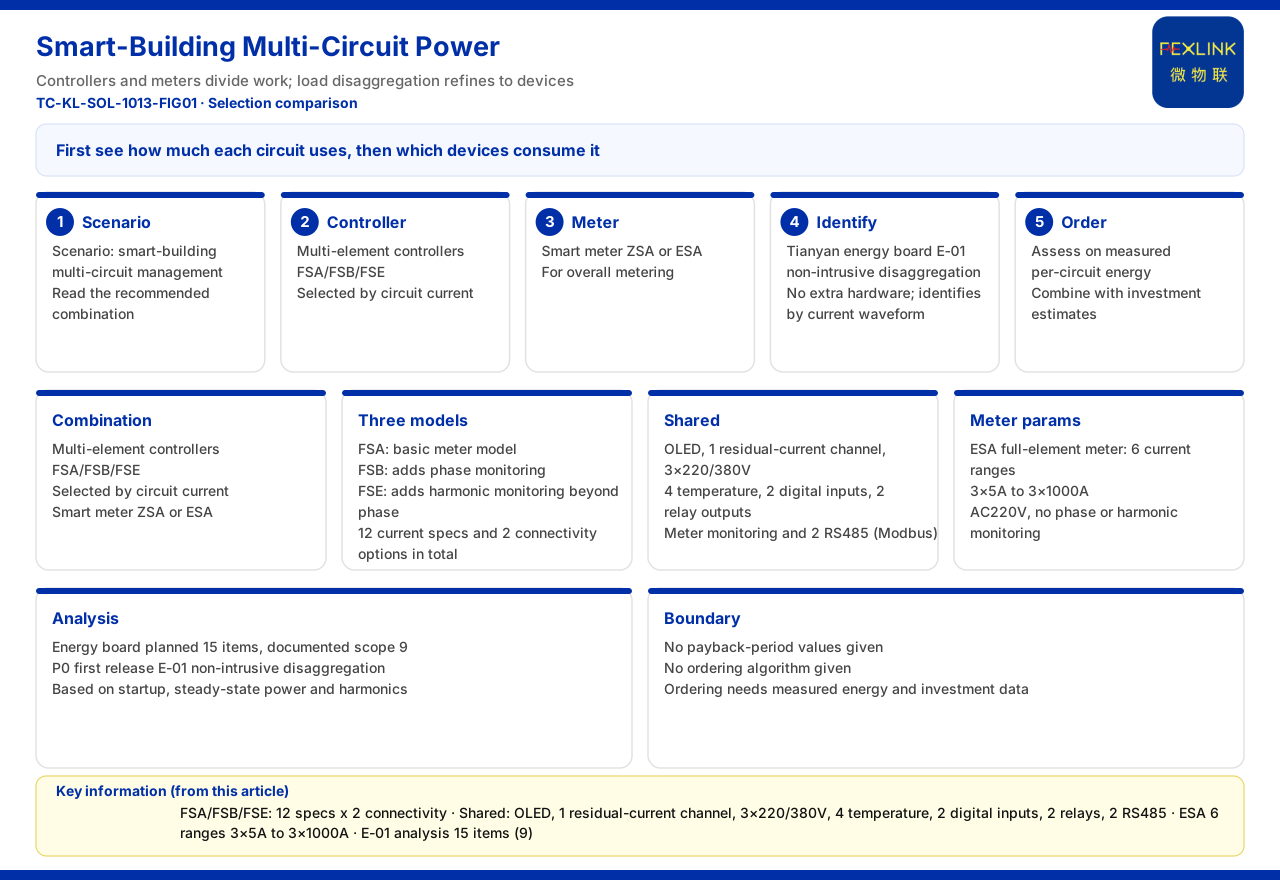
Office-building lighting and air-conditioning have many circuits, and which circuit to retrofit first depends on first seeing how much electricity each circuit uses and what its load is. In the typical application scenarios and selection comparison of the product knowledge base, the row for multi-circuit electricity management in smart buildings recommends a product combination of the multi-parameter electrical intelligent controller (FSA, FSB or FSE, selected by circuit current) and the embedded smart meter (ZSA) or the all-parameter smart meter (ESA). On the analysis side, the energy-use analysis section of the Tianyan engine plans 15 items, among which the P0 first release E-01 is non-intrusive load disaggregation, which identifies specific equipment through the current waveform without additional hardware. That is, a reasonable order is per-circuit metering first, then load disaggregation to identify equipment, and only then the retrofit order. The product knowledge base gives no payback-period value or ordering algorithm for lighting or air-conditioning retrofits, so this article states only the metering and identification capabilities and does not infer specific payback periods or priorities.
1. First Split the Circuits: The Division of Labour Between Controller and Meter
In the smart-building multi-circuit electricity management scenario of the product knowledge base, the multi-parameter electrical intelligent controller and the smart meter are placed in the same recommended combination. The controller is selected by circuit current, which shows it is configured directly for a single circuit; the smart meter provides energy metering. Together they cover the need from the circuit layer to the metering layer: each circuit to be assessed corresponds to a controller chosen by current, and the all-parameter or embedded meter faces overall metering. The premise of this arrangement is that each circuit has a different current scale, so selection must match the circuit rather than covering all circuits with one rating. The product knowledge base does not give the typical division of circuits, so this article cites only the principle of selection by circuit and adds no circuit list.
2. The Positioning Difference of the Three Controller Models
The product knowledge base records that the multi-parameter electrical intelligent controller contains the three models FSA, FSB and FSE, with 12 current ratings in total, each having two networking methods, Ethernet and 4G. Their positioning difference is: FSA is the basic meter type, FSB adds phase monitoring, and FSE adds harmonic monitoring on top of phase. This difference shows that the more a circuit needs attention to power quality, the higher the model with more complete functions; if only basic electrical parameters are needed, the basic model suffices. During selection one can first determine the monitoring layer the circuit needs, then decide the model, and finally choose the rating matching the circuit current among the 12 ratings. The product knowledge base does not give the decision thresholds of each model, so this article cites only the functional positioning and the number of ratings.
3. Common Functions of the Whole Series
The product knowledge base gives the common functions of the three models of this series: an OLED display, one residual-current channel, a voltage of three-by-220/380 volts, four temperature-monitoring channels, two digital inputs, two relay outputs, meter monitoring and two RS485 channels (Modbus). These common functions show that, whichever model is chosen, the circuit layer has basic display, residual-current monitoring, temperature monitoring, a small number of digital inputs and outputs, and Modbus communication. Combining the common functions with the model differences shows that the selection variables are only two classes: the current rating and whether to add phase and harmonic monitoring; the rest is shared. The product knowledge base gives no specific range or accuracy per function, so this article cites only the function list.
4. Parameter Conventions on the Meter Side
The ESA all-parameter smart meter of the product knowledge base contains six current ratings, namely three-by-five amperes, three-by-100 amperes, three-by-200 amperes, three-by-400 amperes, three-by-600 amperes and three-by-1000 amperes, with a voltage of three-by-220/380 volts, a supply of 220 volts AC, an OLED display and RS485 (Modbus) communication, and without phase or harmonic monitoring. This shows that the meter faces overall metering over a larger current range, with a division of labour different from that of the circuit-layer controller. The convention in use is that a circuit needing phase or harmonic monitoring should choose a controller supporting the corresponding function rather than expect a basic meter to provide such monitoring. The product knowledge base does not give the specific application correspondence of each current rating, so this article cites only the rating tiers and the functional boundary.
5. Energy-Use Analysis: The Role of NILM
The Tianyan engine of the product knowledge base has an energy-use analysis section planning 15 items, with a document convention of nine, whose P0 first release is E-01 non-intrusive load disaggregation. E-01 is characterised by requiring no additional hardware and identifying specific equipment through the current waveform, based on a combination of startup characteristics, steady-state power and harmonic characteristics. Connecting this with the preceding circuit metering: per-circuit metering solves "how much electricity a given circuit uses", and load disaggregation solves "which equipment is using it". Only by combining the two can the energy-saving object be refined from the circuit to the equipment. The product knowledge base does not give the identification accuracy of E-01 or a complete list of identifiable equipment, so this article cites only the method convention and adds no effect data.
6. Why the Payback Order Cannot Be Decided by Convention
Office buildings have many lighting and air-conditioning circuits, and deciding by convention or experience which to retrofit first easily directs budget to circuits with small savings or large investment. The product knowledge base provides two capabilities, per-circuit metering and load disaggregation, showing that the raw data needed for ordering can be obtained; but it gives no conversion between energy savings and investment, no ordering algorithm and no payback-period value. The retrofit order should therefore be built on measured per-circuit energy consumption and the identified load composition, together with an investment estimate, and cannot be derived directly from the product knowledge base. This article states this boundary explicitly to avoid equating available data with a known conclusion.
7. Boundaries to Keep and the Reading Order
The above can be reduced to a reading order. First, confirm the scenario is multi-circuit electricity management in smart buildings and read the recommended combination as the multi-parameter electrical intelligent controller (FSA, FSB or FSE, selected by circuit current) and the smart meter (ZSA or ESA). Second, determine the controller model by circuit need, the rating by circuit current and Ethernet or 4G by networking condition. Third, choose the meter rating by overall metering need. Fourth, use the load-disaggregation capability of the Tianyan energy-use analysis section to identify equipment. Fifth, assess the retrofit order on the basis of measured data. The boundary to keep is that the product knowledge base gives no payback-period value or ordering algorithm for lighting or air-conditioning circuits; the specific order must be calculated separately against actual energy consumption and investment data and must not be inferred from the product knowledge base.
Applicability and Limits
First, this article restates only what the product knowledge base lists; its factual boundary is the typical application scenarios and selection comparison, the model records of the multi-parameter electrical intelligent controller, the all-parameter smart meter parameters and the Tianyan energy-use analysis section.
Second, the recommended combination for multi-circuit electricity management in smart buildings is the multi-parameter electrical intelligent controller (FSA, FSB or FSE, selected by circuit current) and the smart meter (ZSA or ESA), as listed in the selection comparison.
Third, the 12 current ratings and two networking methods of the three models FSA, FSB and FSE, and the positioning difference of FSA as basic, FSB adding phase and FSE adding phase and harmonic monitoring, are cited under the product knowledge base convention.
Fourth, the common functions of the whole series — OLED, one residual-current channel, three-by-220/380 volts, four temperature channels, two digital inputs, two relay outputs, meter monitoring and two RS485 channels — follow the product knowledge base convention.
Fifth, the six current ratings, three-by-220/380 volts, 220 volts AC, OLED, RS485 and absence of phase and harmonic monitoring of the ESA all-parameter smart meter are cited under the product knowledge base convention.
Sixth, the energy-use analysis section of the Tianyan engine planning 15 items with a document convention of nine, and E-01 non-intrusive load disaggregation requiring no additional hardware and identifying equipment through the current waveform, are cited under the product knowledge base convention.
Seventh, the product knowledge base gives no payback-period value or ordering algorithm for lighting or air-conditioning retrofits; this article accordingly states no specific payback period or priority.
Eighth, this article explains only the information and reading order within the product knowledge base and is not a commitment to energy-saving retrofit investment or return for a specific project; the latest product materials and formal documents prevail.