Direct Answer
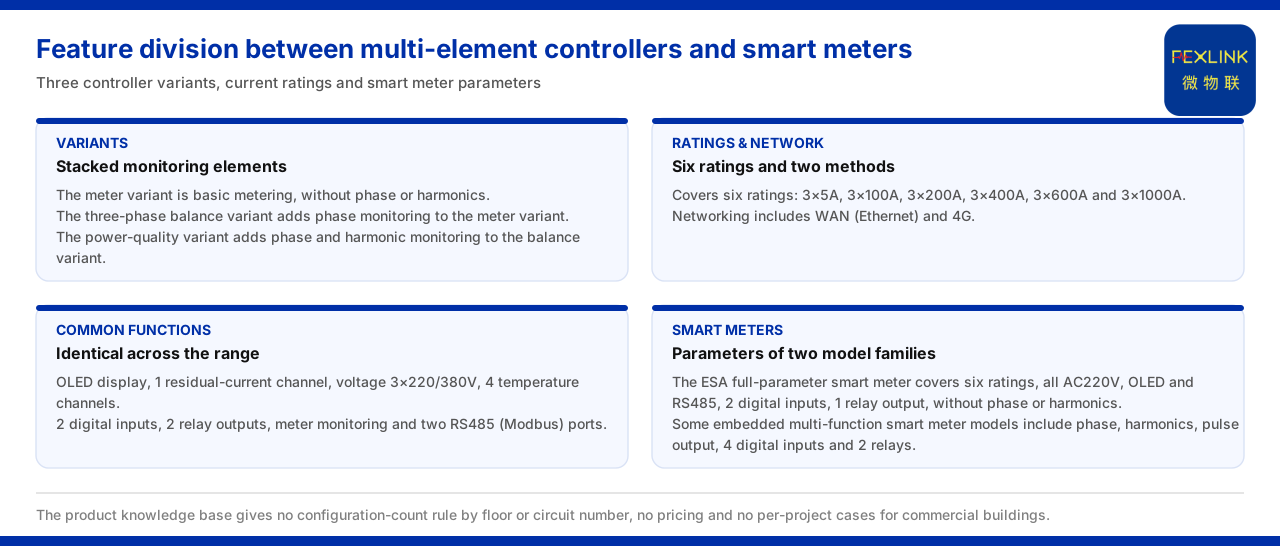
The multi-parameter controller and the smart meter are metering and monitoring products in digital electricity-use and electrical-safety monitoring. The product knowledge base records that the multi-parameter electrical intelligent controller is divided by use into three models: the meter type provides basic meter monitoring without phase or harmonic measurement; the three-phase balance type adds phase monitoring on top of the meter type; and the power-quality type adds harmonic monitoring on top of the three-phase balance type. The whole series covers six current ratings from three-by-five amperes to three-by-one-thousand amperes, and the networking methods include wide-area network and 4G. Common functions include an OLED display, one residual-current channel, a voltage of three-by-two-hundred-twenty or three-by-three-hundred-eighty volts, four temperature-monitoring channels, two digital inputs, two relay outputs, meter monitoring and two RS485 channels. On the smart-meter side, the all-parameter smart meter covers the same six current ratings, all with two hundred twenty volts AC, an OLED display and RS485, supporting two digital inputs and one relay output and without phase or harmonic monitoring; the embedded multi-function smart meter is two hundred twenty volts AC across the series with an OLED display, and some models include phase, harmonics, pulse output, four digital channels and two relays. The product knowledge base does not give a configuration-quantity rule by floor or circuit count for commercial buildings, nor a quotation or a per-project case, so this article cites only the product parameters and the recommended combination and does not infer a configuration quantity.
1. The Division of Labour of the Three Multi-Parameter Controllers
The multi-parameter electrical intelligent controller is divided by use into the meter type, the three-phase balance type and the power-quality type. The product knowledge base records that the meter type provides basic meter monitoring without phase or harmonic measurement; the three-phase balance type adds phase monitoring on top of the meter type; and the power-quality type adds phase monitoring and harmonic monitoring on top of the three-phase balance type. That is, the difference among the three lies in a layer-by-layer accumulation of monitoring elements, the basic metering capability is the same, and the higher the model the more complete the electrical quantities it covers. The product knowledge base does not give the price difference among the three or an applicable-capacity threshold, so this article cites only the functional progression and does not infer a selection conclusion.
2. Current Ratings and Networking Methods
The product knowledge base records that the multi-parameter controller covers six current ratings — three-by-five amperes, three-by-one-hundred amperes, three-by-two-hundred amperes, three-by-four-hundred amperes, three-by-six-hundred amperes and three-by-one-thousand amperes — and that the networking methods include wide-area network (Ethernet) and 4G. The six current ratings show that the product is tiered by circuit current, so selection should first confirm the circuit current and then match the rating; the networking methods show that the product can access the network over wired or cellular links. The product knowledge base does not give the switch or transformer configuration rule corresponding to each current rating, so this article cites only the rating tiers and the networking list.
3. Common Functions of the Multi-Parameter Controller
The product knowledge base lists the common functions of the whole multi-parameter controller series: an OLED display; one residual-current channel; a voltage of three-by-two-hundred-twenty or three-by-three-hundred-eighty volts; four temperature-monitoring channels; two digital inputs; two relay outputs; meter monitoring; and two RS485 channels (Modbus). These functions are consistent among the three models, and the model difference appears only in phase and harmonic monitoring. Separating the common functions from the model differences helps avoid mistakenly adding the phase or harmonic capability specific to one model to all models. The product knowledge base does not give the specific measurement-point positions corresponding to temperature and digital inputs in the common functions, so this article cites only the function items and channel counts.
4. Models and Parameters on the Smart-Meter Side
The smart-meter side contains the all-parameter smart meter and the embedded multi-function smart meter. The product knowledge base records that the all-parameter smart meter covers six current ratings from three-by-five amperes to three-by-one-thousand amperes, all with two hundred twenty volts AC, an OLED display and RS485, supporting two digital inputs and one relay output and without phase or harmonic monitoring; if phase or harmonics are needed, the three-phase imbalance monitor or the power-quality monitor should be chosen instead. The embedded multi-function smart meter is two hundred twenty volts AC across the series with an OLED display, and its models cover one-by-five amperes and three-by-five amperes (adjustable) as well as two hundred twenty volts and three-by-two-hundred-twenty or three-by-three-hundred-eighty volts, with some models including phase, harmonics, pulse output, four digital channels, two relays and RS485. The two meters thus differ in current rating and optional functions. The product knowledge base does not give a substitution rule between the two meters, so this article cites only their respective parameters.
5. Typical Application Combination
In the typical application scenarios and selection comparison of the product knowledge base, the row for multi-circuit electricity management in smart buildings recommends a product combination of the multi-parameter electrical intelligent controller and the smart meter, where the multi-parameter controller is selected by circuit current and the smart meter is exemplified by the embedded multi-function smart meter and the all-parameter smart meter. In this scenario multi-circuit control and energy metering appear as parallel selection items, and the controller's rating is determined by the circuit current. The product knowledge base does not give the wiring method, the number of devices per circuit or the linkage logic among the devices in this combination, so this article cites only the recommended combination and the principle of selection by circuit current and does not expand them into a specific project scheme.
6. Reading Order and Boundaries
The above can be reduced to a reading order. First, confirm whether the object is a multi-parameter controller or a smart meter. Second, for a controller, first choose the meter type, the three-phase balance type or the power-quality type by monitoring element, then match one of the six ratings by circuit current. Third, when reading the common functions, make clear that phase and harmonics appear only in some models; when reading a smart meter, distinguish the functional differences between the all-parameter smart meter and the embedded multi-function smart meter. Fourth, if a scenario is involved, return to the selection comparison and confirm the recommended combination for multi-circuit electricity management in smart buildings. The boundary to keep is that the product knowledge base gives no configuration-quantity rule by floor or circuit count for commercial buildings, nor a quotation or a per-project case; the relevant conclusions must be checked separately and must not be inferred from the product knowledge base.
Applicability and Limits
First, this article restates only what the product knowledge base lists, and its factual boundary is the record of the model functions, current ratings, networking methods and common functions of the multi-parameter electrical intelligent controller, the models and parameters of the smart meters, and the selection comparison.
Second, the functional progression of the meter type, three-phase balance type and power-quality type of the multi-parameter electrical intelligent controller is cited under the model-segment function description; this article adds no price or capacity threshold.
Third, the six current ratings from three-by-five amperes to three-by-one-thousand amperes and the two networking methods of wide-area network and 4G are cited under the model-segment table.
Fourth, the common functions of the multi-parameter controller — OLED display, one residual-current channel, a voltage of three-by-two-hundred-twenty or three-by-three-hundred-eighty volts, four temperature-monitoring channels, two digital inputs, two relay outputs, meter monitoring and two RS485 channels — are cited under the common-function section.
Fifth, the six current ratings, two hundred twenty volts AC, OLED, RS485, two digital inputs and one relay output of the all-parameter smart meter, and the statement that it has no phase or harmonic monitoring, are cited under the model table and its notes.
Sixth, the two hundred twenty volts AC, OLED, one-by-five amperes and three-by-five amperes (adjustable), two hundred twenty volts and three-by-two-hundred-twenty or three-by-three-hundred-eighty volts, and the phase, harmonics, pulse output, four digital channels, two relays and RS485 of some models of the embedded multi-function smart meter are cited under the model table and the series description.
Seventh, the recommended combination for multi-circuit electricity management in smart buildings and the principle of selection by circuit current are cited as listed in the selection comparison, and this article does not expand the wiring method, per-circuit quantity or linkage logic.
Eighth, the product knowledge base gives no configuration-quantity rule by floor or circuit count for commercial buildings, nor a quotation or a per-project case; this article accordingly states no configuration quantity, and the latest product materials and formal documents prevail.