Direct Answer
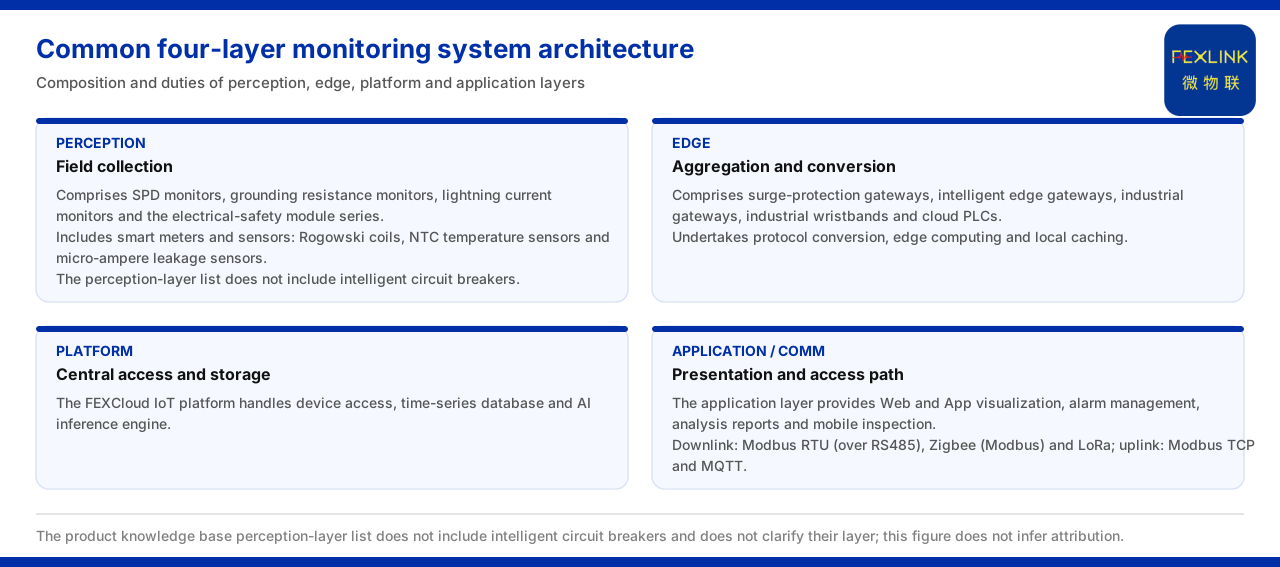
The general four-layer architecture of the monitoring system is the overall framework for understanding how the various products work together. The product knowledge base divides the system from top to bottom into the perception layer, the edge layer, the platform layer and the application layer. The perception layer consists of the surge protective device monitor, the grounding resistance monitor, the lightning current monitor and the electrical-safety series monitoring modules, as well as smart meters and sensors, with the sensors listing Rogowski coils, NTC temperature sensors and microamp-level leakage-current sensors. The edge layer consists of the lightning-protection smart gateway, the intelligent edge-computing gateway, the industrial gateway, the industrial wearable and the cloud PLC, and handles protocol conversion, edge computing and local caching. The platform layer is the FEXCloud IoT cloud platform, which handles device access, the time-series database and the AI inference engine. The application layer provides Web and App visualisation, alarm management, analysis reports and mobile inspection. Perception-layer devices access the edge layer and the platform layer through the communication protocol system, and the protocol matrix lists the downlink and uplink separately. The perception-layer list of the product knowledge base does not include the intelligent circuit breaker and does not explicitly classify the intelligent circuit breaker as a perception-layer device, so this article cites only what the list contains and does not assign a layer to an unlisted product.
1. The Overall Division of the Four Layers
The general four-layer architecture of the monitoring system in the product knowledge base is, from top to bottom, the perception layer, the edge layer, the platform layer and the application layer. The perception layer handles field acquisition, the edge layer handles nearby processing and aggregation, the platform layer handles centralised access, storage and analysis, and the application layer handles presentation and operation for users. The point of understanding this division is that the same data carries different responsibilities at different layers, and a missing or mismatched layer makes the upper-layer functions impossible. The four layers are connected through communication protocols, and the protocol matrix is precisely the convention for data flow between the layers. The product knowledge base does not give the physical deployment form or redundancy requirements of each layer, so this article cites only the layer division and the responsibility descriptions.
2. Composition of the Perception Layer and the Boundary of Its List
The perception layer is the lowest of the four layers. The product knowledge base records that the perception layer consists of the surge protective device monitor, the grounding resistance monitor, the lightning current monitor and the electrical-safety series monitoring modules, as well as smart meters and sensors; the sensors list Rogowski coils, NTC temperature sensors and microamp-level leakage-current sensors. These products and components together perform field acquisition of quantities such as voltage, current, temperature and leakage current. It must be noted that the perception-layer list of the product knowledge base does not include the intelligent circuit breaker, which is listed separately in another passage, and the product knowledge base does not explicitly classify it as a perception-layer device. When citing the perception-layer list, therefore, one should stay within the list itself and not add products outside it to the perception layer.
3. Composition and Responsibilities of the Edge Layer
The edge layer handles protocol conversion, edge computing and local caching. The product knowledge base records that the edge layer consists of the lightning-protection smart gateway, the intelligent edge-computing gateway, the industrial gateway, the industrial wearable and the cloud PLC. The gateways convert the data of downlink devices into protocols that can be carried uplink, while edge computing and local caching provide support when the network is unstable or nearby processing is needed. Putting the edge layer and the perception layer together confirms the division in which the perception layer acquires and the edge layer aggregates and converts. The product knowledge base does not give the maximum mounting count or cache duration of each gateway, so this article cites only the composition and responsibilities and does not add a capacity convention.
4. Functions of the Platform Layer and the Application Layer
The platform layer is the FEXCloud IoT cloud platform, which handles device access, the time-series database and the AI inference engine. Device access solves how devices enter the platform, the time-series database solves how acquired data is stored, and the AI inference engine provides the capability for later analysis. The application layer provides Web and App visualisation, alarm management, analysis reports and mobile inspection, and is the outlet through which data reaches users. The two have a clear division: the platform layer leans towards back-end support, the application layer towards front-end presentation and operation. The product knowledge base does not give the number of platform interfaces or the page list of the application layer, so this article cites only the functional descriptions.
5. The Communication Protocol System
Perception-layer devices access the edge layer and the platform layer through the communication protocol system. The communication protocol matrix of the product knowledge base lists the device downlink protocols as Modbus RTU (based on RS485), Zigbee (Modbus) and LoRa, and the device uplink protocols as Modbus TCP and MQTT (which can be carried over Ethernet or 4G); at gateway level, IEC 61850 is optional. Downlink protocols face the device-to-gateway direction and uplink protocols face the gateway-to-platform direction, and together they form the access path from the perception layer to the platform layer. The product knowledge base does not give a specific criterion or threshold rule for choosing a protocol according to field wiring conditions, transmission distance or platform access method, so this article cites only the protocol list and does not infer a selection conclusion.
6. Reading Order and Boundaries
The above can be reduced to a reading order. First, confirm whether the question to answer is about system layering or the affiliation of a product; the four-layer architecture provides a layer division and responsibilities, not an inference basis beyond the product list. Second, when reading the perception-layer list, stay strictly within the products and components listed in the product knowledge base. Third, when reading the edge layer, platform layer and application layer, correspond them to their responsibility descriptions and do not move responsibilities between layers. Fourth, where the access path is involved, cite the downlink and uplink lists of the communication protocol matrix and do not infer a protocol-selection criterion. The boundary to keep is that the perception-layer list of the product knowledge base does not include the intelligent circuit breaker and does not explicitly classify it as a perception-layer device; the relevant affiliation conclusion must be checked separately and must not be inferred from the product knowledge base.
Applicability and Limits
First, this article restates only what the product knowledge base lists, and its factual boundary is the record of the layer division and layer composition of the general four-layer architecture, together with the communication protocol matrix.
Second, the perception layer consists of the surge protective device monitor, the grounding resistance monitor, the lightning current monitor and the electrical-safety series monitoring modules, as well as smart meters and sensors, with the sensors including Rogowski coils, NTC temperature sensors and microamp-level leakage-current sensors, cited under the general four-layer architecture.
Third, the edge layer consists of the lightning-protection smart gateway, the intelligent edge-computing gateway, the industrial gateway, the industrial wearable and the cloud PLC, and handles protocol conversion, edge computing and local caching, cited under the general four-layer architecture.
Fourth, the device access, time-series database and AI inference engine of the platform layer FEXCloud IoT cloud platform, and the Web and App visualisation, alarm management, analysis reports and mobile inspection of the application layer, are cited under the general four-layer architecture.
Fifth, the downlink Modbus RTU (based on RS485), Zigbee (Modbus) and LoRa and the uplink Modbus TCP and MQTT (over Ethernet or 4G) plus the optional gateway-level IEC 61850 in the communication protocol matrix are cited as listed; this article does not infer a protocol-selection criterion.
Sixth, the perception-layer list of the product knowledge base does not include the intelligent circuit breaker and does not explicitly classify it as a perception-layer device; this article accordingly states no layer affiliation for it.
Seventh, this article explains only the architecture information and reading order within the product knowledge base and is not a commitment to system integration for a specific project; the latest product materials and formal documents prevail.