Direct Answer
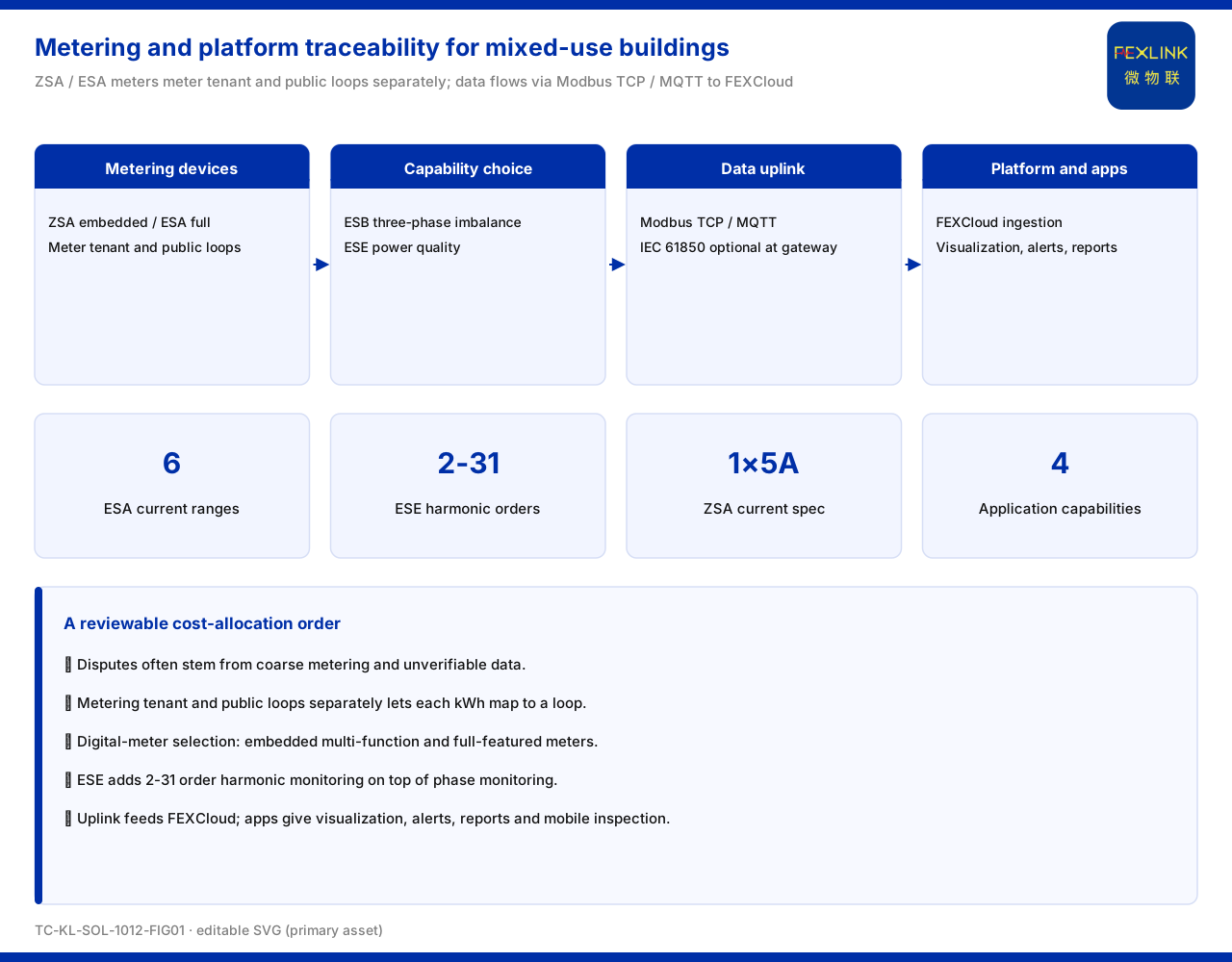
Electricity-cost apportionment in commercial complexes easily causes disputes not because the cost itself is miscalculated, but because the metering basis is not fine enough and the data is not verifiable. According to the existing product material, the selection corresponding to digital meters and multi-function metering needs is the embedded multi-function smart meter and the all-parameter smart meter, the latter including a three-phase imbalance model and a power-quality model; these devices can respectively handle the metering of tenant dedicated lines and public-area circuits. Data is uploaded over Ethernet or a mobile network, connected to the FEXCloud IoT cloud platform, where the platform layer completes device access, time-series data storage and inference, and then the application layer provides visualisation, alarm management, analytical reports and mobile inspection. Taking "metering dedicated lines and public areas separately, with data verifiable on the platform" as the premise, apportionment has a reviewable basis. This article restates these existing conventions only and does not infer the apportionment rules or billing result of any specific project.
1. The Root of Disputes Is Often "Cannot Be Calculated"
Disputes over electricity-cost apportionment usually centre on two questions: who actually consumed a given charge, and why the public-area part is this amount. If metering reaches only the whole building or a whole floor, tenant and property can only argue over one total, with neither side having checkable detail. To reduce disputes, the first step is to refine the metering points: meter tenant dedicated lines separately and public-area circuits separately, so each quantity of electricity lands on a specific circuit. This step involves no billing rule, only the question of whether the data can be viewed separately. The meter selection in the product material provides exactly the device foundation for such itemised metering.
2. Device Choice on the Metering Side
The product material records that the selection for digital meters and multi-function metering is the embedded multi-function smart meter and the all-parameter smart meter, the latter including a three-phase imbalance model and a power-quality model. The embedded multi-function smart meter has a current of single-phase five amps or three-phase five amps, adjustable, and supports meter monitoring; one model additionally supports phase, harmonics, pulse output, four digital inputs and two relay outputs. The all-parameter smart meter covers six current-rating steps, with the same supply and voltage configuration, a display and serial communication. Placing the two meter classes together allows selection along two dimensions, capacity and function: small-capacity dedicated lines can use the adjustable embedded specification, while large-capacity circuits match among the six ratings.
3. Trading Off Phase and Harmonic Capability
Whether tenant metering all needs phase and harmonic capability must be judged by circuit. The product material records that the three-phase imbalance monitor shares the architecture of the all-parameter smart meter and adds phase monitoring; the power-quality monitor adds harmonic monitoring on top of phase monitoring, covering the second to the thirty-first order with an accuracy of plus or minus one percent. For ordinary tenant dedicated lines, metering itself may already suffice; for circuits at risk of three-phase imbalance or sensitive to harmonics, adding phase or harmonic capability is meaningful. Separating this capability layer from the earlier capacity choice avoids pursuing the highest configuration on every circuit and ensures that circuits genuinely needing judgement have the corresponding data. Whether data is checkable depends on whether the circuit needs these parameters, not on having as many as possible.
4. Data Uplink and Platform Access
For metering data to be reviewable, it must leave the field device and enter a queryable platform. The product material records that, in the communication-protocol matrix, the device uplink supports Modbus TCP and MQTT over Ethernet or a mobile network, and at the gateway level optionally IEC 61850. The uplink method determines the rhythm at which data enters the platform: with MQTT it can be used for active reporting by devices, while with Modbus TCP it relies on master polling. For a commercial complex, whether the uplink is stable and the protocol matches directly affects whether tenants can see their own consumption in time. Treating the uplink method as part of selection rather than an afterthought avoids data silos.
5. What the Platform Layer Is Responsible For
After data is uploaded, the platform layer takes over. The product material records that the platform layer is the FEXCloud IoT cloud platform, carrying the three capabilities of device access, the time-series database and the AI inference engine. For itemised metering, these three capabilities solve three problems respectively: device access brings the metering devices of different circuits under unified management; the time-series database saves the electricity data by time, making consumption in any period traceable; and the inference engine supports analysis beyond simple metering. Basing apportionment on time-series data means every quantity of electricity has a corresponding acquisition record rather than only a beginning-and-end difference.
6. How the Application Layer Supports Verifiability
Above the platform, the application layer presents data to users. The product material records that the application layer provides web and mobile visualisation, alarm management, analytical reports and mobile inspection. For apportionment scenarios, visualisation and analytical reports are the key to turning "the property says so" into "the data is reviewable": tenants can view their own circuit's consumption and corresponding records, and the property can use reports to explain the composition of the public-area part, with both sides checking the same set of data. Alarm management and mobile inspection face operation and maintenance, used to discover metering-device anomalies or circuit problems. It should be noted that the concrete functions of the application layer follow the product material, and this article does not infer its report conventions or query-permission settings.
7. The Connection Order of Metering Devices and the Platform
Linking devices and platform gives one complete chain. The general four-layer architecture of the monitoring system in the product material is the perception layer, edge layer, platform layer and application layer: the metering meters sit on the perception and edge sides, handling acquisition and uplink; FEXCloud sits at the platform layer, handling access and storage; and the application layer handles presentation and alarms. For a commercial complex, the meaning of this chain is that itemised metering data is continuous from generation to verifiability: field meters acquire, the uplink protocol enters the platform, and the application layer shows it to users. If any segment is missing, the review chain breaks. Selection must therefore look at meter capability and at whether platform access and presentation are matched.
8. Organising the Verifiable Apportionment Into an Order
Combining the above, itemised tenant metering for a commercial complex can be designed in the following order. First, meter tenant dedicated lines and public-area circuits separately, so each quantity of electricity lands on a specific circuit. Second, by circuit capacity choose the matching device among the specifications of the embedded multi-function smart meter and the all-parameter smart meter. Third, for circuits needing three-phase imbalance or power-quality judgement, add phase or harmonic capability. Fourth, determine the uplink as Modbus TCP or MQTT over Ethernet or a mobile network, ensuring data enters the platform stably. Fifth, let FEXCloud complete access and storage, with the application layer's visualisation, reports and alarms providing verifiability and operation capability. This order separates metering, capability, uplink, platform and presentation, making item-by-item review easier.
Applicability and Limits
- The content is limited to the existing wording of the product material on digital meter and multi-function metering selection, the specifications of the embedded multi-function smart meter and the all-parameter smart meter, the three-phase imbalance and power-quality monitors, the communication-protocol matrix, and the FEXCloud platform layer and application layer. - The current specifications (single-phase five amps or three-phase five amps adjustable, six ratings), the harmonic coverage (second to the thirty-first order, accuracy plus or minus one percent), the digital-input and relay counts, the uplink protocol and the platform capabilities are all as listed in the product material and are not a commitment to any project's results. - On apportionment rules, billing conventions and query permissions, this article cites no concrete parameters; actual rules are governed by project agreement and on-site verification. - Device selection and platform connection are limited to those listed in the product material, and this article does not infer the metering-point layout or system-integration scheme of any specific complex. - This article is not a commitment to any unlisted indicator; actual capability is governed by the latest product material and project scheme.