Is Increased Contact Resistance Related to Arcing?
Increased contact resistance is a hazard repeatedly raised in distribution operation, while arcing is a phenomenon that arc-fault monitoring seeks to capture. In engineering people often mention the two in one sentence, but the product knowledge base handles them more cautiously: it uses the Wanxiang engine's correlation rules to describe the condition for increased contact resistance, and the arc-fault monitoring module to monitor arcing separately, yet it does not write the two as a causal relationship.
This article therefore answers not the vague question "are they related" but where the knowledge base describes contact resistance and arcing, and whether those entries give a direct association between them. Separating "how each is described" from "whether they are written as cause and effect" is the premise for understanding this topic.
1. How Increased Contact Resistance Is Expressed in the Wanxiang Engine
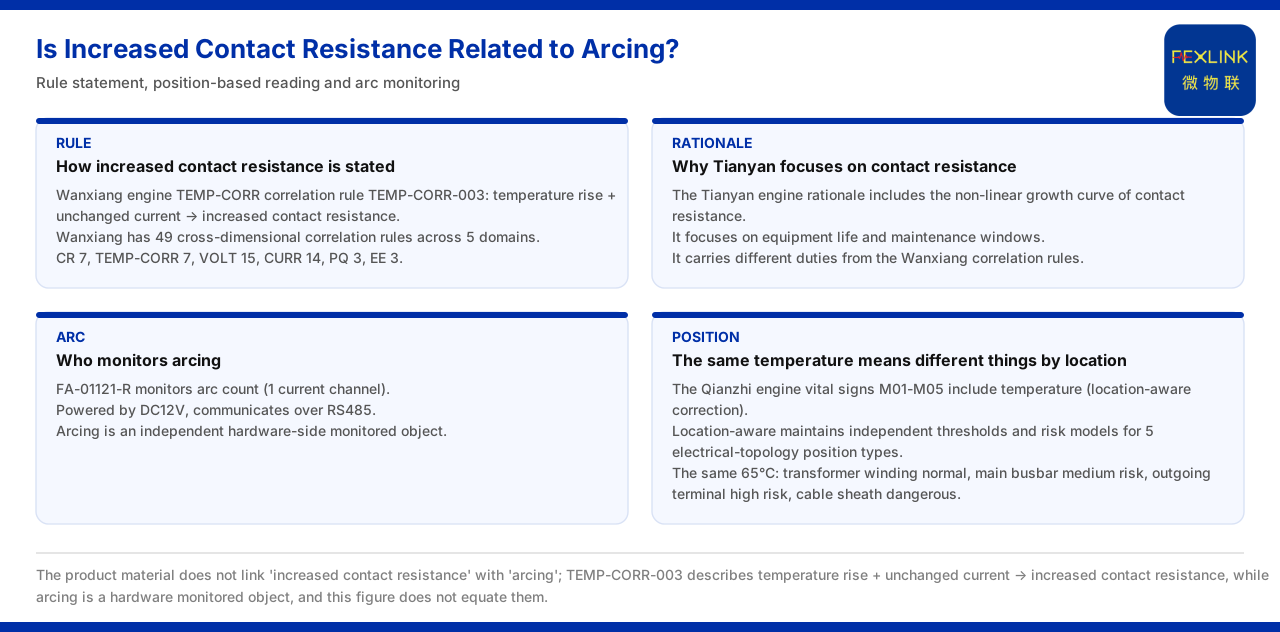
The knowledge base records that, in the temperature-rise and current correlation rule series of the Wanxiang engine, one rule states: when the temperature rise increases while the current stays unchanged, the contact resistance increases. This rule links the change of contact resistance with the two measurable conditions of temperature rise and current.
From the standpoint of observability, the value of this rule is that it gives a relation judgeable from field quantities: if the temperature goes up while the current does not rise accordingly, this cannot be explained by load change alone, and the change of contact resistance comes into view. It does not say what happens after contact resistance increases; it describes only the condition under which it increases. For this reason it is a correlation rule, not a complete inference on a causal chain.
2. The Distribution of Cross-Dimensional Correlation Rules
The knowledge base counts the Wanxiang engine's cross-dimensional correlation rules as 49, in 5 domains: 7 in the CR series, 7 in the TEMP-CORR series, 15 in the VOLT series, 14 in the CURR series, 3 in the PQ series, and another 3 in the EE series.
These numbers show two things. First, the relation between temperature and current is only one class among many correlations, with other domains such as voltage, current and power quality. Second, cross-dimensional means the rules are not limited to the threshold of a single quantity but describe how quantities corroborate one another. The rule containing contact resistance belongs to the crossing domain of temperature and current, and its judgement naturally depends on two quantities providing information at once. Understanding this distribution helps place a rule within the system rather than treating it as an isolated alarm condition.
3. Why the Tianyan Engine Pays Attention to Contact Resistance
The knowledge base records that the Tianyan engine, as a prediction engine, has a theoretical basis that includes the non-linear growth curve of contact resistance. This means contact resistance is not handled as a static threshold but modelled as a quantity changing over time.
The non-linear growth of contact resistance has a practical meaning: it changes slowly early on and faster later. Judged only by an instantaneous threshold, the early stage is hard to trigger; judged by a trend curve, a warning can be given before growth accelerates. This is exactly why the prediction engine attends to it. It should be noted that the material gives a theoretical basis curve, and this article does not infer the growth rate or remaining life of any specific circuit from it.
4. Who Monitors Arcing
The knowledge base assigns the monitoring of arcing to the arc-fault monitoring module, model FA-01121-R, whose function is arc count on 1 current loop, with a DC12V supply and RS485 communication.
From these parameters, arcing is treated in the knowledge base as an event object to be counted. The monitoring module outputs the arc count, not contact resistance or temperature. In other words, whether arcing occurs is answered by arc monitoring itself; whether contact resistance increases is answered by the rules on the temperature and current side. The two belong to different quantities as monitoring objects.
5. Why the Relationship Between the Two Cannot Be Directly Asserted
The knowledge base does not associate increased contact resistance with arcing. The temperature-rise and current correlation rule describes "temperature rise plus unchanged current leads to increased contact resistance", whereas arcing is the monitoring object of the arc-fault monitoring module, and their relationship is not listed in the material.
The boundary must be stated clearly: not listed does not mean it does not exist, nor that it does. This article does not infer from the existing text that increased contact resistance necessarily causes arcing, nor that the two are unrelated. What can be confirmed is: increased contact resistance is a hazard listed in the material, arcing is a monitoring object listed in the material, the two can enter hazard analysis at the same time, and causal attribution must be confirmed by the actual conditions on the project side. In a decision scenario such as early warning, treating an unlisted relationship as an established conclusion would make the system output a judgement the material cannot support.
6. Position Changes the Interpretation of the Same Temperature
The location-awareness record of the knowledge base gives an intuitive example: the same 65 degrees Celsius is interpreted differently at different positions, normal at a transformer winding, medium risk at the main busbar, high risk at an outgoing terminal, and dangerous at the cable sheath. Location awareness maintains independent thresholds and risk models for 5 electrical topology position types.
This example is especially important for understanding contact resistance. Temperature is a key quantity in the contact-resistance rule, and the meaning of the same temperature value varies with position. Ignoring position and using one threshold for all measurement points would judge a normal reading as abnormal, or treat a reading that should be emphasised as normal. Location awareness is therefore not an added decoration to the contact-resistance rule but one of its premises.
7. The Position of Temperature in the Basic Vital Signs
The knowledge base counts the Qianzhi engine's basic-vital-sign sub-models as M01 to M05, which include temperature and carry a location-awareness correction.
Joining this with the above shows temperature appearing at several levels in the system: at the basic-vital-sign level it is a basic quantity continuously tracked; at the Wanxiang engine's correlation-rule level it participates in judging the change of contact resistance; and at the location-awareness level its meaning adjusts with position. Increased contact resistance, as a class of hazard, is perceived precisely through these levels of handling temperature. This multi-level treatment of temperature also shows that a single value is insufficient to support a conclusion and must be combined with position and context.
Applicability and Limits
- This article restates only what the knowledge base lists; its factual boundary is the Wanxiang engine's temperature-rise and current correlation rule and the distribution of its 49 cross-dimensional correlation rules, the non-linear growth curve basis of contact resistance in the Tianyan engine, the arc-fault monitoring module FA-01121-R, the Wanxiang engine's location awareness, and the Qianzhi engine's basic-vital-sign sub-models M01 to M05. - The relationship between increased contact resistance and arcing is not listed in the knowledge base, and this article does not infer that they are cause and effect. - The wording of the temperature-rise and current correlation rule and the domain counts of the 49 correlation rules are cited as listed; this article does not infer concrete threshold parameters. - The interpretation of 65 degrees Celsius at different positions and the 5 topology position types are cited as listed; this article does not infer the thresholds of other position types. - The function, supply and communication parameters of FA-01121-R are cited as listed; this article does not infer its installation method or protection coordination.